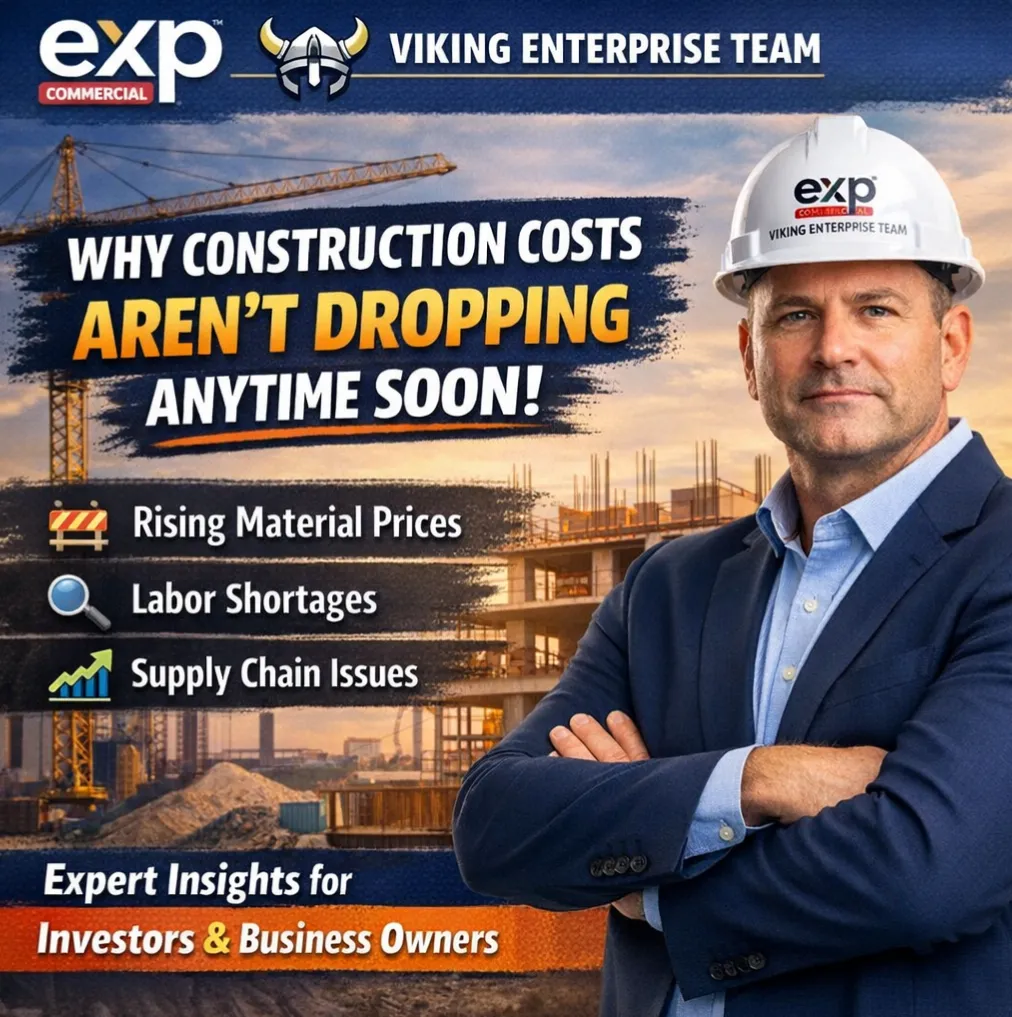
🚧 Why Construction Costs Aren’t Dropping Anytime Soon — What Investors Must Plan For 🏗️
🚧 Why Construction Costs Aren’t Dropping Anytime Soon — What Investors Must Plan For 🏗️
🏗️ Construction Costs in 2026: Why Waiting for Prices to Fall Is a Costly Mistake 🚧
Why Construction Costs Aren’t Dropping Anytime Soon
Many investors and business owners are waiting for construction costs to “normalize.” Unfortunately, that expectation is increasingly disconnected from reality. While inflation has moderated, construction pricing remains structurally elevated—and the forces behind it are long-term, not temporary.
For developers, owner-users, and commercial investors, understanding why costs are staying high is critical for underwriting, deal timing, and capital planning.
Labor Shortages Are Structural, Not Cyclical
The construction industry continues to face a severe labor deficit:
·Skilled trades are aging out faster than they are being replaced
·Immigration constraints limit workforce expansion
·Younger workers are entering the trades at historically low rates
Even during economic slowdowns, wage pressure does not reverse. Contractors must pay more to attract and retain crews, and those costs are passed directly into project pricing.
Bottom line: Labor is now a permanent premium in construction budgets.
Materials Have Reset to a Higher Baseline
While the extreme price spikes of 2021–2022 have eased, materials have not returned to pre-pandemic levels.
Key drivers include:
·Global supply chain restructuring (reshoring = higher costs)
·Energy-intensive manufacturing inputs
·Persistent transportation and logistics expenses
·Tariffs and geopolitical risk pricing
Concrete, steel, electrical components, and mechanical systems remain elevated—and volatility is now the norm.
Regulatory Costs Keep Rising
Construction is increasingly regulated at the local, state, and federal levels:
·More stringent energy codes
·Stormwater, environmental, and zoning compliance
·Lengthier permitting timelines
·Higher impact and utility fees
These are non-negotiable costs that increase total project expense without adding leasable square footage.
Financing Costs Amplify Total Project Pricing
Even if rates ease modestly in 2026, construction loans remain:
·More conservatively underwritten
·Shorter-term with higher contingency requirements
·Heavily focused on sponsor liquidity and experience
Interest carry, reserves, and delayed lease-up all compound total project cost—especially for speculative developments.
What This Means for Investors and Business Owners
Waiting for construction costs to fall may result in:
·Higher land prices as competition returns
·Missed entitlement and leasing windows
·Narrower spreads between new construction and existing assets
Instead, successful sponsors are:
·Locking pricing early with GMP contracts
·Pursuing value-engineered designs
·Exploring adaptive reuse and expansion over ground-up builds
·Structuring capital stacks creatively to preserve returns
Strategic Takeaway
Construction costs are not cyclical anymore—they are structural.
Projects that work today will be the ones that work tomorrow. The focus should not be on waiting for cheaper builds, but on smarter underwriting, disciplined execution, and experienced capital partners.
If you are evaluating a development, build-to-suit, or owner-occupied project, the conversation needs to start with today’s realities—not yesterday’s assumptions.
https://www.houstonrealestatebrokerage.com/
https://www.houstonrealestatebrokerage.com/houston-cre-navigator
https://www.commercialexchange.com/agent/653bf5593e3a3e1dcec275a6
http://expressoffers.com/[email protected]
https://app.bullpenre.com/profile/1742476177701x437444415125976000
https://author.billrapponline.com/
https://www.amazon.com/dp/B0F32Z5BH2
https://veed.cello.so/FOmzTty6oi9
https://creplaybookseries.billrapponline.com
https://creplaybook.billrapponline.com/
© 2023-2024 Bill Rapp, Broker Associate, eXp Commercial Viking Enterprise Team


