📈 What Is Cap Rate? The CRE Metric Every Investor Must Understand 💰
📈 What Is Cap Rate? The CRE Metric Every Investor Must Understand 💰
🏢 Cap Rates Explained: How Smart Investors Analyze Commercial Real Estate Deals 🚀
What Is Cap Rate (And Why It Matters More Than You Think)
In commercial real estate, few metrics are discussed more than the capitalization rate — commonly called the “cap rate.” Yet despite how often the term gets thrown around, many investors and business owners misunderstand what it actually means and how to use it properly.
The truth is this:
Cap rate is not just a formula. It’s a window into risk, value, income stability, financing strategy, and market sentiment.
If you understand cap rates correctly, you can make smarter investment decisions, negotiate better deals, and avoid expensive mistakes.
What Is a Cap Rate?
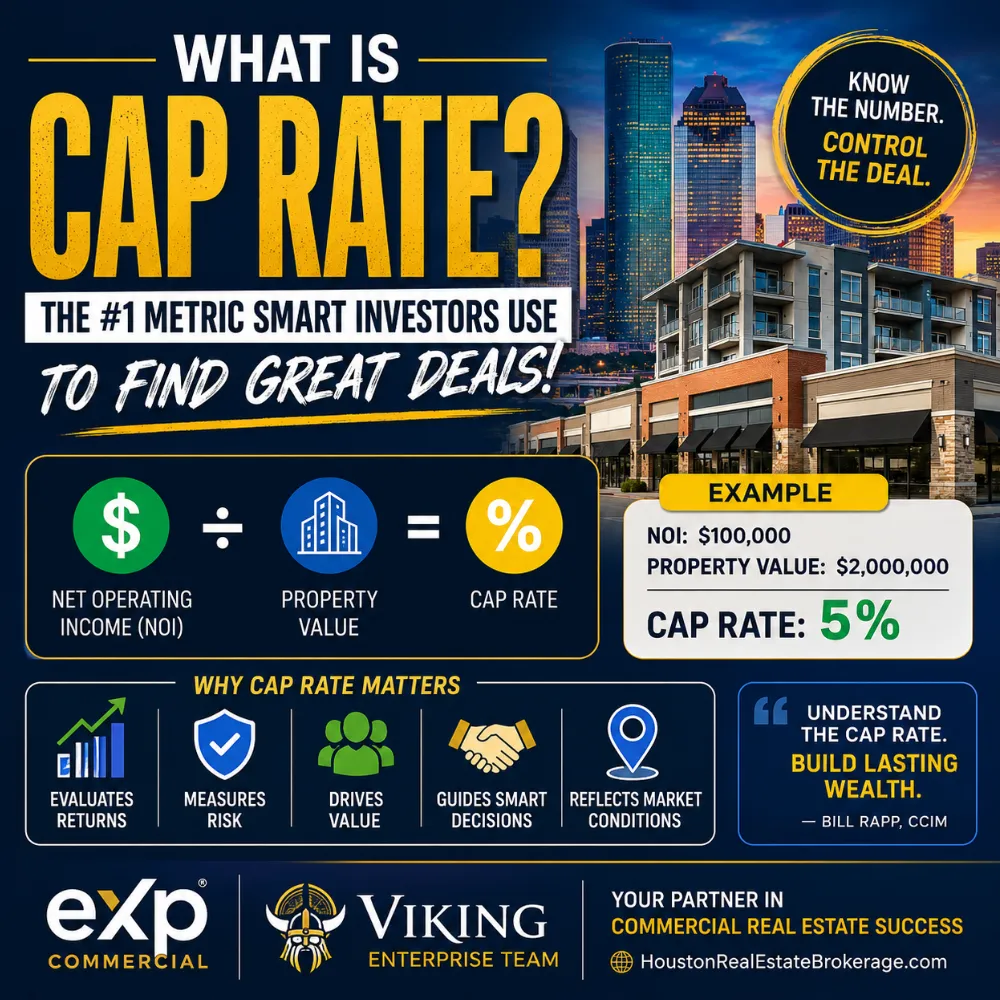
A cap rate measures the relationship between a property’s net operating income (NOI) and its purchase price or value.
The basic formula is:
\text{Cap Rate} = \frac{\text{Net Operating Income (NOI)}}{\text{Property Value}}
For example:
·Property NOI: $100,000
·Purchase Price: $2,000,000
\frac{100,000}{2,000,000}=0.05=5%
That means the property is trading at a 5% cap rate.
In simple terms, a cap rate tells investors what unleveraged return they are receiving based on the property’s income.
Why Cap Rates Matter So Much
Cap rates influence nearly every part of commercial real estate investing.
They impact:
·Property valuation
·Investor demand
·Financing strategy
·Risk perception
·Exit strategy
·Cash flow expectations
·Market pricing trends
Many investors focus too heavily on interest rates while ignoring cap rates.
That’s a mistake.
A strong deal structure often matters more than simply getting the lowest loan rate.
The Relationship Between NOI and Property Value
One of the most important concepts in commercial real estate is understanding how income drives value.
As NOI increases, property value typically increases as well.
This is why operational improvements matter so much.
Small rent increases, expense reductions, or occupancy improvements can create massive equity growth.
For example:
·Increase NOI by $50,000 annually
·Market cap rate = 5%
\frac{50,000}{0.05}=1,000,000
That additional NOI could create approximately $1 million in value.
This is one of the biggest reasons experienced investors focus heavily on operational efficiency.
Lower Cap Rates vs Higher Cap Rates
Lower Cap Rates
Lower cap rates often indicate:
·Stronger locations
·Higher investor demand
·More stable tenants
·Lower perceived risk
·Institutional-quality assets
Examples:
·Trophy office towers
·Prime multifamily
·High-end retail centers
·Medical office buildings in strong corridors
Higher Cap Rates
Higher cap rates often indicate:
·Greater risk
·Older assets
·Weaker locations
·Vacancy concerns
·Short-term lease instability
·Operational challenges
Examples:
·Older strip centers
·Distressed multifamily
·Small-town office properties
·Heavy value-add opportunities
Higher cap rates may offer greater upside potential, but they usually come with more management complexity and risk.
Cap Rates Are NOT Interest Rates
This is where many new investors get confused.
Cap rates are based on property performance.
Interest rates are based on financing costs.
A property can have:
·A strong cap rate but poor financing terms
·A low cap rate but exceptional appreciation potential
·Strong cash flow but weak long-term growth
·Weak cash flow but strong redevelopment upside
Professional investors evaluate all of these factors together.
Why Cap Rates Move
Cap rates constantly fluctuate based on:
·Interest rates
·Investor sentiment
·Supply and demand
·Population growth
·Local job growth
·Property type demand
·Capital market liquidity
For example, Houston industrial and retail assets in high-growth areas like Katy and Fulshear have experienced strong investor demand due to population growth, business expansion, and infrastructure development.
As investor demand rises, cap rates often compress.
That compression increases property values.
Cap Rate Compression vs Expansion
Cap Rate Compression
When cap rates decline:
·Property values rise
·Investor demand strengthens
·Competition increases
Cap Rate Expansion
When cap rates rise:
·Property values decline
·Investors demand more yield
·Financing markets tighten
Understanding this cycle is critical for investors evaluating acquisitions and exits.
Why Smart Investors Study Local Markets
Cap rates vary significantly by:
·City
·Neighborhood
·Asset class
·Tenant quality
·Lease structure
·Property age
A retail strip center in Katy, TX may trade very differently than a similar property in another Texas market.
That’s why local market expertise matters.
Commercial real estate is highly localized.
Final Thoughts
Cap rates are one of the most important concepts in commercial real estate investing.
But the smartest investors understand that cap rates are only one piece of the puzzle.
You must also analyze:
·Tenant stability
·Debt structure
·Lease rollover
·Market growth
·Exit strategy
·Operational risk
·Cash flow durability
The investors who consistently win in commercial real estate are the ones who understand how income, risk, financing, and market psychology all work together.
And that starts with understanding cap rates properly.
—
Bill Rapp, CCIM
eXp Commercial | Viking Enterprise Team
Katy/Fulshear/Houston Commercial Real Estate Brokerage
https://www.houstonrealestatebrokerage.com/
https://www.houstonrealestatebrokerage.com/houston-cre-navigator
https://www.commercialexchange.com/agent/653bf5593e3a3e1dcec275a6
http://expressoffers.com/[email protected]
https://app.bullpenre.com/profile/1742476177701x437444415125976000
https://author.billrapponline.com/
https://www.amazon.com/dp/B0F32Z5BH2
https://veed.cello.so/FOmzTty6oi9
https://buymeacoffee.com/vikingente3
https://creplaybookseries.billrapponline.com
https://creplaybook.billrapponline.com/
© 2023-2024 Bill Rapp, Broker Associate, eXp Commercial Viking Enterprise Team


