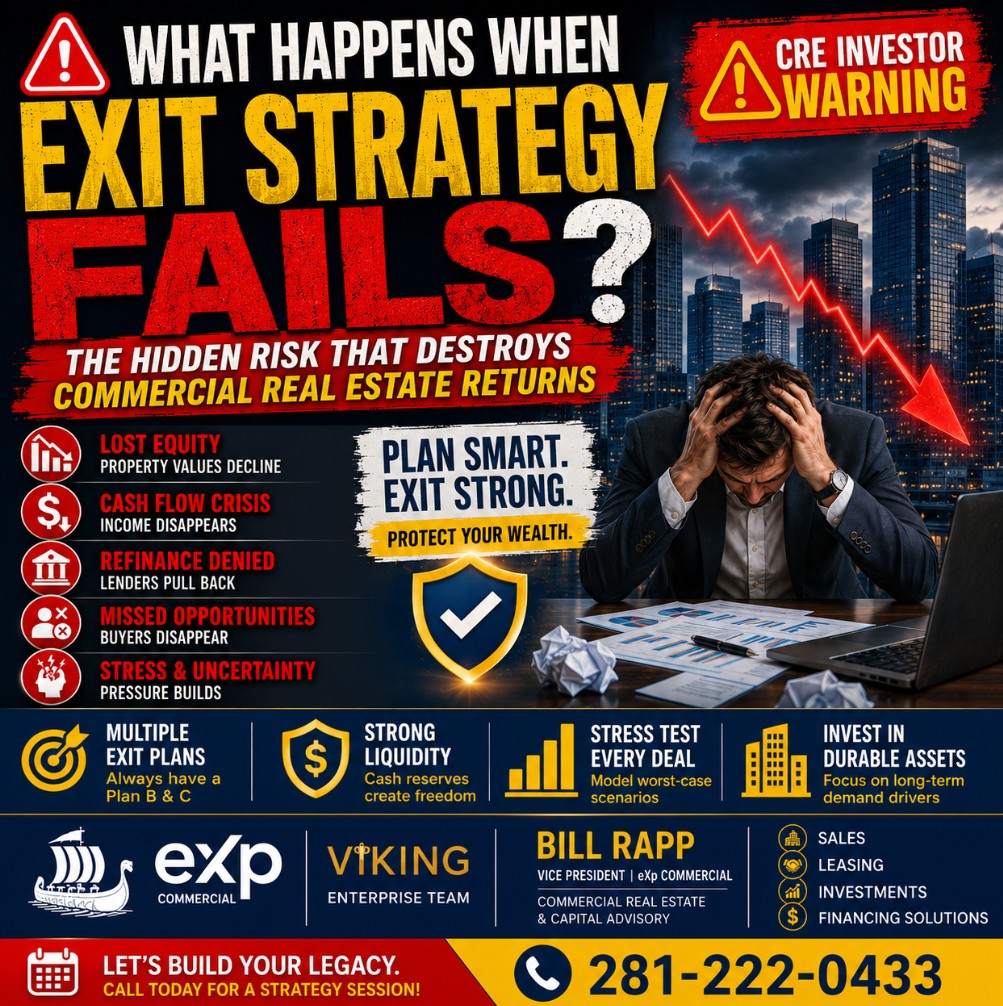
🚨 What Happens When Your Commercial Real Estate Exit Strategy Fails? The Costly Mistakes Investors Make 🏢💸
🚨 What Happens When Your Commercial Real Estate Exit Strategy Fails? The Costly Mistakes Investors Make 🏢💸
⚠️ CRE Exit Strategy Failure: How Investors Get Trapped in Commercial Real Estate Deals 📉🏗️
What Happens When Your Exit Strategy Fails in Commercial Real Estate?
Every commercial real estate investor enters a deal with a plan.
Buy. Improve. Refinance. Sell. Repeat.
At least that's the theory.
But what happens when the exit strategy doesn't work?
The reality is that most commercial real estate losses don't occur when investors buy a property. They occur when investors cannot execute their exit strategy.
Whether you're a first-time investor, syndicator, business owner, or seasoned CRE professional, understanding exit strategy risk is one of the most important skills you can develop.
What Is an Exit Strategy?
An exit strategy is the plan for how an investor intends to realize profits from a commercial real estate investment.
Common exit strategies include:
·Selling the property after appreciation
·Refinancing and pulling out equity
·Increasing rents and stabilizing occupancy
·Redeveloping the asset
·Completing a 1031 exchange
·Holding long-term for cash flow
·Selling to an institutional buyer
The problem?
Many investors focus heavily on acquisition and not enough on disposition.
Why Exit Strategies Fail
1. Interest Rates Move Against You
One of the biggest threats to commercial real estate today is refinancing risk.
Many investors acquired properties during periods of historically low interest rates.
Now they're facing:
·Higher debt service
·Lower loan proceeds
·Stricter underwriting
·Reduced cash flow
A refinance that looked easy three years ago may no longer work today.
If the new loan doesn't generate enough proceeds to pay off the existing debt, investors can be forced to contribute additional capital or sell under pressure.
2. Property Values Decline
Many investors assume values will continue rising.
Unfortunately, commercial real estate is cyclical.
When cap rates expand:
·Property values decline
·Equity disappears
·Refinancing becomes difficult
·Buyer demand slows
This has been especially evident in portions of the office market where declining demand and elevated vacancies have dramatically reduced valuations.
3. Occupancy Falls
Many business plans rely on increasing occupancy.
What happens if leasing activity slows?
Suddenly:
·NOI declines
·DSCR weakens
·Lenders become cautious
·Buyers reduce offers
A property projected to achieve 95% occupancy may stall at 75%.
That difference can be the difference between a successful exit and a distressed sale.
4. Capital Markets Freeze
Many investors forget that financing availability directly impacts property liquidity.
When lenders pull back:
·Buyers struggle to obtain financing
·Closing timelines extend
·Transaction volume drops
·Pricing becomes uncertain
Even great properties can become difficult to sell when debt markets tighten.
5. Development Projects Run Over Budget
Developers often plan to refinance or sell after construction.
But rising costs can create serious challenges:
·Construction overruns
·Delayed lease-up
·Interest carry increases
·Lower-than-expected appraisals
Suddenly the original exit no longer works.
The Domino Effect of a Failed Exit Strategy
When an exit fails, problems rarely occur in isolation.
Instead, they tend to compound.
Step 1:
Loan maturity approaches.
Step 2:
Refinancing proceeds come in lower than expected.
Step 3:
Investors must contribute additional equity.
Step 4:
Partners become frustrated.
Step 5:
Cash reserves shrink.
Step 6:
Property improvements are delayed.
Step 7:
Occupancy suffers.
Step 8:
Value declines further.
This cycle can quickly transform a profitable investment into a distressed asset.
Real-World Example
Imagine an investor purchases a retail center for $5 million.
The business plan:
·Improve occupancy
·Raise rents
·Refinance after three years
The investor expects the property to appraise at $6.5 million.
Instead:
·Interest rates rise
·Cap rates expand
·Occupancy stalls
·Value remains near $5 million
Rather than receiving cash-out proceeds, the lender offers less financing than the current loan balance.
Now the investor must:
·Inject additional cash
·Sell the property
·Seek bridge financing
·Negotiate an extension
The original exit strategy has failed.
How Smart Investors Protect Themselves
Build Multiple Exit Strategies
Never rely on a single outcome.
Ask yourself:
·What if refinancing isn't available?
·What if occupancy stalls?
·What if cap rates rise?
·What if construction costs increase?
The best investors always have Plan B and Plan C.
Maintain Strong Liquidity
Cash reserves create flexibility.
Liquidity allows investors to:
·Extend hold periods
·Handle vacancies
·Fund improvements
·Bridge refinancing gaps
Liquidity often determines whether investors survive market downturns.
Stress Test Every Deal
Before purchasing, model:
·Higher interest rates
·Lower occupancy
·Lower rents
·Longer hold periods
·Lower refinance proceeds
If the deal only works under perfect conditions, it's probably too risky.
Focus on Durable Assets
Properties with strong fundamentals generally provide greater flexibility during economic uncertainty.
Examples include:
·Medical office
·Industrial facilities
·Neighborhood retail
·Essential-service tenants
·Multifamily housing
These asset classes often maintain demand even during market disruptions.
Final Thoughts
The best commercial real estate investors don't simply buy properties.
They engineer exits.
Every acquisition should begin with the end in mind.
The investors who survive economic cycles are the ones who understand that the exit strategy—not the purchase price—is often what determines success or failure.
Before your next acquisition, ask yourself:
If my primary exit strategy fails tomorrow, what's my backup plan?
That single question can save millions.
About Bill Rapp
Bill Rapp is Vice President with eXp Commercial. He helps commercial property owners, investors, developers, and business owners acquire, finance, lease, and dispose of commercial real estate throughout Houston,
Connect With Viking Enterprise Team
📍 eXp Commercial & eXp Realty
📍 Houston | Katy | Fulshear | West Houston
📅 Calendly.com/VikingEnterprise
📞 281-222-0433
📞 Bill Rapp, CCIM
eXp Commercial | Viking Enterprise Team
Commercial Real Estate & Capital Advisory
🌐 https://houstonrealestatebrokerage.com
https://www.houstonrealestatebrokerage.com/
https://www.houstonrealestatebrokerage.com/houston-cre-navigator
https://www.commercialexchange.com/agent/653bf5593e3a3e1dcec275a6
http://expressoffers.com/[email protected]
https://app.bullpenre.com/profile/1742476177701x437444415125976000
https://author.billrapponline.com/
https://www.amazon.com/dp/B0F32Z5BH2
https://veed.cello.so/FOmzTty6oi9
https://buymeacoffee.com/vikingente3
https://creplaybookseries.billrapponline.com
https://creplaybook.billrapponline.com/
© Bill Rapp, Broker Associate, eXp Commercial Viking Enterprise Team


