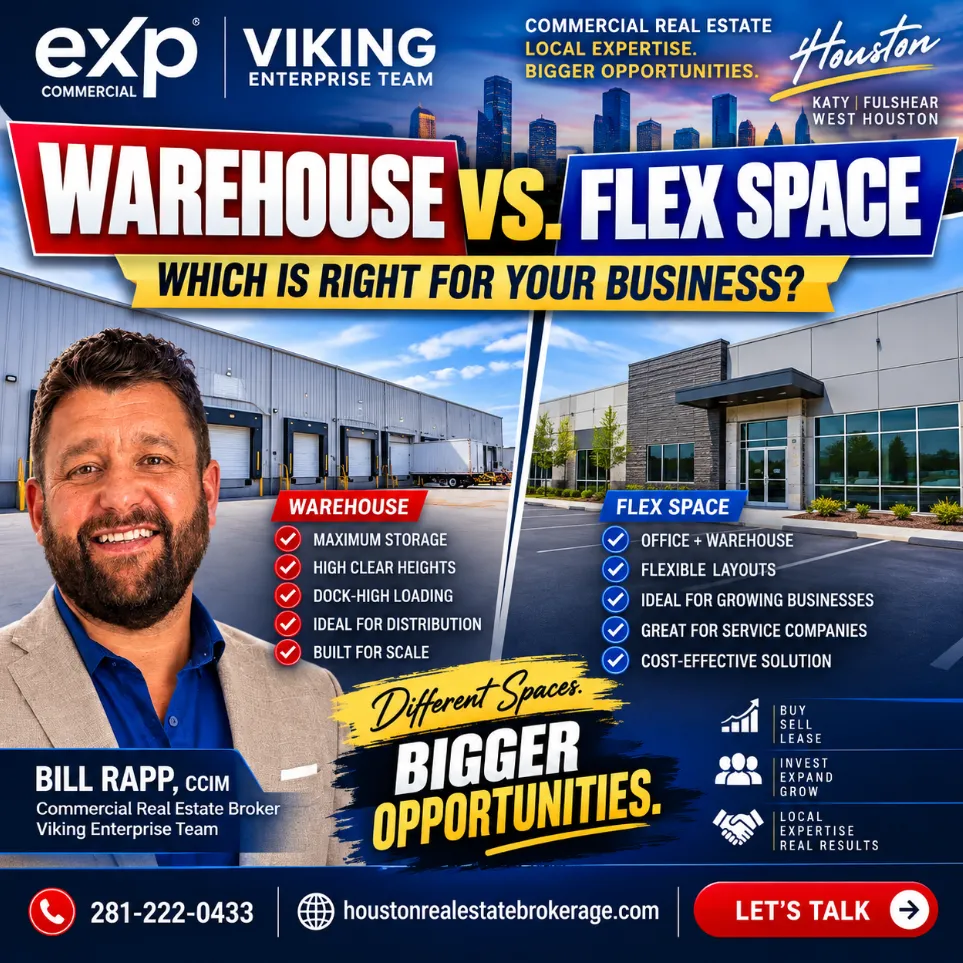
🏭 Warehouse vs. Flex Space: Which Commercial Property Is Right for Your Business? 🔑
🏭 Warehouse vs. Flex Space: Which Commercial Property Is Right for Your Business? 🔑
📦 Flex Space vs. Warehouse Space: How Houston Businesses Can Choose the Right Property 🏢
________________________________________________________________________________
Warehouse vs. Flex Space: Which Is Right for Your Business?
When a business owner begins searching for commercial real estate, one of the first questions may be whether they need a traditional warehouse or a flex space.
At first glance, the two can look similar. Both may offer warehouse areas, loading capabilities, parking, office space, and convenient access to major transportation corridors.
But operationally, they can serve very different purposes.
For businesses searching for commercial space in Houston, Katy, Fulshear, Brookshire, or West Houston, understanding those differences can help avoid leasing or purchasing a building that doesn't support the company's long-term needs.
What Is Traditional Warehouse Space?
A traditional warehouse is generally designed around storage, distribution, logistics, manufacturing, or industrial operations.
The building typically dedicates a relatively small percentage of its total square footage to offices. Most of the property is warehouse space.
Common warehouse features include:
·Higher clear heights
·Dock-high or grade-level loading
·Large truck courts
·Trailer or outdoor storage areas
·Heavy electrical capacity
·Wide column spacing
·Large open warehouse areas
·Easy access to highways and transportation infrastructure
For a distribution company storing pallets of inventory, for example, maximizing usable warehouse space may be far more important than having an elaborate office area.
What Is Flex Space?
Flex space combines elements of office, showroom, warehouse and light industrial space within one property.
Instead of dedicating nearly the entire building to warehouse operations, a flex property might contain a meaningful office component in the front and warehouse or production space in the rear.
That configuration can work particularly well for businesses that need employees, customers and inventory under the same roof.
Examples might include contractors, technology companies, medical suppliers, e-commerce businesses, specialty distributors, light manufacturers, service companies and trade businesses.
Warehouse vs. Flex Space: The Key Differences
The right choice depends less on what the property is called and more on how your business actually operates.
Office requirements are one of the biggest differences. A traditional warehouse might have only 5%–15% office space, while some flex properties can have substantially more.
Loading requirements matter as well. Distribution businesses moving tractor-trailers throughout the day may need dock-high doors and significant truck maneuvering space. A contractor operating vans and pickup trucks may only need grade-level doors.
Clear height can also materially affect usability. A distribution operation using high pallet racking may benefit from 24-, 28-, 32-foot or greater clear heights. Businesses using the warehouse primarily for equipment or smaller inventory may not need that vertical capacity.
Customer traffic is another consideration. Some flex properties offer storefront-style entrances and more attractive office finishes, making them better suited for businesses that regularly receive customers or vendors.
Don't Choose Based on Rent Alone
Business owners sometimes compare properties primarily by the quoted rental rate.
That can be misleading.
A cheaper warehouse may become expensive if you have to build additional offices, install HVAC, upgrade electrical service, add loading infrastructure or make other improvements.
Likewise, paying for highly finished flex space doesn't necessarily make sense if 90% of your operation is simply storing inventory.
Instead, calculate the property's total occupancy cost.
That may include base rent, NNN expenses, utilities, insurance, maintenance, tenant improvements and other operating costs.
Leasing vs. Buying Warehouse or Flex Space
Another important question is whether the business should lease or purchase its facility.
Leasing can provide flexibility and may require less upfront capital. This can be valuable for rapidly growing businesses whose space requirements may change.
Purchasing commercial real estate can potentially allow a business owner to build equity, control occupancy costs and create a long-term real estate asset.
Financing options may include conventional commercial loans and, for qualifying owner-occupied businesses, SBA financing.
The correct strategy depends on the company's financial position, growth plans, liquidity and expected occupancy period.
Investors Should Evaluate Flex and Warehouse Properties Differently
For commercial real estate investors, the distinction matters as well.
Traditional industrial properties may appeal to logistics, manufacturing and distribution tenants, while smaller flex properties can serve a broader collection of local businesses.
Investors should evaluate factors including tenant demand, lease rollover, market rents, loading configuration, clear height, parking, office percentage, truck access and the cost required to reconfigure the building for another tenant.
A property that works perfectly for one specialized user may be expensive to reposition for the next tenant.
Location Still Matters
Across the Houston region, industrial users often prioritize access to major transportation arteries.
For businesses in West Houston, that may include proximity to I-10, Grand Parkway/SH 99, Beltway 8 and other major corridors.
But the best location isn't automatically the property closest to a freeway.
A business should consider where its employees live, where customers are located, where deliveries originate, where trucks need to travel and how frequently employees or customers need to access the building.
Questions to Ask Before Touring Properties
Before beginning a warehouse or flex-space search, determine:
1.How much total square footage do you need?
2.How much office space versus warehouse space?
3.Do you need dock-high or grade-level loading?
4.What clear height does your operation require?
5.Do you need outside storage?
6.What electrical capacity is necessary?
7.How many employees and parking spaces will you have?
8.Will customers regularly visit the property?
9.What are your truck-access requirements?
10.Are you better positioned to lease or buy?
Answering these questions before touring properties can dramatically narrow the search.
The Bottom Line
The question isn't simply warehouse vs. flex space.
It's about finding commercial real estate that supports the way your company operates today while providing enough flexibility for where the business is going next.
A distribution company may need maximum warehouse efficiency, loading and clear height. A growing contractor might prefer a combination of offices, warehouse space and grade-level doors. Another owner-user may benefit from purchasing a flex building and building equity instead of continuing to lease.
The property should fit the business—not force the business to fit the property.
Connect With Viking Enterprise Team
📍 eXp Commercial & eXp Realty
📍 Houston | Katy | Fulshear | West Houston
📅 Calendly.com/VikingEnterprise
📞 281-222-0433
📞 Bill Rapp, CCIM
eXp Commercial | Viking Enterprise Team
Commercial Real Estate & Capital Advisory
🌐 https://houstonrealestatebrokerage.com
https://www.houstonrealestatebrokerage.com/
https://www.houstonrealestatebrokerage.com/houston-cre-navigator
https://www.commercialexchange.com/agent/653bf5593e3a3e1dcec275a6
http://expressoffers.com/[email protected]
https://app.bullpenre.com/profile/1742476177701x437444415125976000
https://author.billrapponline.com/
https://www.amazon.com/dp/B0F32Z5BH2
https://veed.cello.so/FOmzTty6oi9
https://buymeacoffee.com/vikingente3
https://creplaybookseries.billrapponline.com
https://creplaybook.billrapponline.com/
© Bill Rapp, Broker Associate, eXp Commercial Viking Enterprise Team


