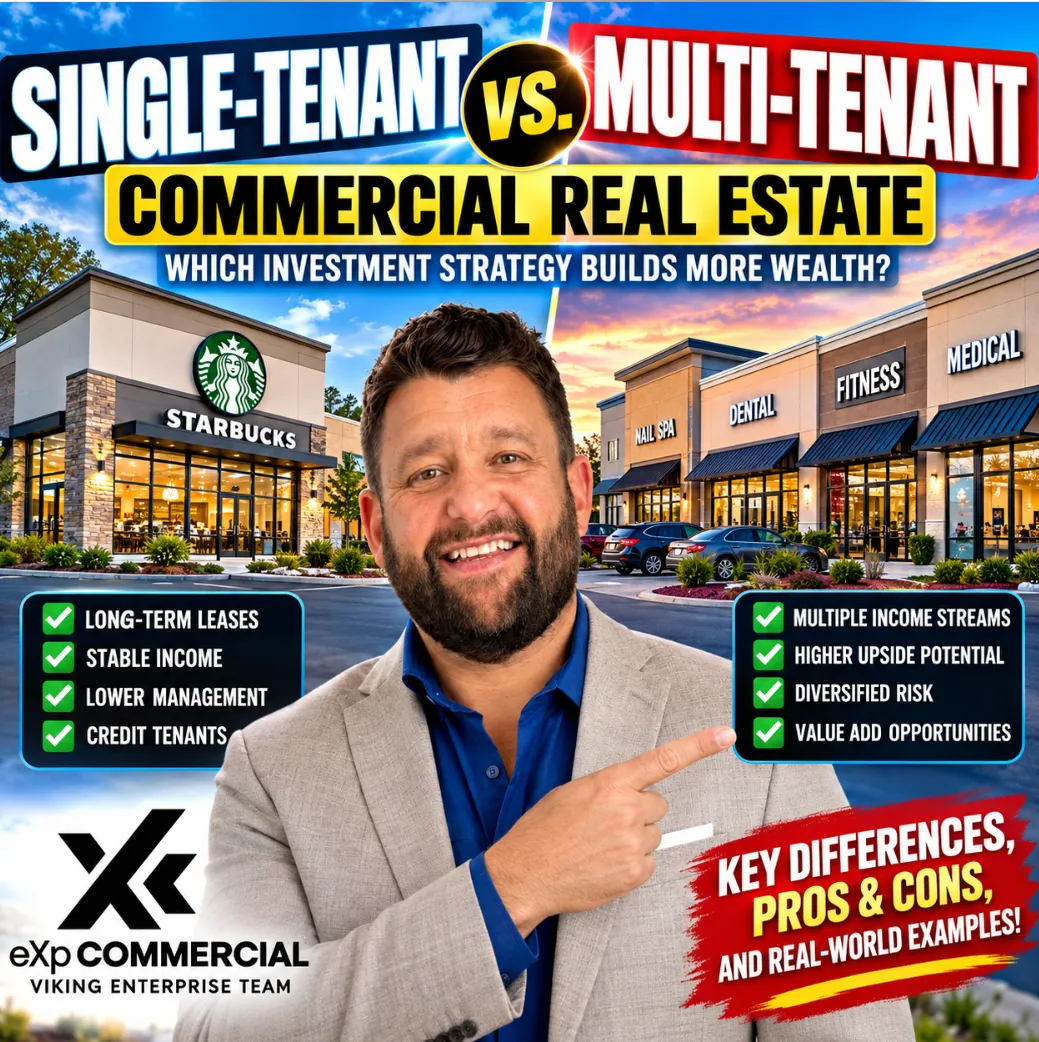
🏢 Single-Tenant vs. Multi-Tenant Commercial Real Estate: Which Investment Is Better? 💰
🏢 Single-Tenant vs. Multi-Tenant Commercial Real Estate: Which Investment Is Better? 💰
📈 Single-Tenant vs. Multi-Tenant Properties: Cash Flow, Vacancy Risk & Investment Returns Explained! 🔑
________________________________________________________________________________
Single-Tenant vs. Multi-Tenant Commercial Real Estate: Which Investment Is Better?
When investing in commercial real estate, one of the biggest decisions you'll face is whether to purchase a single-tenant commercial property or a multi-tenant commercial property.
Both strategies offer opportunities to generate rental income, build equity, and create long-term wealth. However, the risks, cash flow characteristics, management requirements, and financing considerations can be dramatically different.
For investors exploring opportunities in Houston, Katy, Fulshear, and West Houston, understanding these differences is essential before committing capital.
Let's compare the advantages, disadvantages, and financial considerations of each strategy.
What Is Single-Tenant Commercial Real Estate?
A single-tenant commercial property is a building leased to one business or organization.
Common examples include:
·Standalone restaurants and quick-service restaurants
·Pharmacies and convenience stores
·Medical and dental office buildings
·Freestanding retail stores
·Industrial warehouses occupied by one business
·Bank branches
Many single-tenant investments are structured using triple-net leases (NNN leases), where tenants pay or reimburse property taxes, insurance, and certain maintenance expenses.
However, not all single-tenant properties have NNN leases, and landlords may retain responsibility for certain capital expenditures or structural repairs.
Advantages of Single-Tenant Commercial Properties
1. Simplified property management
With only one tenant, owners generally have fewer lease negotiations, tenant communications, and rent collection responsibilities.
2. Potentially predictable rental income
Long-term leases may provide a stable contractual income stream, particularly when the tenant has strong financial credentials.
3. Reduced operating expense exposure
Under some NNN lease structures, tenants assume responsibility for substantial property operating expenses.
4. Attractive opportunities for passive-oriented investors
Investors seeking fewer day-to-day management responsibilities may find certain single-tenant properties appealing.
Disadvantages of Single-Tenant Properties
The primary disadvantage is tenant concentration risk.
When your only tenant vacates, your property may go from fully occupied to completely vacant.
This can create significant financial challenges:
·Rental income may stop entirely.
·Mortgage payments continue.
·Property taxes and insurance remain due.
·Maintenance and security costs may increase.
·Finding a replacement tenant can require substantial time and capital.
Additionally, highly specialized buildings may be difficult to lease to a different type of business.
Key takeaway: A single-tenant investment can be relatively simple to operate, but its income depends heavily on one tenant.
What Is Multi-Tenant Commercial Real Estate?
A multi-tenant commercial property contains several separately leased spaces occupied by different businesses.
Examples include:
·Neighborhood shopping centers
·Retail strip centers
·Multi-suite office buildings
·Medical office complexes
·Multi-bay industrial and flex buildings
·Mixed-use commercial developments
Instead of relying on one tenant for rental income, the property owner collects rent from multiple businesses.
Advantages of Multi-Tenant Commercial Properties
1. Diversified rental income
If one tenant vacates, other tenants may continue generating income.
This reduces dependence on a single business.
2. Potential for increased property value
Multi-tenant properties may offer value-add opportunities through renovations, improved leasing, expense management, and rent adjustments.
3. Multiple lease expiration dates
Staggered lease expirations can reduce the risk of losing all tenants simultaneously.
4. Opportunities to capture market rent growth
As leases expire, landlords may be able to negotiate rents closer to current market levels.
Disadvantages of Multi-Tenant Properties
Multi-tenant commercial properties typically require more active management.
Challenges can include:
·Multiple lease negotiations
·More frequent tenant turnover
·Higher leasing commissions
·Tenant improvement expenses
·Common area maintenance administration
·Complex property budgets
·Tenant conflicts and parking requirements
Key takeaway: Multi-tenant investments can offer greater income diversification, but usually require more hands-on asset management.
Single-Tenant vs. Multi-Tenant Commercial Real Estate: Side-by-Side Comparison
Factor | Single-Tenant | Multi-Tenant |
Number of tenants | One | Multiple |
Income diversification | Low | Higher |
Vacancy exposure | Concentrated | Distributed |
Property management | Generally simpler | Generally more complex |
Lease structures | Often NNN | NNN, gross, modified gross |
Tenant turnover | One major event | Multiple events |
Value-add potential | Often more limited | Often greater |
Primary risk | Loss of sole tenant | Multiple vacancies and operating costs |
Financing focus | Tenant credit and lease | Rent roll and occupancy |
Neither property type is automatically a better investment.
The right choice depends on the purchase price, tenant quality, location, lease terms, financing, and your investment objectives.
Real-World-Style Example: Two $2 Million Commercial Properties
Let's compare two hypothetical commercial real estate investments.
Property A: Single-Tenant Retail Building
·Purchase price: $2,000,000
·Annual rental income: $160,000
·Assumed owner operating expenses: $0
·Net operating income: $160,000
·Capitalization rate: 8%
·Number of tenants: One
For this simplified example, assume the tenant pays all property operating expenses and the landlord has no additional operating expense deductions.
The property generates $160,000 in annual NOI.
However, if the tenant leaves, rental income could fall to zero.
The owner would then be responsible for carrying the vacant building until another tenant is secured.
Property B: Five-Tenant Retail Center
·Purchase price: $2,000,000
·Number of tenants: Five
·Annual rent per tenant: $40,000
·Potential annual rental income: $200,000
·Annual operating expenses: $40,000
·Stabilized NOI: $160,000
·Capitalization rate: 8%
Both properties initially generate the same NOI and have the same capitalization rate.
Now assume one tenant leaves the multi-tenant center.
The remaining four tenants continue paying $160,000 in annual rent.
If operating expenses remain at $40,000, the property's NOI declines to $120,000.
That's a 25% reduction in NOI.
Compare that with the single-tenant property, where the loss of the only tenant eliminates all rental income.
This example demonstrates why tenant diversification matters.
However, actual results depend on operating expense recoveries, lease provisions, vacancies, capital costs, and financing obligations.
The lesson: Two properties with identical cap rates can have dramatically different risk profiles.
How Commercial Financing Differs
Commercial mortgage lenders evaluate single-tenant and multi-tenant properties using many of the same financial metrics, but their underwriting priorities can differ.
Financing Single-Tenant Properties
Lenders may emphasize:
·Tenant creditworthiness
·Remaining lease term
·Tenant guarantees
·Rent escalations
·Renewal options
·Alternative property uses
·Property location
·Debt service coverage ratio
·Loan-to-value ratio
A strong tenant with a long remaining lease can be favorable for financing.
However, a property with a short remaining lease or limited alternative uses may face additional scrutiny.
Financing Multi-Tenant Properties
Lenders often examine:
·Current rent roll
·Occupancy and collection history
·Tenant concentration
·Lease expiration schedule
·Historical operating expenses
·Net operating income
·Market rents
·Tenant improvement reserves
·Debt service coverage ratio
A property with multiple tenants can still present substantial risk if several leases expire simultaneously.
Three Financial Metrics Every Investor Should Know
1. Net Operating Income (NOI)
NOI = Effective Gross Income − Operating Expenses
NOI measures property operating profitability before financing costs, depreciation, and income taxes.
2. Capitalization Rate
Cap Rate = NOI ÷ Property Value
For example:
$160,000 ÷ $2,000,000 = 8%.
Cap rates are useful for comparing properties, but they do not measure the investor's leveraged cash-on-cash return.
3. Debt Service Coverage Ratio (DSCR)
DSCR = NOI ÷ Annual Debt Service
If a property generates $160,000 in NOI and annual debt service is $120,000:
DSCR = 1.33x.
That means the property generates approximately $1.33 in NOI for every $1.00 of annual debt payments.
Commercial lenders may apply additional underwriting adjustments and program-specific DSCR requirements.
Which Strategy Is Better for First-Time Commercial Investors?
For investors who prefer fewer tenant relationships and simpler day-to-day operations, a single-tenant property may be attractive.
For investors comfortable with more active leasing and management, a multi-tenant property may provide greater opportunities for income diversification and operational improvements.
However, investors should never assume a single-tenant property is automatically safer because it has a long lease.
Likewise, a multi-tenant property is not automatically more profitable because it has multiple tenants.
The investment must make financial sense under realistic assumptions.
Opportunities in Houston, Katy, and Fulshear
Investors evaluating commercial real estate in Katy, Fulshear, and West Houston can consider both single-tenant and multi-tenant investment strategies.
Potential single-tenant opportunities include standalone medical offices, restaurants, retail buildings, and industrial facilities.
Multi-tenant opportunities include neighborhood retail centers, professional office buildings, medical office complexes, and small-bay industrial properties.
When evaluating these investments, consider:
·Population and employment trends
·Local business demand
·Traffic counts and accessibility
·Competitive commercial inventory
·Property taxes and insurance costs
·Flood exposure
·Market rents
·Future development activity
Local market growth can support commercial demand, but individual properties still require thorough underwriting.
Seven Questions to Ask Before Buying
1.How financially strong are the existing tenants?
2.When do the leases expire?
3.What happens to NOI if a tenant vacates?
4.Are property taxes and insurance accurately projected?
5.What capital improvements or leasing expenses may be required?
6.Can the property cover its debt service during a vacancy?
7.What is the exit strategy if market conditions change?
These questions can help investors identify risks before they become expensive problems.
Final Verdict: Single-Tenant or Multi-Tenant?
Single-tenant commercial real estate may appeal to investors seeking simplified management and long-term contractual income.
Multi-tenant commercial real estate may appeal to investors seeking income diversification and opportunities to increase property performance.
The better investment depends on your objectives, risk tolerance, available capital, and ability to manage the property.
Don't buy a commercial property based solely on its advertised cap rate. Evaluate the income, expenses, tenant quality, financing, and downside risks.
Work With Bill Rapp, CCIM
Whether you're considering a single-tenant retail property, multi-tenant shopping center, medical office building, or industrial investment, I can help you evaluate your options.
At eXp Commercial – Viking Enterprise Team, we assist commercial real estate investors, business owners, and property owners throughout Katy, Fulshear, West Houston, and the greater Houston market.
Bill Rapp, CCIM
eXp Commercial — Viking Enterprise Team
📍 Serving Katy | Fulshear | Richmond | Brookshire | West Houston | Greater Houston
📧 [email protected]
☎️ 281-222-0433
🌐 HoustonRealEstateBrokerage.com
📍 eXp Commercial & eXp Realty
📅 Calendly.com/VikingEnterprise
https://www.houstonrealestatebrokerage.com/
https://www.houstonrealestatebrokerage.com/houston-cre-navigator
https://www.commercialexchange.com/agent/653bf5593e3a3e1dcec275a6
http://expressoffers.com/[email protected]
https://app.bullpenre.com/profile/1742476177701x437444415125976000
https://author.billrapponline.com/
https://www.amazon.com/dp/B0F32Z5BH2
https://veed.cello.so/FOmzTty6oi9
https://buymeacoffee.com/vikingente3
https://creplaybookseries.billrapponline.com
https://creplaybook.billrapponline.com/
© Bill Rapp, Broker Associate, eXp Commercial Viking Enterprise Team


