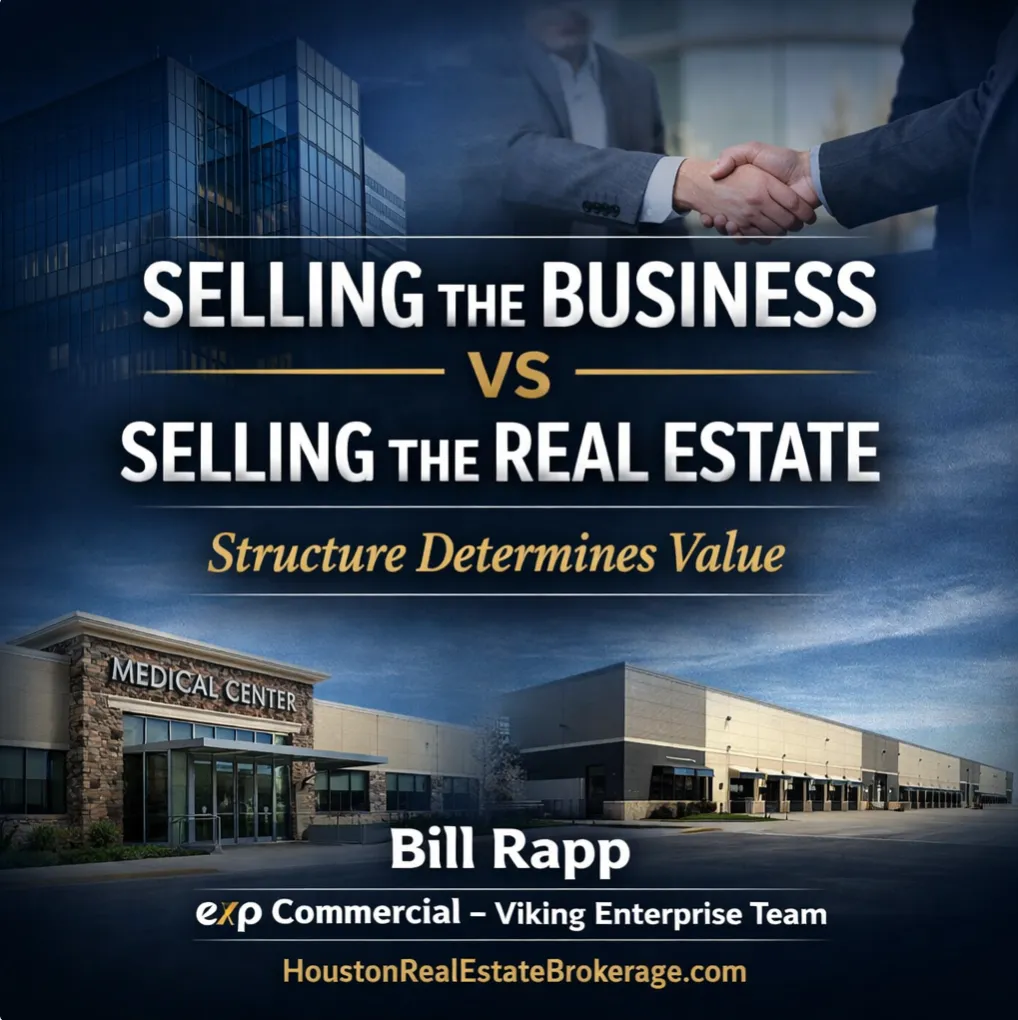
💼 Selling Your Business vs Selling the Real Estate: The Costly Mistake Owner-Users Make 🏢
💼 Selling Your Business vs Selling the Real Estate: The Costly Mistake Owner-Users Make 🏢
🚨 Business Sale or Property Sale First? How to Structure a Clean Exit Without Losing Value 💰
Selling the Business vs Selling the Real Estate
What Owner-Users Must Know Before Planning an Exit
If you own both your operating business and the building it sits in, your exit strategy is more complex—and more valuable—than you think.
Most owner-users don’t lose money because of market conditions.
They lose money because they structure the sale incorrectly.
For business owners in Katy, Fulshear, and West Houston, understanding how to sell a business and commercial real estate properly can mean the difference between:
·A clean, maximized exit
·Or a stalled transaction with discounted pricing
Let’s break this down clearly.
The Core Issue: Two Assets, One Decision
When you own both:
1.The operating company
2.The commercial real estate
You are controlling two separate but interdependent assets.
The mistake? Treating them like they’re unrelated.
They are not.
The business supports the building.
The building supports the business.
The financing on each affects the other.
Why Separating Them Often Kills Value
1️⃣ The Buyer Risk Problem
If you sell the real estate without securing a long-term lease from the business buyer:
·Investors see vacancy risk.
·Cap rates rise.
·Value drops.
A vacant building tied to a recently sold business = perceived instability.
2️⃣ The Financing Breakdown
Business buyers typically use:
·SBA 7(a) loans
·SBA 504 loans
·Seller financing
Real estate buyers often use:
·Conventional commercial loans
·DSCR loans
·Bridge loans
If you try to sell the building separately, you may eliminate SBA financing—which often provides the highest leverage and best terms for owner-users.
That can shrink your buyer pool significantly.
3️⃣ Emotional vs Financial Buyers
A business buyer cares about:
·Cash flow
·Goodwill
·Customer base
A real estate investor cares about:
·NOI
·Lease strength
·Credit tenant profile
If those don’t align, you create friction.
Financing Implications Owner-Users Must Understand
The most powerful exit structure for many owner-users is a combined sale using SBA 504 or SBA 7(a) financing.
Why?
Because SBA financing allows:
·Up to 90% total project financing
·Business + real estate in one transaction
·Longer amortizations
·Lower down payment requirements
This dramatically expands your buyer pool.
If you separate the assets, you may:
·Force higher down payments
·Reduce leverage
·Require stronger credit borrowers
·Narrow qualified buyers
That usually translates into lower pricing.
When Separating Them Makes Sense
There are exceptions.
You may consider splitting the sale if:
·You want long-term passive income from the building
·The business is unstable but the real estate is strong
·The property has redevelopment upside
·You want to complete a 1031 exchange
In these cases, you must structure:
·A strong lease agreement
·Market rent
·Clear operating history
Without that, investors discount heavily.
How to Structure a Clean Exit
Here’s the disciplined approach we use at the Viking Enterprise Team:
Step 1: Valuation Strategy
·Value the business based on EBITDA or SDE
·Value the real estate based on NOI and cap rate
·Analyze how the lease structure affects property value
Step 2: Financing Mapping
Identify which loan structure maximizes:
·Buyer pool
·Leverage
·Certainty of close
Often SBA-backed financing wins here.
Step 3: Exit Alignment
Determine:
·Sell both together?
·Sell business first with lease?
·Sell building to investor with leaseback?
·1031 into replacement property?
Your structure should align with:
·Tax strategy
·Retirement goals
·Cash flow needs
·Risk tolerance
A Real-World Owner-User Example
A medical office owner in West Houston:
·Owned their practice
·Owned the building
·Considered selling the building first
After analysis, we restructured:
·Sold business + real estate together
·Used SBA financing
·Increased buyer pool
·Improved pricing
·Delivered a clean close
That’s strategic exit planning—not reactive selling.
The Bottom Line
If you own both your business and the real estate:
You are not selling one asset.
You are selling a capital structure.
And the structure determines value.
If you’re in Katy, Fulshear, or West Houston and considering an exit within the next 1–3 years, the time to plan is now—not when you list.
📞 Let’s build your exit strategy the right way.
https://www.houstonrealestatebrokerage.com/
https://www.houstonrealestatebrokerage.com/houston-cre-navigator
https://www.commercialexchange.com/agent/653bf5593e3a3e1dcec275a6
http://expressoffers.com/[email protected]
https://app.bullpenre.com/profile/1742476177701x437444415125976000
https://author.billrapponline.com/
https://www.amazon.com/dp/B0F32Z5BH2
https://veed.cello.so/FOmzTty6oi9
https://buymeacoffee.com/vikingente3
https://creplaybookseries.billrapponline.com
https://creplaybook.billrapponline.com/
© 2023-2024 Bill Rapp, Broker Associate, eXp Commercial Viking Enterprise Team


