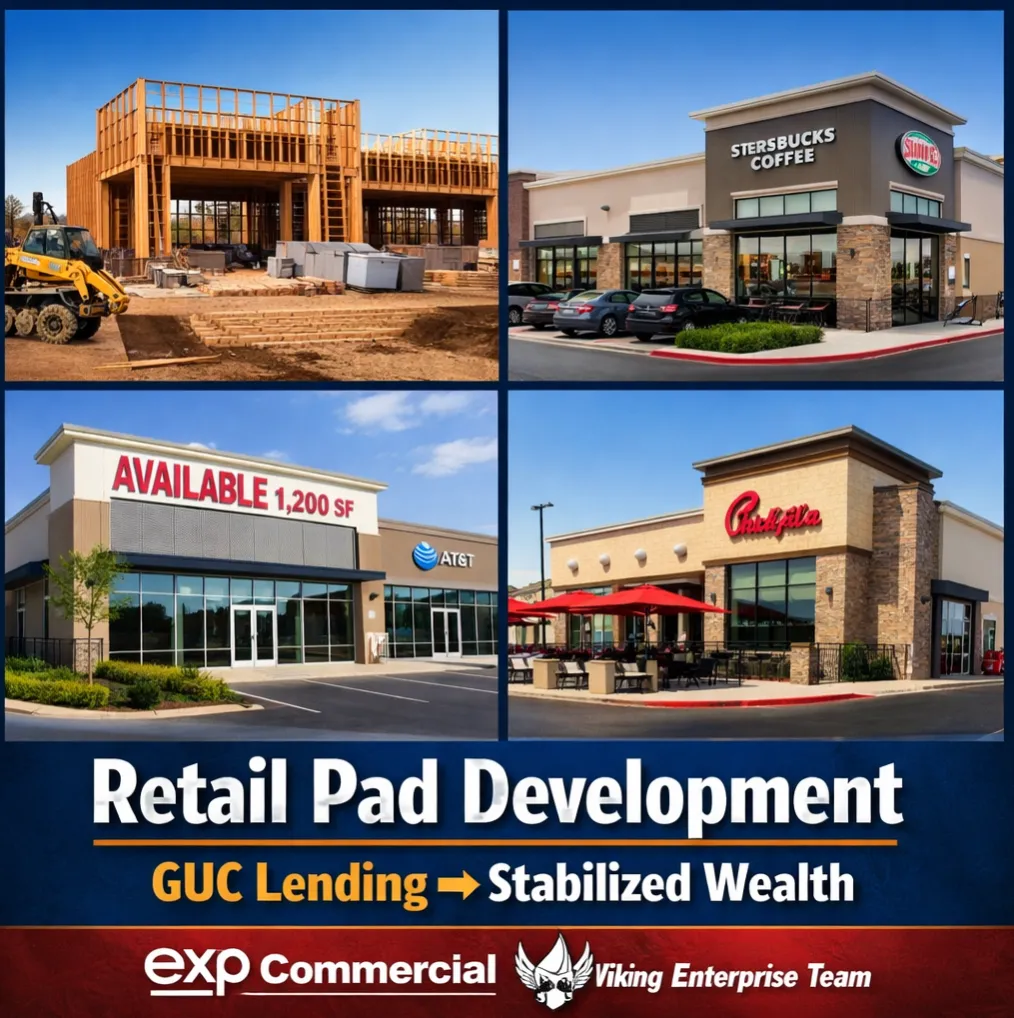
🏗️ Retail Pad Development in Master-Planned Communities: GUC Lending to Stabilized Multi-Tenant Value 💼📈
🏗️ Retail Pad Development in Master-Planned Communities: GUC Lending to Stabilized Multi-Tenant Value 💼📈
🏬 Corporate Credit Tenants & Retail Pads: How to Finance Ground-Up and Refinance for Long-Term Wealth 💰🏦
Retail Pad Development in Master-Planned Communities
Corporate Credit Tenants, Ground-Up Construction (GUC) Lending & Stabilized Multi-Tenant Financing
By Bill Rapp
eXp Commercial – Viking Enterprise Team
Serving Katy, Fulshear, West Houston & Surrounding Growth Corridors
Executive Summary
Retail pad development inside master-planned communities (MPCs) is one of the most durable commercial real estate strategies in Texas growth corridors. When paired with corporate credit tenants and structured correctly with Ground-Up Construction (GUC) financing, these projects can transition from development risk to long-term stabilized cash flow assets.
In markets like Katy and Fulshear—where rooftops, income levels, and traffic counts continue expanding—retail pads positioned at hard corners and major entrances offer predictable tenant demand and strong exit options.
The strategy is simple:
1.Secure the dirt in a high-growth MPC
2.Pre-lease to corporate credit tenants
3.Execute GUC financing with disciplined leverage
4.Refinance into stabilized long-term debt or portfolio multi-tenant financing
Done correctly, this is a wealth-compounding model.
Why Master-Planned Communities Matter
Master-planned communities create built-in demand.
They provide:
·Controlled traffic flow
·School districts driving residential growth
·HOA-regulated aesthetics
·Long-term population density
In West Houston corridors like Katy and Fulshear, retail development is demand-driven—not speculative. Pads near grocery anchors, medical corridors, and high-visibility intersections lease faster and hold value longer.
Retail follows rooftops. And rooftops are expanding.
The Role of Corporate Credit Tenants
Corporate tenants dramatically reduce risk.
Think national brands:
·Quick-service restaurants
·National coffee concepts
·Corporate medical operators
·Branded convenience or service providers
When leases are structured with:
·10–15 year primary terms
·Corporate guarantees
·Strong rent coverage
·Built-in escalations
Lenders treat these as lower-risk assets.
The tenant credit strength directly impacts:
·Loan proceeds
·Cap rate compression
·Exit value
·Debt yield
This is where development turns into institutional-grade real estate.
Ground-Up Construction (GUC) Lending for Retail Pads
GUC lending for retail pads is typically structured as:
·60–75% Loan-to-Cost (LTC)
·Interest-only during construction
·12–24 month term
·Interest reserves built into the loan
·Refinance upon certificate of occupancy and lease stabilization
Key underwriting drivers include:
·Tenant pre-lease commitments
·Developer liquidity
·Construction budget accuracy
·Exit strategy clarity
Lenders focus on debt yield and stabilized DSCR—not just LTV.
A signed lease with a corporate guaranty can materially improve leverage and pricing.
Transition to Stabilized Financing
Once the property is complete and leased, the financing strategy shifts.
Options include:
Single-Tenant Stabilized Loan
·Lower cap rate environment
·5–10 year fixed rate
·Potential 70–75% LTV
·Non-recourse options
Multi-Tenant Strip Center Financing
·Underwritten to blended DSCR
·Evaluates lease rollover schedule
·Credit diversification matters
·Focus on weighted average lease term (WALT)
Stabilized retail in master-planned communities often attracts regional banks, CMBS lenders, life companies, and debt funds.
This is where long-term wealth is built.
Risk Factors to Manage
Even strong retail pad developments require discipline:
·Overpaying for land
·Underestimating site work
·Weak tenant credit
·Short lease terms
·Aggressive rent projections
In Texas growth markets, underwriting conservatively while planning for refinance flexibility is critical.
Exit design matters more than entry optimism.
Why This Strategy Works in Katy & Fulshear
High per-capita income
Rapid residential absorption
School district strength
Major traffic corridors (I-10 West, FM 1093, Grand Parkway)
Retail pads in these corridors are not speculative—they are response-driven development.
For developers, investors, and owner-operators, this strategy bridges development upside with stabilized income durability.
Capital Advisory Matters
Retail pad development requires alignment between:
·Land acquisition
·Construction capital
·Tenant structuring
·Permanent financing
When brokerage and capital advisory work together, leverage becomes strategic—not reactive.
If you are evaluating retail pad development inside a master-planned community, structure the capital stack first.
Then build.
https://www.houstonrealestatebrokerage.com/
https://www.houstonrealestatebrokerage.com/houston-cre-navigator
https://www.commercialexchange.com/agent/653bf5593e3a3e1dcec275a6
http://expressoffers.com/[email protected]
https://app.bullpenre.com/profile/1742476177701x437444415125976000
https://author.billrapponline.com/
https://www.amazon.com/dp/B0F32Z5BH2
https://veed.cello.so/FOmzTty6oi9
https://buymeacoffee.com/vikingente3
https://creplaybookseries.billrapponline.com
https://creplaybook.billrapponline.com/
© 2023-2024 Bill Rapp, Broker Associate, eXp Commercial Viking Enterprise Team


