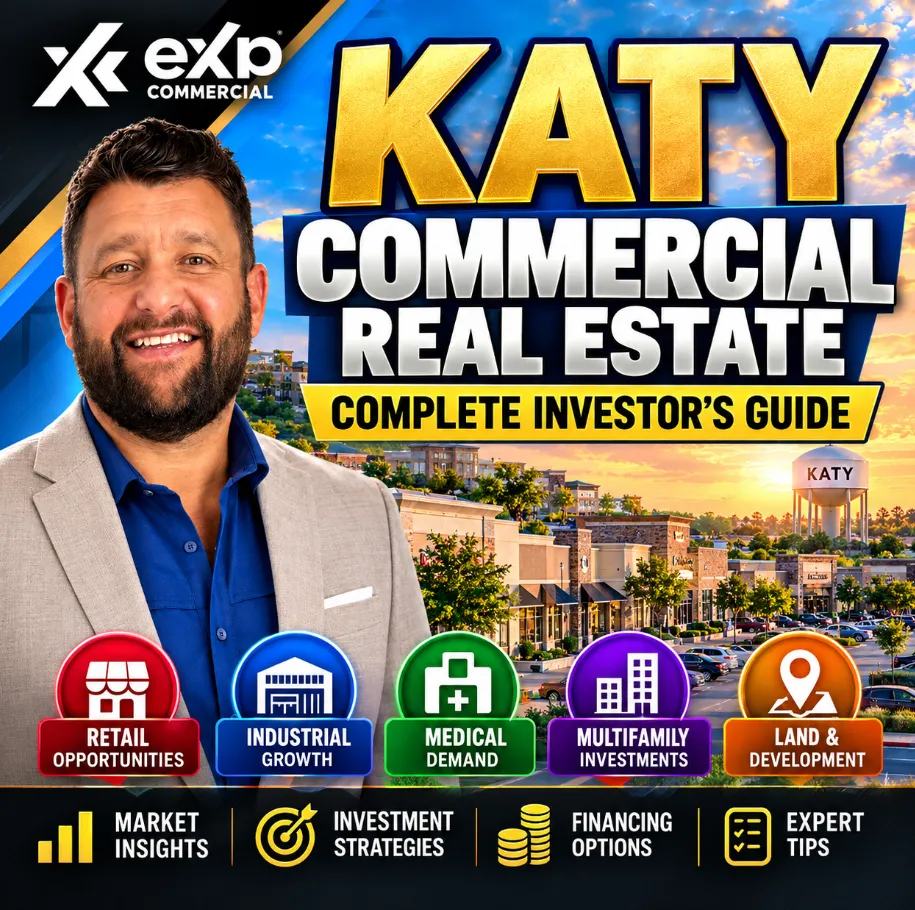
🏢 Katy Commercial Real Estate: The Complete Investor’s Guide to Profitable Opportunities in 2026 📈
🏢 Katy Commercial Real Estate: The Complete Investor’s Guide to Profitable Opportunities in 2026 📈
💰 Investing in Katy, TX Commercial Real Estate: Best Property Types, Financing & Investment Strategies 🏙️
_____________________________________________________________________________
Katy Commercial Real Estate: The Complete Investor’s Guide for 2026
Katy, Texas, has evolved from a suburban community west of Houston into an important destination for commercial real estate investment, business expansion, and property development.
For investors looking to acquire retail centers, industrial buildings, medical offices, multifamily properties, or commercial land, the Katy market offers a compelling combination of residential growth, transportation access, and expanding business activity.
But investing in Katy commercial real estate requires more than identifying a fast-growing neighborhood.
Successful investors understand property fundamentals, tenant demand, financing structures, location-specific risks, and the relationship between purchase price and sustainable cash flow.
In this complete investor's guide, we'll explore the opportunities, challenges, financing strategies, and due diligence considerations that every investor should understand before purchasing commercial property in Katy, Texas.
1. Why Investors Are Interested in Katy Commercial Real Estate
Katy benefits from its position within the Greater Houston metropolitan area and its access to major transportation corridors, including Interstate 10, the Grand Parkway (SH 99), and the Westpark Tollway.
These corridors connect businesses and residents with Houston's Energy Corridor, employment centers, distribution networks, and surrounding communities.
Population and Household Growth
Residential development throughout the broader Katy area, including Cinco Ranch, Elyson, Cane Island, and nearby Fulshear, has helped create demand for neighborhood retail, healthcare services, professional offices, and other commercial uses.
For commercial investors, household growth can support tenant demand, but population increases alone do not guarantee successful investments.
Investors should also examine household income, spending patterns, competing developments, traffic counts, and the pace of new commercial construction.
Business Expansion and Commercial Development
As neighborhoods expand, businesses frequently look for locations closer to their customers.
Potential beneficiaries include:
·Medical and dental practices
·Restaurants and neighborhood retailers
·Childcare and educational facilities
·Fitness and wellness businesses
·Professional service providers
·Contractors, distributors, and light-industrial users
These business categories create opportunities for both commercial landlords and owner-occupants.
2. Best Types of Commercial Real Estate Investments in Katy
Different property types offer different risk profiles, capital requirements, and potential returns.
Retail Shopping Centers
Neighborhood shopping centers and multi-tenant retail properties can benefit from growing residential communities.
Investors should focus on tenant creditworthiness, lease expirations, occupancy costs, rental comparables, and tenant mix.
A center with several established service businesses may provide diversified rental income, while a property dependent on one major tenant can carry substantial concentration risk.
Investor tip: Review lease rollover schedules and tenant improvement obligations before assuming that current net operating income will continue indefinitely.
Industrial and Flex Properties
Industrial and flex properties can appeal to contractors, logistics companies, service businesses, distributors, and smaller manufacturers.
Buildings with practical loading access, appropriate clear heights, sufficient parking, and functional office-to-warehouse ratios may serve a broad range of tenants.
However, not all industrial buildings are interchangeable.
Truck circulation, power capacity, zoning, deed restrictions, drainage, and access to major roads can significantly affect marketability.
Investor tip: Verify the property's permitted uses and physical specifications before relying on projected industrial rental rates.
Medical and Professional Office Buildings
Healthcare providers often value proximity to established residential neighborhoods and convenient patient access.
Medical office properties can involve specialized buildouts, plumbing, electrical requirements, accessibility considerations, and substantial tenant improvement costs.
Long-term tenants may provide attractive income stability, but investors should evaluate the cost of re-leasing specialized space if a tenant vacates.
Investor tip: Evaluate both the tenant's financial strength and the property's adaptability to future users.
Multifamily Investment Properties
Multifamily investors evaluating Katy-area opportunities should analyze employment accessibility, rent comparables, concessions, insurance expenses, property taxes, and competitive apartment supply.
For apartment acquisitions, the difference between advertised rents and effective collected rents can materially affect underwriting.
Investors should also distinguish between smaller residential rental properties and commercial multifamily assets, typically involving five or more units.
Investor tip: Underwrite realistic stabilized occupancy and operating expenses rather than relying exclusively on a seller's projected performance.
Commercial Land and Development Sites
Vacant commercial land offers flexibility but introduces entitlement, infrastructure, and development risk.
Before acquiring land, investors should evaluate:
·Legal and physical access
·Floodplain and drainage conditions
·Water and wastewater capacity
·Utility extension costs
·Applicable zoning or land-use restrictions
·Municipal utility district obligations
·Platting and permitting requirements
·Construction costs and absorption assumptions
The Katy area includes multiple jurisdictions and unincorporated locations, so land-use requirements can vary considerably from one parcel to another.
Investor tip: Obtain professional feasibility reviews before removing due diligence contingencies.
3. Where to Look for Commercial Investment Opportunities
The broader Katy commercial market is not one uniform investment area.
Interstate 10 Corridor
The I-10 corridor provides regional visibility and transportation access.
It can be attractive for retail, hospitality, office, and certain industrial uses, depending on the property's location and access configuration.
Grand Parkway / SH 99
The Grand Parkway connects developing residential communities and commercial districts across western Greater Houston.
Investors should evaluate interchange access, surrounding rooftops, planned construction, and competing retail supply.
Cinco Ranch and Established Residential Areas
Established neighborhoods can support medical, professional, restaurant, and service-oriented retail uses.
Available sites may be limited, and acquisition costs can reflect established demand.
West Katy, Elyson, and Nearby Growth Corridors
Expanding residential areas may create opportunities for new commercial services.
However, investors should be careful about paying today's price for rental income that may take years to materialize.
Fulshear and Surrounding Communities
Fulshear's expansion creates additional opportunities for retail, medical, office, and service-related development.
It should be analyzed as a related but distinct submarket, with its own infrastructure constraints, competitive conditions, and local development requirements.
4. How to Analyze a Katy Commercial Investment
One of the most important lessons in commercial real estate investing is that a property's advertised capitalization rate does not tell the entire story.
Net Operating Income
Net operating income, or NOI, represents the property's operating revenue minus ordinary operating expenses, before debt service, income taxes, depreciation, and capital expenditures.
NOI = Effective Gross Income − Operating Expenses
Investors should verify the rent roll, actual collections, recoverable expenses, property taxes, insurance, management fees, maintenance costs, and vacancy assumptions.
Capitalization Rate
The capitalization rate compares a property's NOI with its purchase price.
Cap Rate = NOI ÷ Purchase Price
For example, consider a hypothetical Katy retail property offered for $2,000,000 with annual NOI of $140,000.
The going-in cap rate would be:
$140,000 ÷ $2,000,000 = 7.0%
That calculation provides a useful starting point, but it does not establish whether the property is a good investment.
If the building has significant deferred maintenance, an upcoming lease expiration, or rising insurance expenses, the projected return could change substantially.
Debt Service Coverage Ratio
Commercial lenders commonly examine debt service coverage ratio, or DSCR.
DSCR = NOI ÷ Annual Debt Service
If the same property generates $140,000 in annual NOI and annual principal-and-interest payments total $112,000:
$140,000 ÷ $112,000 = 1.25 DSCR
That means the property generates $1.25 of NOI for every $1.00 of scheduled annual debt service.
Lenders may require different coverage levels based on the property, borrower, leverage, and loan program.
Cash-on-Cash Return
Cash-on-cash return measures annual pre-tax cash flow relative to the investor's total initial cash invested.
Cash-on-Cash Return = Annual Pre-Tax Cash Flow ÷ Total Initial Cash Invested
This calculation is particularly useful when comparing financing alternatives, although it should be supplemented with capital expenditure reserves, refinancing risk, and long-term return projections.
5. Commercial Real Estate Financing Options in Katy
Choosing the right financing structure can be as important as choosing the right property.
Conventional Commercial Loans
Banks and commercial lenders may offer financing for stabilized investment properties and owner-occupied buildings.
Loan structures can include fixed or floating interest rates, amortization periods that extend beyond the initial loan term, balloon maturities, and recourse provisions.
SBA 7(a) and SBA 504 Loans
Eligible business owners purchasing property primarily for their own business operations may benefit from SBA financing.
SBA 7(a) and 504 programs have different structures, eligible uses, occupancy requirements, and underwriting standards.
Certain eligible owner-occupied transactions may allow substantially lower down payments than conventional investment-property financing.
SBA loans generally are not intended for passive investment properties.
DSCR and Cash-Flow-Based Financing
Some lenders place substantial emphasis on property income and DSCR rather than traditional borrower income documentation.
Available terms, underwriting standards, leverage, and eligible property types vary significantly.
Bridge Financing
Bridge loans may help investors acquire properties requiring renovation, lease-up, stabilization, or repositioning.
However, bridge financing often carries higher borrowing costs, shorter maturities, and meaningful refinancing risk.
Construction and Development Financing
Ground-up development financing requires careful evaluation of land costs, infrastructure, construction budgets, contingencies, borrower equity, and exit strategy.
Investors should establish financing feasibility before committing significant nonrefundable capital.
6. Understanding Property Taxes, Insurance, and Flood Risk
Texas commercial property investors must pay particular attention to property taxes and insurance.
A purchase can affect future assessed values, and a seller's existing tax expense may not represent the buyer's stabilized expense.
Depending on the parcel, taxes may involve county, school district, municipal, and special district assessments.
Insurance premiums, windstorm exposure, drainage conditions, and flood risk also deserve careful review.
Never rely solely on the seller's current property tax bill or insurance premium when projecting future NOI.
Obtain independent estimates and examine the property's flood history, floodplain designation, drainage characteristics, and insurance availability.
7. A Practical Katy Commercial Investment Example
Imagine an investor evaluating a hypothetical 12,000-square-foot multi-tenant retail property in Katy.
The property has:
·Purchase price: $2,000,000
·Annual NOI: $140,000
·Going-in cap rate: 7.0%
·Loan amount: $1,400,000
·Down payment: $600,000
·Assumed annual debt service: $112,000
·DSCR: 1.25
·Annual cash flow before capital expenditures and income taxes: $28,000
At first glance, the investment appears straightforward.
But suppose one tenant occupies 30% of the space and has a lease expiring within 12 months.
If that tenant vacates, the investor could face lost rental income, leasing commissions, tenant improvements, and several months of downtime.
The investment decision should therefore depend on more than the current 7% cap rate.
A thorough underwriting process would test vacancy scenarios, replacement rents, leasing costs, and cash reserves.
This is why disciplined due diligence matters more than a compelling marketing brochure.
8. Common Mistakes Katy Commercial Real Estate Investors Should Avoid
Some of the most expensive commercial real estate mistakes occur before closing.
Mistake #1: Buying based on cap rate alone. A high cap rate may reflect substantial tenant, physical, or market risk.
Mistake #2: Underestimating property taxes and insurance. Stabilized operating expenses may differ significantly from historical expenses.
Mistake #3: Ignoring lease expirations. Current occupancy does not guarantee future income.
Mistake #4: Overlooking capital expenditures. Roofs, HVAC systems, parking lots, and building systems can require significant reinvestment.
Mistake #5: Choosing financing solely by interest rate. Prepayment penalties, balloon payments, guarantees, and refinancing provisions also matter.
Mistake #6: Assuming all Katy locations perform equally. Traffic patterns, accessibility, demographics, competition, and jurisdictional requirements vary.
Mistake #7: Failing to develop an exit strategy. Investors should understand likely resale demand, refinancing alternatives, and future capital requirements.
9. Due Diligence Checklist Before Buying Commercial Property in Katy
Before completing an acquisition, investors should review:
·Current rent roll and executed leases
·Historical operating statements and supporting records
·Property tax assessments and applicable tax districts
·Insurance quotes and claims history
·Property condition and environmental reports
·Roof, HVAC, foundation, and major systems
·Survey, title commitment, easements, and restrictions
·Floodplain and drainage conditions
·Zoning, permitted uses, and applicable deed restrictions
·Utility availability and capacity
·Tenant estoppels and security deposits
·Financing terms, loan covenants, and maturity dates
·Local lease and sales comparables
·Capital expenditure reserves and exit strategy
Qualified legal, engineering, environmental, insurance, and tax professionals should be involved as appropriate.
10. How a Commercial Real Estate Advisor Can Help
Commercial acquisitions often involve several interconnected decisions.
An investor may find an attractive property but discover that the financing terms undermine the expected return.
A business owner may identify an ideal location but underestimate buildout costs or occupancy requirements.
Working with an experienced commercial real estate advisor can help coordinate property sourcing, financial analysis, negotiations, due diligence, and financing considerations.
As a commercial real estate broker and CCIM, I focus on helping investors and business owners evaluate opportunities through both a real estate and capital-structure perspective.
Whether the objective is acquiring a cash-flowing investment, purchasing a building for your business, identifying a 1031 exchange replacement property, or exploring development opportunities, the goal is to make informed decisions based on realistic underwriting.
Final Thoughts: Is Katy Commercial Real Estate a Good Investment?
Katy offers opportunities across retail, industrial, medical office, multifamily, and commercial land.
But no location or property type guarantees a profitable outcome.
The strongest investment decisions combine local market knowledge, sound financial analysis, realistic financing assumptions, and disciplined due diligence.
The question isn't simply whether Katy is growing. The question is whether a specific property can deliver the income, risk profile, and long-term value that match your investment objectives.
Let's Discuss Your Katy Commercial Real Estate Goals
I'm Bill Rapp, CCIM, with eXp Commercial and the Viking Enterprise Team.
If you're looking to buy, sell, lease, develop, or invest in commercial real estate in Katy, Fulshear, West Houston, or the Greater Houston area, I'd welcome the opportunity to discuss your objectives.
Bill Rapp, CCIM
eXp Commercial — Viking Enterprise Team
📍 Serving Katy | Fulshear | Richmond | Brookshire | West Houston | Greater Houston
📧 [email protected]
☎️ 281-222-0433
🌐 HoustonRealEstateBrokerage.com
📍 eXp Commercial & eXp Realty
📅 Calendly.com/VikingEnterprise
https://www.houstonrealestatebrokerage.com/
https://www.houstonrealestatebrokerage.com/houston-cre-navigator
https://www.commercialexchange.com/agent/653bf5593e3a3e1dcec275a6
http://expressoffers.com/[email protected]
https://app.bullpenre.com/profile/1742476177701x437444415125976000
https://author.billrapponline.com/
https://www.amazon.com/dp/B0F32Z5BH2
https://veed.cello.so/FOmzTty6oi9
https://buymeacoffee.com/vikingente3
https://creplaybookseries.billrapponline.com
https://creplaybook.billrapponline.com/
© Bill Rapp, Broker Associate, eXp Commercial Viking Enterprise Team


