🏗️ Houston Office Demolition Boom: Why Land Is Now More Valuable Than the Building 🏢
🏗️ Houston Office Demolition Boom: Why Land Is Now More Valuable Than the Building 🏢
🚧 Houston Office Market Reset: Why Obsolete Office Buildings Are Coming Down 💼
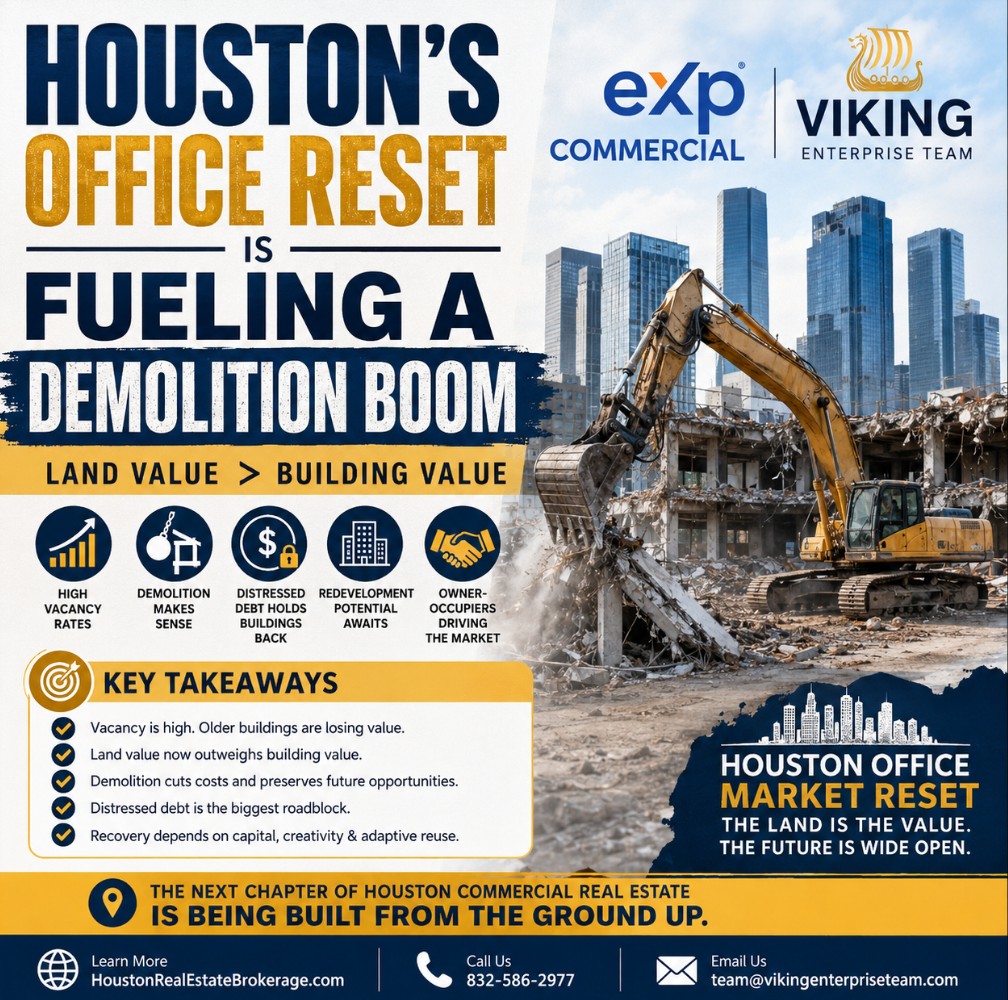
Houston's Office Reset Is Fueling a Demolition Boom
For years, Houston's commercial real estate market has been defined by rising office vacancies. Today, however, the market has entered an entirely new phase.
The challenge is no longer simply filling empty office buildings.
Instead, owners are asking a much bigger question:
Is the building worth saving at all?
Across Houston, many older Class B and Class C office properties have become economically obsolete. In many cases, the underlying land is now worth more than the structure sitting on it, leading owners to consider demolition as the most financially responsible strategy.
For commercial property owners, investors, developers, and business owners, this shift is creating both challenges and opportunities.
Houston Office Vacancy Remains Among the Highest in America
Houston's office market recorded an estimated 26.8% vacancy rate during the first quarter of 2026, placing it among the highest vacancy markets in the United States.
While premium Class A buildings continue attracting tenants through modern amenities, energy efficiency, collaborative workspaces, and prime locations, older office inventory continues struggling to compete.
Today's tenants expect:
·Modern HVAC systems
·Flexible floorplans
·High-speed technology infrastructure
·Walkable amenities
·Attractive common areas
·Energy-efficient buildings
Unfortunately, many office buildings constructed during the 1970s through 1990s simply cannot compete without massive capital investment.
When Land Becomes More Valuable Than the Building
One of the clearest examples is the Halbouty Center at 5100 Westheimer.
The approximately 109,000-square-foot office building, built in 1973, carries an appraised value near $9.3 million.
However:
·Approximately $7 million of that value comes from the land itself.
·Only a small portion represents the actual building.
That changes the investment equation entirely.
Rather than spending millions renovating an aging office property with uncertain leasing prospects, many owners conclude that demolition preserves more long-term value.
Why Demolition Makes Financial Sense
For debt-free owners, demolition can immediately improve financial performance by:
Eliminating Carrying Costs
Vacant buildings still require:
·Security
·Insurance
·Utilities
·Maintenance
·Property management
·Repairs
Removing the building eliminates many ongoing expenses.
Reducing Liability
Empty buildings become liabilities.
Owners face:
·Vandalism
·Water damage
·Code violations
·Safety concerns
·Higher insurance exposure
Vacant land dramatically reduces these risks.
Preserving Redevelopment Flexibility
A cleared site offers flexibility for:
·Medical offices
·Mixed-use developments
·Retail
·Multifamily housing
·Industrial flex
·Build-to-suit projects
Rather than being tied to an obsolete office design, owners regain control of future possibilities.
Debt Is Keeping Many Buildings Standing
Ironically, many buildings that should be demolished cannot be.
The reason?
Debt.
Many Houston office properties still carry loans that exceed the current economic value of the improvements.
Lenders often hesitate to:
·Finance demolition
·Foreclose
·Invest additional capital
·Approve redevelopment
As a result, obsolete office buildings remain frozen in place while waiting for loan restructurings, ownership transfers, or market improvements.
Demolition Companies Are Seeing More Work
The office reset has also created significant opportunities for demolition contractors.
Recent Houston-area projects include:
·Former Fluor campus in Sugar Land
·George R. Brown Convention Center renovation
·Numerous obsolete office buildings throughout Houston
However, higher interest rates continue slowing private redevelopment, meaning many demolition firms are supplementing work through public infrastructure projects.
Office Market Is Becoming a Land Market
Perhaps the biggest takeaway is this:
Houston office values are increasingly being driven by land economics rather than rental income.
That represents a major structural shift.
Investors are now evaluating:
·Redevelopment potential
·Zoning
·Traffic counts
·Population growth
·Future highest-and-best use
rather than simply occupancy percentages.
Opportunity for Owner-Occupiers
Not every office building is destined for demolition.
Many owner-users are taking advantage of historically discounted pricing.
Businesses purchasing office space for their own operations can often acquire properties at prices well below replacement cost while eliminating future rent increases.
This trend continues removing older office inventory from the leasing market.
What This Means for Investors
Commercial real estate investors should pay close attention to several emerging themes.
1. Land Is Becoming the Primary Asset
Future appreciation may come from redevelopment rather than office cash flow.
2. Debt Matters More Than Ever
Owners without debt possess significantly greater flexibility.
3. Adaptive Reuse Will Continue
Many buildings may become:
·Medical offices
·Multifamily housing
·Educational facilities
·Mixed-use developments
·Self-storage
·Industrial conversions
4. Capital Markets Will Drive Recovery
Lower interest rates and improved lending conditions will likely accelerate redevelopment activity.
Key Takeaways
·Houston's office market has evolved from an occupancy problem into an asset repositioning challenge.
·Many Class B and Class C office buildings are now worth less than the land beneath them.
·Demolition is becoming an increasingly attractive strategy for debt-free property owners.
·Distressed loans remain the biggest obstacle preventing redevelopment.
·Adaptive reuse, redevelopment, and owner-occupier acquisitions will likely shape Houston's next commercial real estate cycle.
Final Thoughts
Houston's commercial real estate market is undergoing one of its most significant transformations in decades.
For many aging office properties, the future is no longer found in attracting another office tenant—it lies in unlocking the value of the land itself.
As financing conditions improve and distressed assets change hands, expect to see more demolitions, adaptive reuse projects, and redevelopment opportunities reshape Houston over the coming years.
Whether you're an investor, developer, business owner, or commercial property owner, understanding this market shift will be essential for identifying opportunities before the next phase of Houston's commercial real estate cycle begins.
About Bill Rapp
Bill Rapp is a Commercial Real Estate Advisor with eXp Commercial – Viking Enterprise Team, serving Houston, Katy, Fulshear, and surrounding Texas markets. He helps investors, business owners, and developers buy, sell, lease, and finance commercial real estate while providing strategic guidance on redevelopment opportunities and commercial lending solutions.
Connect With Viking Enterprise Team
📍 eXp Commercial & eXp Realty
📍 Houston | Katy | Fulshear | West Houston
📅 Calendly.com/VikingEnterprise
📞 281-222-0433
📞 Bill Rapp, CCIM
eXp Commercial | Viking Enterprise Team
Commercial Real Estate & Capital Advisory
🌐 https://houstonrealestatebrokerage.com
https://www.houstonrealestatebrokerage.com/
https://www.houstonrealestatebrokerage.com/houston-cre-navigator
https://www.commercialexchange.com/agent/653bf5593e3a3e1dcec275a6
http://expressoffers.com/[email protected]
https://app.bullpenre.com/profile/1742476177701x437444415125976000
https://author.billrapponline.com/
https://www.amazon.com/dp/B0F32Z5BH2
https://veed.cello.so/FOmzTty6oi9
https://buymeacoffee.com/vikingente3
https://creplaybookseries.billrapponline.com
https://creplaybook.billrapponline.com/
© Bill Rapp, Broker Associate, eXp Commercial Viking Enterprise Team


