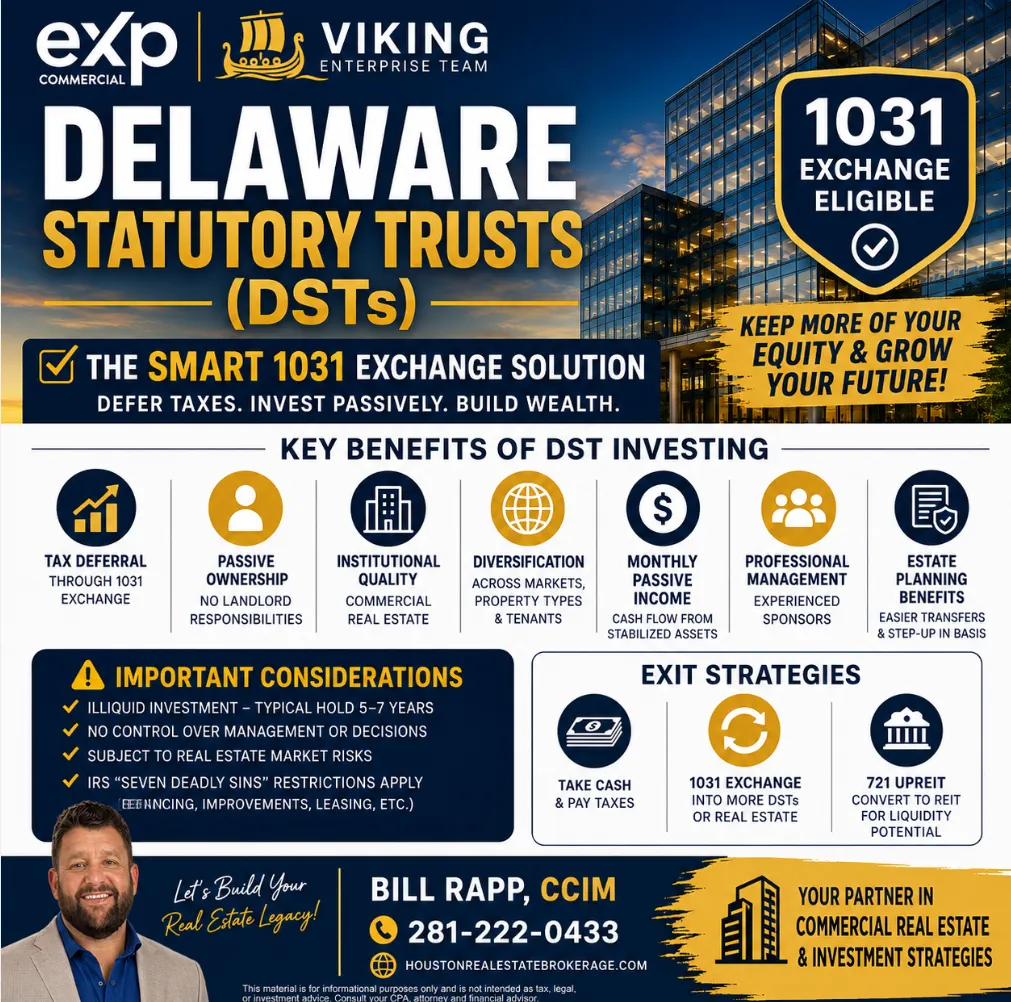
🏢 Delaware Statutory Trusts (DSTs): The Smart 1031 Exchange Strategy for Passive Real Estate Investing 💰
🏢 Delaware Statutory Trusts (DSTs): The Smart 1031 Exchange Strategy for Passive Real Estate Investing 💰
📈 How Delaware Statutory Trusts Help Investors Defer Taxes and Build Passive Income Through 1031 Exchanges 🏢
Delaware Statutory Trusts (DSTs): A Smarter Way to Complete a 1031 Exchange
Selling an investment property can create a significant tax burden. Between federal capital gains taxes, depreciation recapture, and state taxes, investors can lose a substantial portion of their equity unless they utilize a tax-deferral strategy.
For many accredited investors, a Delaware Statutory Trust (DST) has become one of the most attractive replacement property options available under Section 1031 of the Internal Revenue Code.
DSTs allow investors to defer capital gains taxes while transitioning from active property ownership into professionally managed, institutional-quality commercial real estate.
Whether you're a retiring landlord, a commercial investor seeking diversification, or simply tired of managing tenants and maintenance issues, a Delaware Statutory Trust may provide an excellent solution.
What Is a Delaware Statutory Trust (DST)?
A Delaware Statutory Trust is a legal ownership structure that allows multiple accredited investors to own fractional interests in institutional-quality commercial real estate.
Rather than owning an entire property yourself, you own a beneficial interest in a professionally managed trust.
The IRS officially recognized DSTs as qualifying replacement property for 1031 exchanges through Revenue Ruling 2004-86, making them eligible investments for tax-deferred exchanges.
Investors receive many of the same economic benefits as direct ownership while eliminating virtually all day-to-day management responsibilities.
How DSTs Work
Instead of purchasing another investment property directly, an investor completing a 1031 exchange purchases an ownership interest in a Delaware Statutory Trust.
The DST sponsor:
·Acquires the property
·Arranges financing
·Manages leasing
·Oversees operations
·Handles maintenance
·Coordinates property sales
Investors simply receive their proportionate share of income distributions while maintaining ownership for tax purposes.
Benefits of Delaware Statutory Trusts
1. Capital Gains Tax Deferral
DSTs qualify as replacement property in a 1031 exchange, allowing investors to defer:
·Federal capital gains taxes
·Depreciation recapture
·Potential state taxes
This preserves more investment capital for future growth.
2. Truly Passive Ownership
Many investors eventually grow tired of:
·Late-night maintenance calls
·Tenant turnover
·Leasing vacancies
·Property management headaches
DSTs eliminate these responsibilities while still allowing investors to participate in commercial real estate ownership.
3. Institutional-Quality Real Estate
DSTs often own assets individual investors could rarely purchase independently, including:
·Class A apartment communities
·Medical office buildings
·Industrial distribution centers
·Self-storage facilities
·Grocery-anchored retail centers
·Senior housing communities
4. Diversification
Instead of placing all of your equity into one replacement property, DST investors can diversify across:
·Multiple markets
·Property types
·Geographic regions
·Tenant bases
·Sponsors
Diversification may help reduce concentration risk.
5. Monthly Passive Income
Most DST properties are stabilized income-producing assets designed to generate regular cash flow.
Income distributions are generally paid monthly or quarterly depending on the offering.
6. Professional Asset Management
Professional sponsors oversee every aspect of ownership, including:
·Leasing
·Operations
·Capital improvements
·Financing
·Reporting
·Disposition strategy
Investors benefit from institutional management without becoming landlords.
7. Estate Planning Advantages
DST ownership interests are generally easier to transfer than direct property ownership.
Additionally, many investors may benefit from a potential step-up in basis for heirs under current tax law.
8. Built-In Financing
Most DST offerings include non-recourse financing already in place.
This can help satisfy debt replacement requirements in a 1031 exchange without requiring investors to personally qualify for a new commercial mortgage.
9. Long-Term Appreciation Potential
Although income is often the primary objective, investors also participate in any appreciation realized when the property is eventually sold.
Important Investment Considerations
Like every investment, Delaware Statutory Trusts involve risks.
Investors should carefully evaluate:
Limited Liquidity
Most DST investments are intended to be held approximately:
·5–7 years
There is generally no secondary market for ownership interests.
Limited Control
Investors cannot:
·Refinance
·Lease space
·Sell the property
·Replace management
·Approve daily operational decisions
All decisions are handled by the sponsor.
Market Risk
DSTs remain real estate investments.
Performance may be affected by:
·Interest rates
·Occupancy
·Local market conditions
·Tenant credit
·Economic cycles
IRS Operational Restrictions
DSTs must comply with several IRS limitations commonly referred to as the "Seven Deadly Sins."
These restrictions limit:
·Refinancing
·Capital improvements
·New capital contributions
·Reinvestment of sale proceeds
·Operational flexibility
These rules help preserve DST eligibility for 1031 exchanges.
Exit Strategies
When a DST property is sold, investors generally have several choices.
Option 1
Receive proceeds and pay applicable taxes.
Option 2
Complete another 1031 exchange into:
·Another DST
·Directly owned commercial real estate
Option 3
Some sponsors offer a 721 UPREIT conversion, allowing investors to exchange into operating partnership units of a REIT while continuing tax deferral and potentially improving long-term liquidity.
Who Should Consider a DST?
Delaware Statutory Trusts may be appropriate for:
·Retiring landlords
·Business owners selling investment properties
·Investors seeking passive income
·High-net-worth individuals
·Accredited investors completing a 1031 exchange
·Families focused on estate planning
·Investors seeking diversification
Due Diligence Matters
Not all Delaware Statutary Trust offerings are created equal.
Before investing, evaluate:
·Sponsor experience
·Property quality
·Market fundamentals
·Tenant strength
·Debt structure
·Fees
·Exit strategy
·Historical performance
Working with experienced commercial real estate and tax professionals can help determine whether a DST aligns with your long-term investment objectives.
Final Thoughts
For accredited investors looking to complete a 1031 exchange, Delaware Statutory Trusts offer a compelling combination of tax deferral, passive ownership, institutional-quality real estate, professional management, and portfolio diversification.
While they are not suitable for every investor, DSTs can provide an elegant solution for those seeking to preserve wealth while reducing the burdens of active property ownership.
If you're considering selling an investment property and want to explore whether a Delaware Statutory Trust fits your investment strategy, consulting experienced commercial real estate, legal, and tax professionals before your sale can help maximize your available options.
Connect With Viking Enterprise Team
📍 eXp Commercial & eXp Realty
📍 Houston | Katy | Fulshear | West Houston
📅 Calendly.com/VikingEnterprise
📞 281-222-0433
📞 Bill Rapp, CCIM
eXp Commercial | Viking Enterprise Team
Commercial Real Estate & Capital Advisory
🌐 https://houstonrealestatebrokerage.com
https://www.houstonrealestatebrokerage.com/
https://www.houstonrealestatebrokerage.com/houston-cre-navigator
https://www.commercialexchange.com/agent/653bf5593e3a3e1dcec275a6
http://expressoffers.com/[email protected]
https://app.bullpenre.com/profile/1742476177701x437444415125976000
https://author.billrapponline.com/
https://www.amazon.com/dp/B0F32Z5BH2
https://veed.cello.so/FOmzTty6oi9
https://buymeacoffee.com/vikingente3
https://creplaybookseries.billrapponline.com
https://creplaybook.billrapponline.com/
© Bill Rapp, Broker Associate, eXp Commercial Viking Enterprise Team


