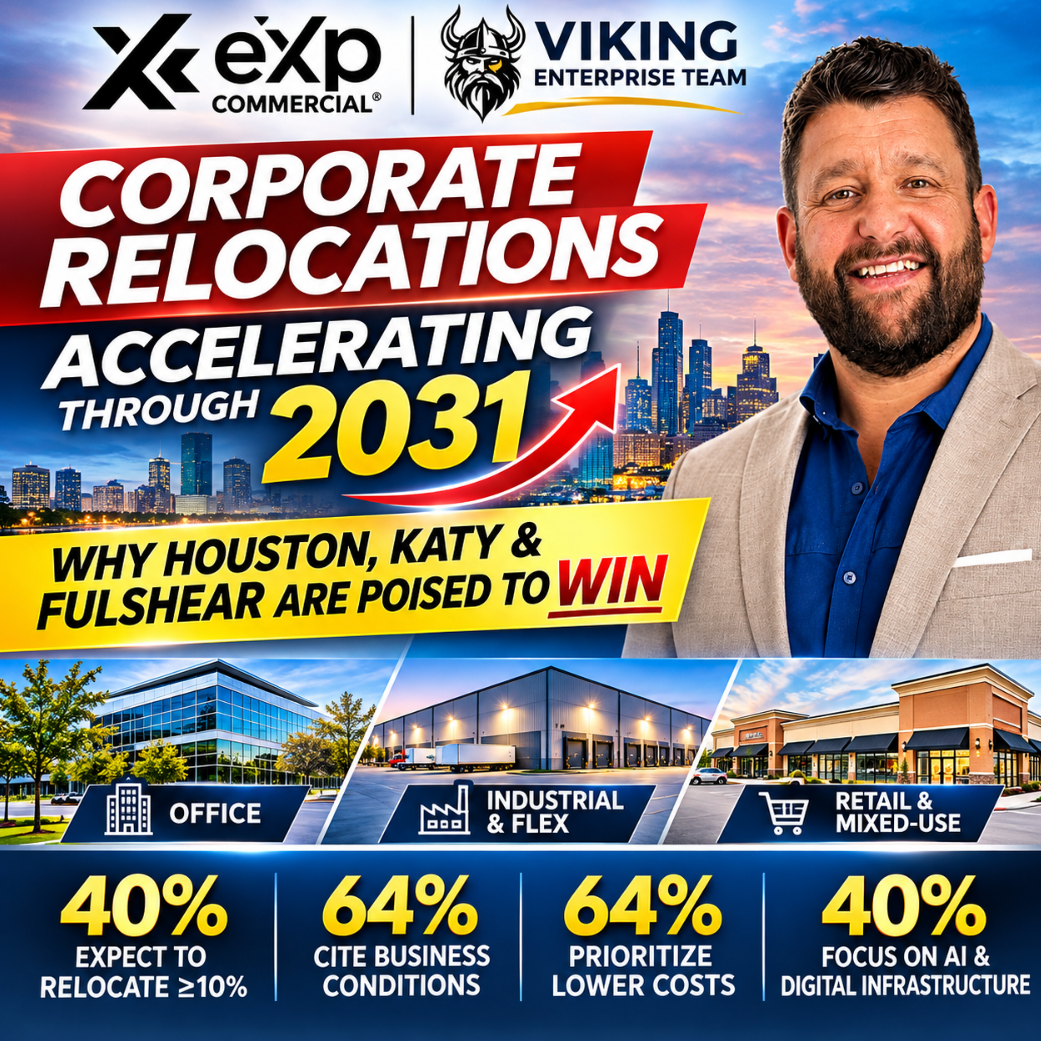
🏢 Corporate Relocations 2027–2031: Why Houston Wins 🚀
🏢 Corporate Relocations 2027–2031: Why Houston Wins 🚀
🚨 Corporate Relocation Boom: Katy & Fulshear Opportunities 🏙️
______________________________________________________________________________
Corporate Relocations Through 2031: Why Houston, Katy & Fulshear Could Win
Corporate America is preparing to rethink where it does business—and Houston, Katy, and Fulshear could be among the markets positioned to benefit.
A global corporate real estate survey conducted by Colliers and CoreNet Global suggests that significant portfolio repositioning may occur over the next three to five years.
According to the survey, 40% of corporate real estate professionals expect to relocate at least 10% of their organizations' real estate portfolios, while 14% anticipate relocating more than 20%.
These expectations could translate into meaningful opportunities for commercial real estate investors, corporate occupiers, property owners, developers, and commercial brokers.
But the real story goes beyond companies simply moving offices.
Corporate relocation decisions increasingly involve operating expenses, workforce access, energy reliability, technology infrastructure, and long-term flexibility.
For Houston and the rapidly developing communities of Katy and Fulshear, those priorities create an interesting commercial real estate opportunity.
Corporate Real Estate Relocation Trends: What the Numbers Reveal
The Colliers and CoreNet Global survey identifies several factors influencing corporate location strategies:
·40% expect to relocate at least 10% of their corporate real estate portfolios.
·64% identify business conditions as a major factor influencing location decisions.
·64% prioritize reducing real estate operating costs.
·40% identify artificial intelligence and digital infrastructure as important considerations.
·61% emphasize workforce talent quality.
·60% prioritize workforce accessibility and commuting convenience.
These findings suggest that corporate real estate decisions are becoming more strategic and increasingly connected to company-wide financial and operational performance.
Importantly, the survey reflects expectations from more than 140 global respondents. It does not establish that these relocations will occur or that Houston will capture a specific share.
Nevertheless, it provides valuable insight into the criteria companies may use when evaluating future locations.
Why Houston Could Benefit From Corporate Relocations
Houston offers a combination of characteristics that may appeal to companies considering expansion, consolidation, or relocation.
1. Competitive Business Environment
Texas has long attracted attention from businesses evaluating their operating environments.
Houston offers access to a large metropolitan economy, established business networks, transportation infrastructure, and multiple industry clusters.
Texas also has no individual state income tax, although businesses must evaluate franchise taxes, property taxes, insurance expenses, labor costs, and other obligations when comparing locations.
For corporate occupiers, the relevant question is not simply which market offers the lowest rent.
It is which location delivers the strongest combination of total occupancy cost, workforce access, operational efficiency, and long-term growth potential.
2. Houston's Industrial and Logistics Infrastructure
Houston benefits from major transportation assets, including:
·Interstate 10 and Interstate 45
·Interstate 69 and US Highway 290
·Grand Parkway and Beltway 8
·George Bush Intercontinental Airport
·William P. Hobby Airport
·Port Houston and its associated logistics network
These transportation connections support manufacturing, distribution, energy services, construction, logistics, and other industrial operations.
Companies relocating distribution facilities or regional operations may evaluate Houston because of its connections to domestic and international markets.
For investors, these trends could support demand for industrial warehouses, small-bay flex buildings, and outdoor storage properties in appropriate submarkets.
3. Corporate Access to Skilled Labor
Workforce availability is becoming an increasingly important factor in corporate real estate decisions.
Houston's diverse employment base includes energy, healthcare, engineering, construction, logistics, professional services, and technology.
Companies considering relocation must evaluate both the available labor pool and employees' ability to commute efficiently.
This is particularly relevant to suburban employment centers where residential growth and commercial development intersect.
Why Katy Is Positioned for Corporate Real Estate Growth
Katy occupies a strategic location along the Interstate 10 corridor west of Houston.
The area benefits from access to the Energy Corridor, Grand Parkway, established residential communities, and a growing concentration of retail, medical, and professional services.
Several property categories could benefit from corporate relocation activity.
Suburban Office and Medical Office
Companies reevaluating traditional office footprints may consider suburban locations that reduce commuting burdens for employees.
Katy could appeal to businesses seeking regional offices, professional service locations, medical offices, or satellite operations.
Modern buildings offering flexible floor plans, adequate parking, reliable connectivity, and competitive occupancy expenses may be better positioned than obsolete office properties.
Industrial and Flex Properties
The Katy, Brookshire, and West Houston industrial corridors offer opportunities for businesses requiring warehouse, service, manufacturing, and distribution space.
Small-bay industrial and flex buildings can be particularly relevant to contractors, equipment suppliers, specialty distributors, and service businesses.
Properties with appropriate electrical capacity, loading configurations, clear heights, truck circulation, and outdoor storage may have competitive advantages.
Retail and Supporting Services
When employment centers expand, surrounding retail and service demand can change.
Restaurants, childcare facilities, fitness centers, medical providers, and convenience-oriented retailers may benefit from increased daytime employment.
However, actual demand depends on the number of workers, occupancy patterns, household growth, and local competition.
Why Fulshear Could Capture the Next Wave of Commercial Development
Fulshear represents a different type of opportunity.
While Katy has an established commercial base, Fulshear is experiencing residential expansion and continued infrastructure development.
This creates potential opportunities for businesses looking to establish operations closer to growing suburban communities.
Emerging Retail and Service Demand
Residential growth can support demand for:
·Neighborhood retail centers
·Medical and dental offices
·Professional service businesses
·Childcare and educational facilities
·Restaurants and personal services
·Smaller office and flex facilities
Corporate and regional businesses evaluating Fulshear will need to consider the maturity of local infrastructure, available labor, traffic patterns, and household purchasing power.
Build-to-Suit Opportunities
Some relocating businesses require facilities that existing buildings cannot accommodate.
Build-to-suit commercial development may provide a solution.
Developers can potentially design facilities around specific tenant requirements, including building configuration, technology infrastructure, parking, loading, electrical capacity, and expansion options.
For landowners and developers, understanding prospective occupier requirements early can help determine which sites are most suitable for future commercial development.
Strategic Transportation Access
Grand Parkway, FM 1093, FM 1463, and connections toward the Westpark Tollway and Interstate 10 influence how businesses evaluate accessibility in the greater Katy-Fulshear area.
However, infrastructure availability varies significantly by site.
Investors and developers should verify road access, utilities, drainage, entitlement requirements, and development costs before assuming a property can support a corporate user.
Five Commercial Real Estate Sectors That Could Benefit
1. Industrial and Small-Bay Flex
Corporate relocations involving service companies, logistics providers, light manufacturers, and regional distributors could generate demand for industrial properties.
Modern facilities with functional loading, appropriate power capacity, and efficient access may command greater attention.
2. Suburban Office
Corporate occupiers may relocate from older office properties into more efficient buildings closer to employees.
This does not necessarily mean total office demand will increase.
Some companies may reduce their overall footprints while improving the quality of the space they retain.
3. Medical Office
Growing suburban populations and employment centers can create opportunities for healthcare providers.
Medical office buildings, outpatient clinics, dental practices, and specialty healthcare facilities may benefit where demographic demand supports expansion.
4. Retail and Mixed-Use
New employment concentrations can influence consumer spending patterns.
Retail investors should evaluate daytime population, residential demographics, traffic counts, tenant demand, and competing inventory.
5. Investment Sales and Sale-Leasebacks
Corporate portfolio restructuring can create opportunities beyond traditional leasing.
Businesses may decide to sell owned real estate, consolidate locations, execute sale-leasebacks, or acquire more strategically positioned properties.
These transactions can create opportunities for investors seeking income-producing commercial assets.
What Corporate Relocation Means for Commercial Property Owners
Owners should begin evaluating how their properties compare with the requirements of modern corporate occupiers.
Four considerations deserve particular attention.
Operating efficiency: Understand total occupancy costs, including rent, property taxes, insurance, utilities, maintenance, and common-area expenses.
Infrastructure readiness: Evaluate electrical capacity, broadband connectivity, HVAC performance, loading access, and potential improvement costs.
Workforce accessibility: Consider commuting patterns, nearby housing, parking availability, and access to major transportation routes.
Lease flexibility: Determine whether a property can accommodate expansion, contraction, phased occupancy, or tenant improvements.
A property that performs well in these categories may be better positioned to compete for relocation-driven demand.
A Practical Example: Corporate Relocation to West Houston
Consider a hypothetical regional service company evaluating a move from an older 30,000-square-foot facility into a more efficient 24,000-square-foot flex property near the Katy-Brookshire corridor.
Assume its existing occupancy expense is $24 per square foot annually, while the proposed facility costs $20 per square foot annually on a comparable all-in basis.
Existing annual occupancy cost:
30,000 SF × $24 = $720,000
Proposed annual occupancy cost:
24,000 SF × $20 = $480,000
Potential annual occupancy savings: $240,000.
Over five years, that represents $1.2 million in gross occupancy savings before relocation costs, tenant improvements, rent escalations, operational changes, and other expenses.
For the company, the transaction could improve operating efficiency.
For the property owner, it could create a significant leasing opportunity.
For a developer, it could demonstrate demand for appropriately designed flex space.
And for the commercial broker, understanding both the real estate and financing implications could help produce a more effective transaction strategy.
This example is illustrative and does not represent an actual relocation or a forecast of available market rents.
Corporate Relocation Outlook: 2027–2031
The next five years could create meaningful commercial real estate opportunities as corporations reconsider how their properties support business strategy.
Houston may benefit from its diversified economy and infrastructure.
Katy may benefit from its established employment corridors, industrial properties, and suburban accessibility.
Fulshear may benefit from residential expansion, developing commercial districts, and opportunities for appropriately planned new construction.
But opportunities will not be distributed equally.
Properties with competitive operating costs, modern infrastructure, convenient locations, and flexible configurations may outperform less functional alternatives.
Likewise, developers should avoid assuming that anticipated corporate relocations automatically justify speculative construction.
Actual tenant demand, infrastructure capacity, financing feasibility, and absorption conditions remain essential.
The Bottom Line: Position Your Property Before Demand Arrives
Corporate real estate relocation is increasingly about optimizing business performance—not simply changing addresses.
For commercial property owners, investors, and developers throughout Houston, Katy, and Fulshear, understanding these changing requirements can help identify opportunities before competitors do.
Whether you're evaluating a corporate relocation, repositioning an investment property, purchasing a commercial building, or developing a build-to-suit project, a well-informed real estate strategy matters.
Work With Bill Rapp, CCIM — eXp Commercial
I help business owners, investors, developers, and commercial property owners evaluate real estate opportunities throughout Houston, Katy, Fulshear, and surrounding Texas markets.
My approach combines commercial brokerage expertise with an understanding of commercial real estate financing and investment analysis.
Bill Rapp, CCIM
eXp Commercial — Viking Enterprise Team
📍 Serving Katy | Fulshear | Richmond | Brookshire | West Houston | Greater Houston
📧 [email protected]
☎️ 281-222-0433
🌐 HoustonRealEstateBrokerage.com
📍 eXp Commercial & eXp Realty
📅 Calendly.com/VikingEnterprise
https://www.houstonrealestatebrokerage.com/
https://www.houstonrealestatebrokerage.com/houston-cre-navigator
https://www.commercialexchange.com/agent/653bf5593e3a3e1dcec275a6
http://expressoffers.com/[email protected]
https://app.bullpenre.com/profile/1742476177701x437444415125976000
https://author.billrapponline.com/
https://www.amazon.com/dp/B0F32Z5BH2
https://veed.cello.so/FOmzTty6oi9
https://buymeacoffee.com/vikingente3
https://creplaybookseries.billrapponline.com
https://creplaybook.billrapponline.com/
© Bill Rapp, Broker Associate, eXp Commercial Viking Enterprise Team


