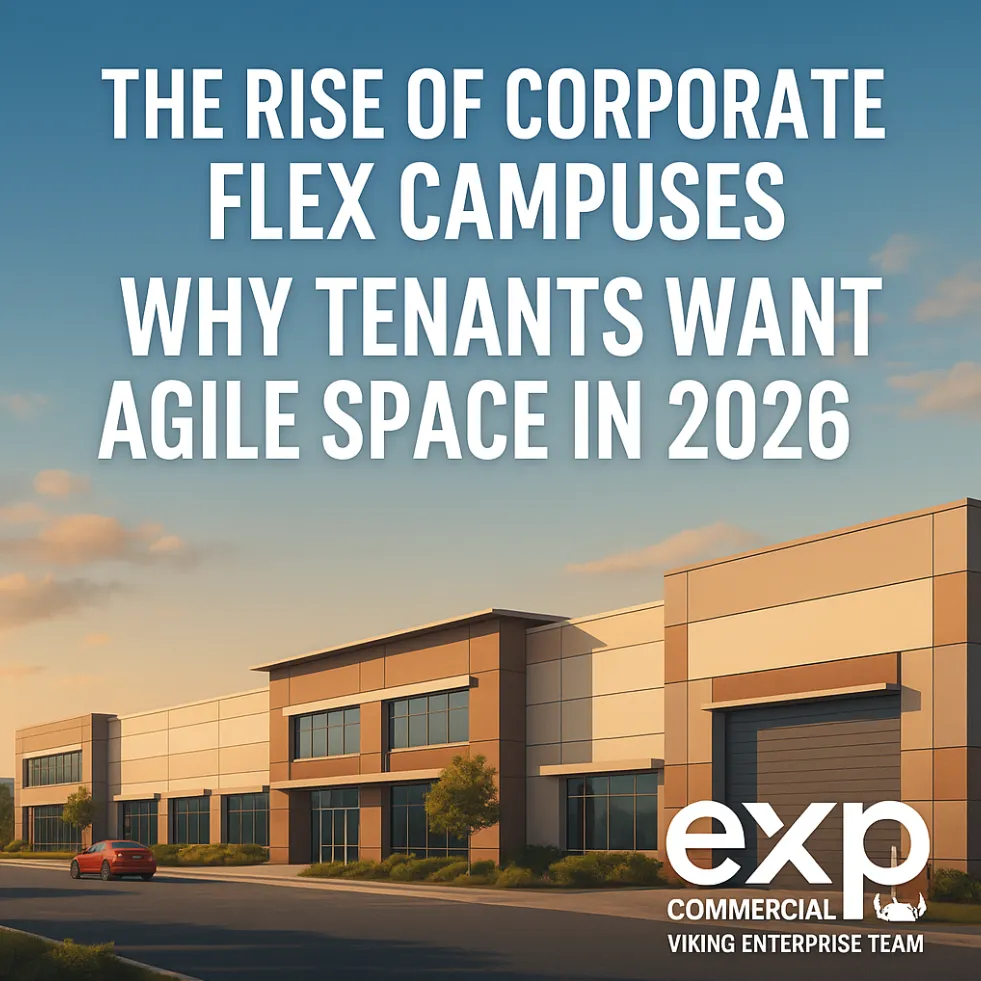
💼 The Rise of Corporate Flex Campuses: Why Agile Space Is the Future of CRE in 2026 🚀
💼 The Rise of Corporate Flex Campuses: Why Agile Space Is the Future of CRE in 2026 🚀
🏢 Why Flexible Corporate Campuses Are Taking Over Houston CRE in 2026 📈
The Rise of Corporate Flex Campuses: Why Tenants Want Agile Space in 2026
Corporate real estate demand is shifting fast, and one trend continues to accelerate across Houston, Katy, and Fulshear: the rise of flexible corporate campuses. As companies rethink their workplace strategy for efficiency, culture, and cost control, flex campuses have emerged as the preferred solution for 2026 expansion plans.
In markets where industrial, office, and R&D users are all competing for strategically located space, flex campuses create what traditional office buildings cannot—agility.
What Is a Corporate Flex Campus?
A corporate flex campus is a multi-building or multi-bay commercial environment where tenants can combine:
• Office
• Light industrial
• R&D or lab
• Training space
• Warehouse or logistics functions
Rather than locking into a large single-use office building, tenants design a modular footprint that scales with staffing, equipment needs, and production cycles.
For emerging industries—AI, robotics, medical technology, manufacturing, e-commerce, and healthcare—this flexibility is no longer optional.
Why Flex Campuses Are Exploding in Demand in 2026
1. Tenants Need Expansion Flexibility Without Breaking the Bank
Traditional office leases often require long-term commitments with rigid configurations. Flex campuses allow tenants to:
• Expand into adjacent bays
• Add warehouse or production space
• Scale back office footprint when remote work shifts
• Avoid expensive tenant improvements
For CFOs and operations executives, this reduces long-term liabilities and improves balance-sheet efficiency.
2. Hybrid Work Created a “Right-Sizing” Revolution
Companies aren’t abandoning offices—they’re right-sizing, redistributing square footage away from oversized administrative office space and toward:
• Collaboration rooms
• Engineering labs
• Training facilities
• Production or assembly areas
Flex campuses support hybrid operations far more effectively than legacy office towers.
3. Industrial & Logistics Growth Is Driving Campus Demand
Houston’s industrial sector remains one of the strongest in the country. Local drivers include:
• E-commerce distribution
• Manufacturing tied to CHIPS Act projects
• AI hardware production
• Medical device and life-sciences expansions
• Katy/Fulshear industrial absorption along I-10, FM 1463, and the Grand Parkway
Corporate users want industrial performance + office functionality on the same property—exactly what flex campuses deliver.
4. Faster Time-to-Occupancy
Speed matters more than ever. Flex campuses offer:
• Move-in ready spaces
• Existing grade-level and dock-high loading
• Configurable power and ventilation
• Pre-built office suites
This “plug-and-play” model appeals to rapidly scaling tenants.
5. Campus Environments Strengthen Recruitment & Culture
A surprising driver behind flex campus demand: talent attraction.
Companies want:
• Modern office finishes
• Outdoor spaces
• Onsite amenities
• Walkable campus layouts
• Branding opportunities on facades
Flex campuses overcome the sterile feel of traditional industrial parks while keeping costs well below Class A office.
Where This Trend Is Growing in Houston
1. Katy & Fulshear
• High-income demographics
• Elite schools attracting medical/tech employers
• Major industrial growth along I-10
• Master-planned land for campus-style developments
2. West Houston / Energy Corridor
• Vacant office redevelopments
• Large corporate users downsizing into flex environments
3. North Houston / Spring / The Woodlands
• Tech, biotech, and engineering firms pursuing hybrid industrial-office setups
Investors and developers in these regions are already capitalizing on the shift by building low-rise, multi-bay campuses designed for flexibility from day one.
The Investment Case for Flex Campuses in 2026
For investors, flex campuses offer:
• Lower construction cost vs. office
• Broad tenant universe
• Sticky tenants—expansion reduces turnover
• Strong rent growth in industrial-heavy markets
• Higher yields vs. standalone office or single-tenant NNN
As financing becomes more favorable, lenders increasingly prefer multi-tenant, diversified, flex industrial assets due to lower vacancy risk.
Bottom Line
Corporate flex campuses are no longer a niche product. They are becoming the default growth format for companies that demand adaptability in a rapidly changing economy.
For owners, developers, and tenants across Houston, Katy, and Fulshear, the next decade will belong to properties that offer modular, scalable, hybrid-use solutions. Flex campuses deliver exactly that.
https://www.houstonrealestatebrokerage.com/
https://www.houstonrealestatebrokerage.com/houston-cre-navigator
https://www.commercialexchange.com/agent/653bf5593e3a3e1dcec275a6
http://expressoffers.com/[email protected]
https://app.bullpenre.com/profile/1742476177701x437444415125976000
https://author.billrapponline.com/
https://www.amazon.com/dp/B0F32Z5BH2
https://veed.cello.so/FOmzTty6oi9
https://creplaybookseries.billrapponline.com
https://creplaybook.billrapponline.com/
© 2023-2024 Bill Rapp, Broker Associate, eXp Commercial Viking Enterprise Team


