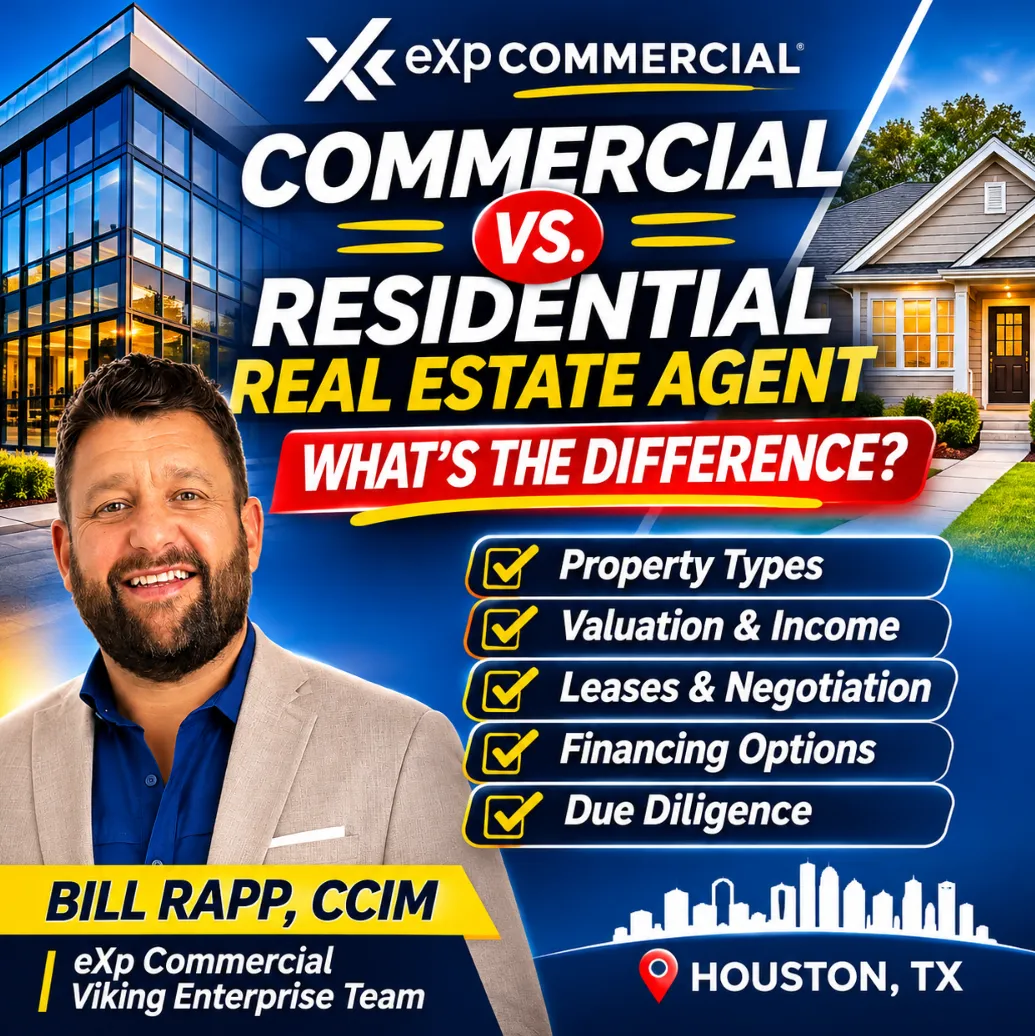
🏢 Commercial vs. Residential Real Estate Agents: Key Differences 🔑
🏢 Commercial vs. Residential Real Estate Agents: Key Differences 🔑
🏠 Commercial Real Estate Agent vs. Residential Agent: Who Do You Need? 🏢
_____________________________________________________________________________
Commercial Real Estate Agent vs. Residential Agent: What's the Difference?
When buying a house, you typically call a residential real estate agent. But what happens when you're buying a warehouse, leasing a retail storefront, purchasing an office building, or investing in a shopping center?
That's where a commercial real estate agent comes in.
Although commercial and residential agents both help clients buy, sell, and lease real estate, their responsibilities, analytical methods, transaction structures, and areas of expertise can be dramatically different.
For business owners and investors in Katy, Fulshear, Houston, and throughout Texas, understanding these differences can help protect your capital and improve your real estate decisions.
Let's explore what separates commercial real estate brokerage from residential real estate brokerage—and why choosing the right professional matters.
What Does a Residential Real Estate Agent Do?
A residential real estate agent primarily represents buyers, sellers, landlords, and tenants in transactions involving homes and other residential properties.
Common residential property types include single-family homes, condominiums, townhomes, and residential investment properties.
Residential agents generally focus on:
·Comparable home sales and market pricing.
·Property condition, location, and neighborhood amenities.
·Home inspections, appraisals, and negotiations.
·Mortgage preapproval and buyer financing.
·Marketing homes and coordinating closings.
Residential buyers frequently evaluate properties based on lifestyle considerations, including schools, commute times, floor plans, neighborhood amenities, and affordability.
For example, a family purchasing a $500,000 home in Katy may prioritize bedroom count, school zoning, and monthly mortgage payments.
These considerations are important, but commercial real estate transactions typically require an additional layer of financial analysis.
What Does a Commercial Real Estate Agent Do?
A commercial real estate agent specializes in properties used for business operations, income generation, or development.
Common commercial property types include:
·Retail shopping centers and standalone retail buildings.
·Industrial warehouses and small-bay flex properties.
·Office buildings and medical office facilities.
·Multifamily apartment communities.
·Commercial land and development sites.
·Restaurants, hotels, and self-storage facilities.
·Investment properties with commercial leases.
Commercial agents frequently work with investors, business owners, developers, landlords, tenants, and institutional buyers.
Rather than focusing primarily on a property's residential appeal, commercial brokerage places significant emphasis on income, operating expenses, financing, tenant creditworthiness, market demand, and investment returns.
For example, a commercial real estate investor purchasing a $2.5 million retail center needs to understand more than the property's location and physical condition.
The investor must evaluate rental income, operating expenses, lease expirations, tenant financial strength, capitalization rates, and financing requirements.
That's where specialized commercial brokerage expertise becomes particularly valuable.
Commercial vs. Residential Real Estate Agents: 7 Key Differences
Category | Residential agent | Commercial agent |
Primary clients | Homebuyers and homeowners | Investors, businesses, developers |
Property focus | Homes and residential units | Income-producing and business properties |
Valuation | Comparable sales | NOI, cap rates, comps, cash flow |
Financing | Conventional, FHA, VA, jumbo | SBA, bank, DSCR, bridge, agency |
Leases | Residential rental agreements | NNN, gross, modified gross |
Due diligence | Inspections, title, appraisal | Leases, financials, environmental, zoning |
Decision criteria | Lifestyle and affordability | Investment returns and operational needs |
These are typical differences, not absolute boundaries. Experienced residential agents may work with investors, and some brokers practice in both markets.
Difference #1: Commercial Property Valuation Is More Financially Driven
One of the biggest differences between commercial and residential real estate is how properties are valued.
Residential agents frequently use comparable sales to estimate market value.
Commercial agents may also use comparable sales, but income-producing commercial properties often require an income-based valuation.
A commonly used formula is:
\[ \text{Property Value}=\frac{\text{Net Operating Income}}{\text{Cap Rate}} \]
Imagine a retail property generating $180,000 in annual net operating income (NOI).
At a 7.5% capitalization rate:
\[ \$180,000 \div 0.075=\$2,400,000 \]
The indicated value is approximately $2.4 million.
However, if market conditions or property risks require an 8.5% cap rate:
\[ \$180,000 \div 0.085\approx \$2,117,647 \]
Illustrative valuation sensitivity
Illustrative valuation of a retail property with $180,000 NOI at two capitalization rates.
$0$650K$1.3M$2M$2.6M7.5% cap8.5% cap
Illustration only. Actual values depend on market evidence, lease quality, asset condition, and other underwriting assumptions.
That's approximately a $282,000 valuation difference on the same income stream.
Understanding capitalization rates, NOI, and market risk is essential when negotiating commercial investment properties.
Difference #2: Commercial Financing Is More Complex
Residential financing generally focuses on the borrower's income, credit, assets, debt-to-income ratio, and property appraisal.
Commercial financing often involves additional underwriting factors:
·Debt service coverage ratio (DSCR).
·Property cash flow and occupancy.
·Loan-to-value ratio (LTV).
·Tenant leases and creditworthiness.
·Business operating history.
·Borrower liquidity and guarantor strength.
·Loan maturity, amortization, and prepayment provisions.
Commercial financing options can include conventional bank loans, SBA 7(a) and 504 loans, bridge loans, commercial DSCR loans, and agency multifamily financing.
Consider a dentist purchasing an office building for $1.5 million.
The right financing strategy could depend on whether the dentist will occupy the property, how much space the practice uses, and whether the property meets SBA eligibility requirements.
A commercial agent who understands lending can help buyers evaluate financing feasibility before committing significant time and money to a transaction.
Difference #3: Commercial Leases Require Specialized Negotiation
Residential leases typically address rent, deposits, maintenance responsibilities, and lease duration.
Commercial leases may involve substantially more complicated economic terms.
Common commercial lease structures include:
Triple Net (NNN): Tenants pay base rent plus their allocated share of property taxes, insurance, and certain operating expenses.
Full-Service Gross: Rent generally includes specified operating expenses, subject to the lease's exclusions and expense provisions.
Modified Gross: The landlord and tenant divide expenses according to negotiated terms.
Other important provisions include tenant improvement allowances, rent escalations, renewal options, assignment rights, permitted use, exclusivity, and personal guarantees.
For a business owner leasing 5,000 square feet, misunderstanding operating expense pass-throughs or tenant improvement obligations could create substantial unanticipated costs.
Difference #4: Commercial Due Diligence Goes Beyond the Building Inspection
Commercial buyers must evaluate both the physical property and its economic performance.
Typical commercial due diligence may include reviewing:
·Rent rolls and executed leases.
·Historical operating statements.
·Property tax assessments.
·Tenant payment histories.
·Environmental Site Assessments.
·Zoning and permitted uses.
·Surveys, title commitments, and easements.
·Roof, HVAC, structural, and mechanical systems.
·Capital expenditure requirements.
For example, a warehouse may appear attractive until a Phase I Environmental Site Assessment identifies a recognized environmental condition requiring further investigation.
Or a retail center may be fully occupied today but have several major leases expiring within 12 months.
These risks can materially affect financing, valuation, and the investor's projected return.
Difference #5: Commercial Transactions Often Take Longer
Residential transactions can often close in approximately 30–45 days after contract execution, although timing varies.
Commercial transactions may require 60–120 days or longer depending on property complexity, lender requirements, due diligence, and negotiations.
Some commercial development transactions take many months.
A commercial broker must coordinate not only the buyer and seller but potentially lenders, attorneys, surveyors, environmental consultants, inspectors, engineers, and title professionals.
Difference #6: Commercial Agents Work With Different Decision-Makers
Residential real estate often involves individuals or families making personal housing decisions.
Commercial transactions may involve several stakeholders.
A business owner buying an office building might consult a CPA, attorney, lender, business partner, and financial advisor before making a final decision.
An institutional investor might require investment committee approval and extensive underwriting.
Commercial agents need to communicate effectively with these stakeholders and understand the financial objectives driving the transaction.
Difference #7: Commercial Real Estate Requires a Different Marketing Strategy
Residential marketing often relies on photography, virtual tours, open houses, and consumer-facing listing platforms.
Commercial marketing frequently includes offering memorandums, financial summaries, lease abstracts, investor outreach, broker networks, demographic analysis, and specialized listing platforms.
For example, marketing a retail center requires more than attractive exterior photography.
Investors want to know the property's NOI, capitalization rate, tenant mix, lease terms, and potential value-add opportunities.
Marketing must speak to the investor's financial objectives.
Can a Residential Agent Sell Commercial Real Estate in Texas?
Yes. In Texas, there is not a separate commercial real estate salesperson license.
A properly licensed Texas real estate sales agent can generally participate in commercial transactions while acting under the sponsorship and supervision of a licensed broker.
However, legal authorization does not automatically establish commercial brokerage competency.
Texas real estate professionals must comply with applicable licensing, brokerage, competency, and disclosure requirements.
A residential agent handling a commercial transaction should have the necessary knowledge or obtain appropriate assistance and supervision.
For consumers, the important question is not simply whether an agent can legally handle the transaction.
It is whether the agent has the relevant experience, analytical capabilities, and professional network to represent the client's interests effectively.
Real-World Example: Buying a $2.5 Million Retail Center
Imagine an investor evaluating a neighborhood retail center in Katy, Texas.
Hypothetical investment scenario
Purchase price
$2.5M
Annual NOI
$175K
Going-in cap rate
7.0%
Occupancy
100%
At first glance, the property appears stable.
But further analysis reveals that two tenants representing 40% of rental income have leases expiring within 18 months.
A commercial real estate broker would investigate tenant renewal probability, market rents, replacement tenant demand, leasing commissions, and potential vacancy costs.
The broker would also evaluate financing assumptions, debt service coverage, and potential capital expenditures.
This additional analysis might lead to a lower purchase offer, revised financing terms, or additional protections during due diligence.
The objective is not simply to complete a transaction. It is to help the investor make an informed investment decision.
Should You Hire a Commercial or Residential Real Estate Agent?
The answer depends on your property and transaction objectives.
If you're purchasing or selling a home, a qualified residential agent is generally the appropriate choice.
If you're acquiring an industrial warehouse, leasing retail space, buying an office building, or purchasing an income-producing commercial property, a commercial specialist is generally better positioned to assist.
When interviewing a commercial agent, ask about their experience with your asset type, local market knowledge, valuation process, leasing expertise, financing relationships, and due diligence approach.
Also ask whether they primarily represent investors, landlords, tenants, or owner-occupants.
The right specialization can make a significant difference.
Why Work With Bill Rapp, CCIM, and eXp Commercial?
Commercial real estate decisions require more than access to listings.
They require market knowledge, investment analysis, negotiation skills, and an understanding of how financing affects a transaction.
I'm Bill Rapp, CCIM, Team Lead of the Viking Enterprise Team at eXp Commercial.
I work with commercial real estate investors, property owners, business owners, and developers throughout Katy, Fulshear, West Houston, and the greater Houston market.
My approach combines commercial brokerage expertise with capital advisory knowledge to help clients evaluate acquisitions, dispositions, leasing opportunities, and financing strategies.
Whether you're buying your first commercial property, expanding your business, or repositioning an investment portfolio, my goal is to help you understand the numbers and make informed decisions.
Frequently Asked Questions
Is commercial real estate harder than residential real estate?
Commercial real estate generally involves more specialized financial analysis, lease negotiation, and due diligence. Both sectors require significant professional expertise.
Do commercial real estate agents make more money?
Commercial transactions can generate larger individual commissions, but income is highly variable. Deal cycles, transaction volume, brokerage splits, and expenses all influence earnings.
Can a residential Realtor help me buy a commercial building?
Potentially, provided the agent is properly licensed and competent to handle the transaction. For complex commercial transactions, specialized commercial experience is especially valuable.
Do I need a commercial agent to lease office space?
Not necessarily, but an experienced commercial tenant representative can help evaluate market rents, lease expenses, improvement allowances, and other negotiated provisions.
What is the CCIM designation?
The Certified Commercial Investment Member (CCIM) designation is a professional credential focused on commercial real estate investment analysis, market analysis, financial analysis, and related competencies.
Final Thoughts: Choose Expertise That Matches the Transaction
Residential and commercial real estate agents both play important roles in the property market.
But commercial real estate involves unique financial, operational, legal, and investment considerations.
If you're investing in a retail center, purchasing a warehouse, leasing medical office space, or developing commercial land, working with a qualified commercial real estate professional can help you better understand the risks and opportunities.
Ready to discuss your next commercial real estate transaction?
Contact Bill Rapp, CCIM, and the eXp Commercial Viking Enterprise Team.
Bill Rapp, CCIM
eXp Commercial — Viking Enterprise Team
📍 Serving Katy | Fulshear | Richmond | Brookshire | West Houston | Greater Houston
📧 [email protected]
☎️ 281-222-0433
🌐 HoustonRealEstateBrokerage.com
📍 eXp Commercial & eXp Realty
📅 Calendly.com/VikingEnterprise
https://www.houstonrealestatebrokerage.com/
https://www.houstonrealestatebrokerage.com/houston-cre-navigator
https://www.commercialexchange.com/agent/653bf5593e3a3e1dcec275a6
http://expressoffers.com/[email protected]
https://app.bullpenre.com/profile/1742476177701x437444415125976000
https://author.billrapponline.com/
https://www.amazon.com/dp/B0F32Z5BH2
https://veed.cello.so/FOmzTty6oi9
https://buymeacoffee.com/vikingente3
https://creplaybookseries.billrapponline.com
https://creplaybook.billrapponline.com/
© Bill Rapp, Broker Associate, eXp Commercial Viking Enterprise Team


