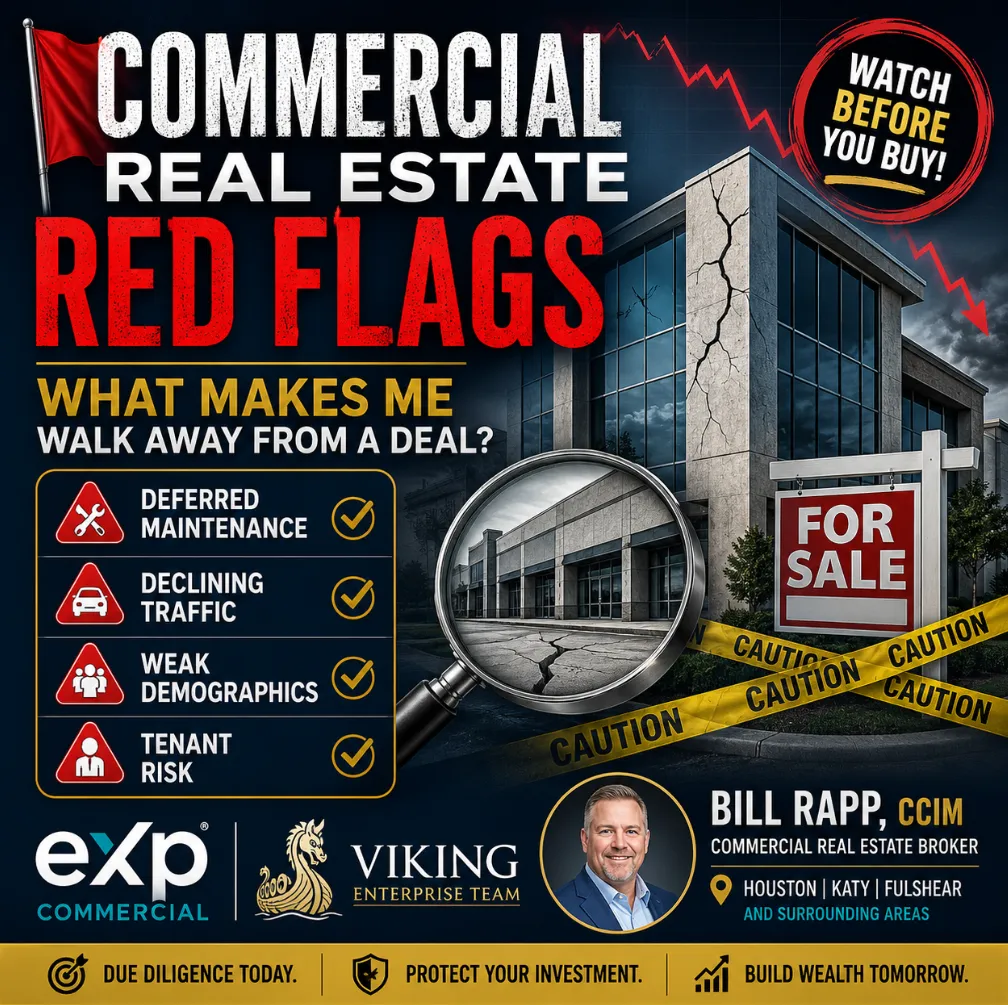
🚩 The Commercial Real Estate Red Flags Every Investor Should Watch For Before Buying 🏢
🚩 The Commercial Real Estate Red Flags Every Investor Should Watch For Before Buying 🏢
⚠️ Commercial Real Estate Due Diligence: The Warning Signs That Make Me Walk Away 📉
The Commercial Real Estate Red Flags I Look For Before Buying
Commercial real estate investing isn't just about finding great opportunities—it's about avoiding expensive mistakes.
Some properties look fantastic in an online listing, but once you start digging deeper, the warning signs become impossible to ignore. Over the years, I've learned that the biggest losses often come from buying a property with problems that could have been identified during proper due diligence.
Whether you're buying your first commercial property or adding to an investment portfolio, these are some of the biggest commercial real estate red flags I always evaluate before recommending a purchase.
1. Deferred Maintenance
This is one of the biggest warning signs.
A property that has been neglected for years usually costs far more than buyers initially expect.
Look for:
·Aging roofs
·HVAC systems nearing end of life
·Parking lot deterioration
·Foundation movement
·Water intrusion
·Old electrical systems
·Plumbing issues
·Damaged landscaping
·Poor curb appeal
Many sellers underestimate repair costs while buyers often underestimate them even more.
A building needing $500,000 in repairs isn't automatically a bad investment—but you need to buy it at the right price.
2. Declining Traffic Counts
Location still matters.
Retail, restaurants, medical offices, and many service businesses depend heavily on visibility and customer traffic.
Ask questions like:
·Has traffic increased or declined?
·Have road improvements redirected vehicles?
·Is nearby construction affecting access?
·Are major employers leaving the area?
A beautiful shopping center isn't valuable if fewer customers drive past every year.
3. Bad Demographics
Demographics drive commercial real estate demand.
I always evaluate:
·Population growth
·Household income
·Employment growth
·Business expansion
·Housing development
·Consumer spending
·Age distribution
If businesses are leaving an area while residents relocate elsewhere, long-term appreciation becomes much harder.
4. High Vacancy Nearby
One vacant building may simply be a management issue.
Multiple vacant buildings often indicate something larger.
Ask:
·Are nearby buildings also vacant?
·How long have spaces remained empty?
·Are landlords heavily discounting rents?
·Is there too much new supply?
Oversupply can keep rents flat for years.
5. Weak Tenant Quality
Commercial property value often depends more on tenants than buildings.
Consider:
·Credit quality
·Lease length
·Industry stability
·Rent payment history
·Tenant concentration
A fully occupied building isn't necessarily a safe investment if tenants are financially struggling.
6. Environmental Issues
Environmental problems can quickly derail a transaction.
Examples include:
·Underground storage tanks
·Prior gas stations
·Dry cleaners
·Chemical contamination
·Floodplain concerns
·Wetlands
·Hazardous materials
Always obtain the appropriate environmental reports before closing.
7. Unrealistic Financial Statements
If the numbers seem too good to be true…
They usually are.
Review:
·Rent rolls
·Operating expenses
·Maintenance history
·Utility bills
·Property taxes
·Insurance
·Capital expenditures
·Lease agreements
Verify every assumption.
8. Poor Access
Customers won't visit properties that are difficult to reach.
Watch for:
·Difficult left turns
·Limited visibility
·Poor signage
·Shared driveways
·Congestion
·Inadequate parking
Accessibility directly impacts tenant demand.
9. Deferred Capital Improvements
Many sellers postpone major projects before selling.
Examples include:
·Roof replacement
·Parking lot resurfacing
·Elevator modernization
·Fire suppression upgrades
·ADA compliance
These items can become significant expenses shortly after acquisition.
10. Buying Based on Emotion
This may be the biggest red flag of all.
Commercial real estate is an investment—not a trophy.
Successful investors focus on:
·Cash flow
·Risk
·Market fundamentals
·Tenant quality
·Exit strategy
·Financing
·Long-term appreciation
If the numbers don't work, don't force the deal.
Final Thoughts
Every commercial property has imperfections.
The goal isn't to find a perfect property—it's to understand the risks before closing.
Some red flags create opportunity when they're reflected in the purchase price.
Others should cause you to walk away entirely.
Working with an experienced commercial real estate advisor can help uncover issues before they become expensive surprises.
If you're evaluating a commercial property in Houston, Katy, Fulshear, or anywhere in Texas, I'd be happy to help you analyze the opportunity before you commit.
Discussion Question
What commercial real estate red flag would stop you from buying a property?
Leave your thoughts in the comments.
Connect With Viking Enterprise Team
📍 eXp Commercial & eXp Realty
📍 Houston | Katy | Fulshear | West Houston
📅 Calendly.com/VikingEnterprise
📞 281-222-0433
📞 Bill Rapp, CCIM
eXp Commercial | Viking Enterprise Team
Commercial Real Estate & Capital Advisory
🌐 https://houstonrealestatebrokerage.com
https://www.houstonrealestatebrokerage.com/
https://www.houstonrealestatebrokerage.com/houston-cre-navigator
https://www.commercialexchange.com/agent/653bf5593e3a3e1dcec275a6
http://expressoffers.com/[email protected]
https://app.bullpenre.com/profile/1742476177701x437444415125976000
https://author.billrapponline.com/
https://www.amazon.com/dp/B0F32Z5BH2
https://veed.cello.so/FOmzTty6oi9
https://buymeacoffee.com/vikingente3
https://creplaybookseries.billrapponline.com
https://creplaybook.billrapponline.com/
© Bill Rapp, Broker Associate, eXp Commercial Viking Enterprise Team


