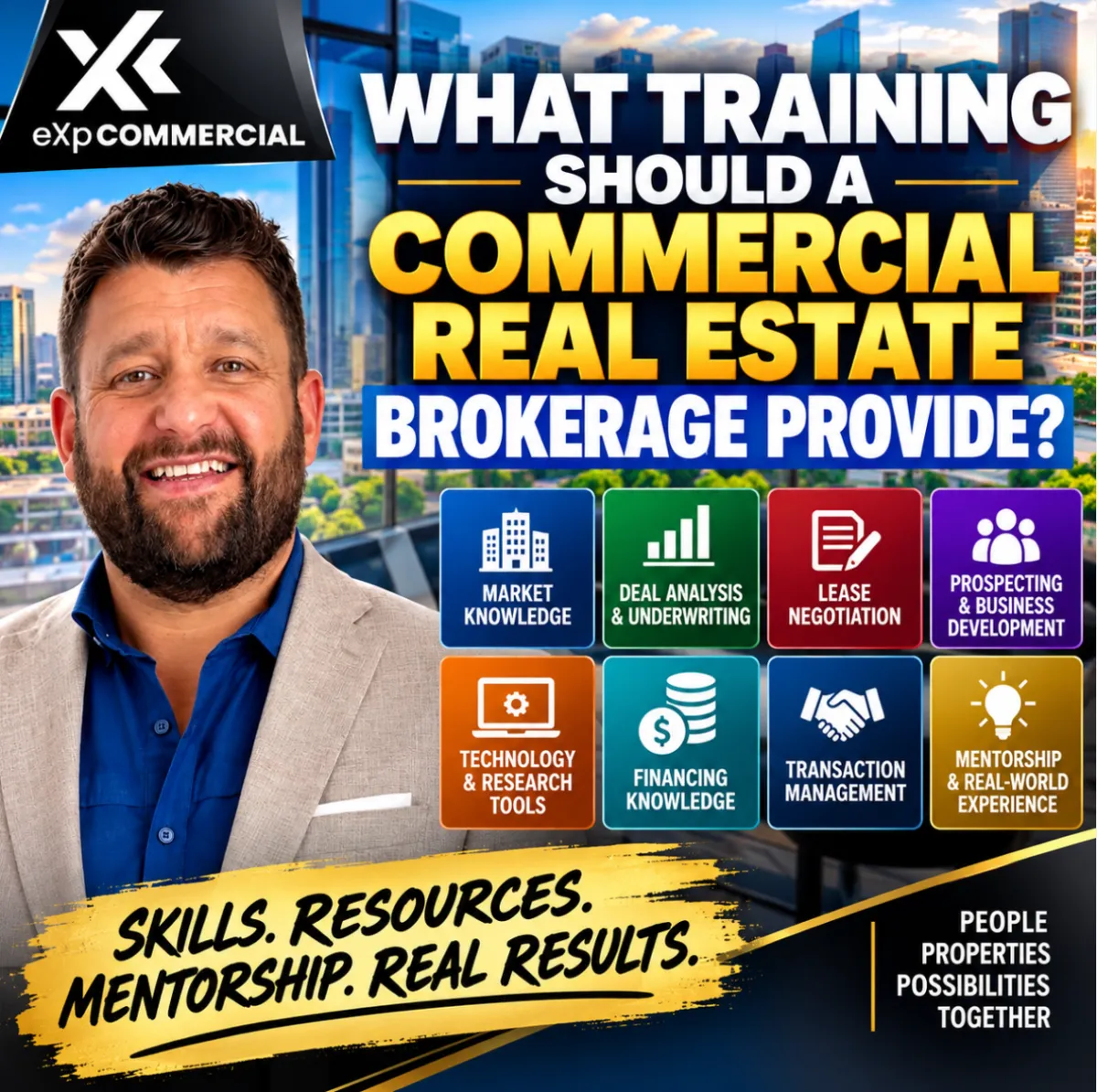
🏢 What Training Should a Commercial Real Estate Brokerage Provide? A Guide for CRE Agents 📈
🏢 What Training Should a Commercial Real Estate Brokerage Provide? A Guide for CRE Agents 📈
🎓 Commercial Real Estate Agent Training: 8 Skills Your Brokerage Should Help You Master 🏙️
What Training Should a Commercial Real Estate Brokerage Provide?
Getting a real estate license may allow you to practice commercial real estate, but it does not automatically teach you how to analyze an investment property, prospect for clients, negotiate a commercial lease, structure a transaction, understand financing, or build a sustainable book of business.
That is why commercial real estate agent training can be one of the most important factors an agent considers when evaluating a brokerage.
Commercial real estate is fundamentally different from residential brokerage. Transactions can involve sophisticated investors, business owners, developers, lenders, attorneys, CPAs, property managers, contractors, and institutional decision-makers. A commercial agent needs more than sales skills.
They need to understand the business and financial mechanics behind the real estate.
For agents considering a career in commercial real estate—or experienced agents looking for a stronger platform—here are eight areas where a commercial real estate brokerage should provide meaningful training and resources.
1. Commercial Real Estate Fundamentals
Training should begin with a strong foundation in the major commercial property types, including:
·Retail
·Office
·Industrial and flex
·Multifamily
·Land
·Medical office
·Owner-occupied properties
·Investment properties
Agents should understand how investors and users evaluate these assets differently.
A warehouse purchased by an owner-user, for example, requires a different analysis than a leased industrial property acquired primarily for its cash flow.
2. Financial Analysis and Underwriting
One of the biggest differences between residential and commercial brokerage is the importance of financial analysis.
Commercial agents should understand concepts such as net operating income (NOI), capitalization rates, cash-on-cash returns, internal rate of return, loan-to-value, debt service coverage ratio and debt yield.
Training should also teach agents how to analyze rent rolls, operating statements, leases, comparable properties and financing assumptions.
You do not have to become a Wall Street analyst to succeed in CRE. But you should be able to understand the numbers well enough to identify opportunities, recognize risks and communicate intelligently with investors and lenders.
3. Commercial Lease Analysis and Negotiation
Commercial leases can be substantially more complicated than residential leases.
Agents should understand:
·Base rent
·NNN expenses
·CAM charges
·Rent escalations
·Tenant improvement allowances
·Free rent
·Renewal options
·Personal guarantees
·Assignment and subletting
·Exclusive-use provisions
·Operating expense structures
Training should go beyond terminology and teach agents how these provisions affect the economics of a transaction.
4. Prospecting and Business Development
Knowing CRE without knowing how to generate business is not enough.
A strong commercial brokerage should help agents develop a repeatable prospecting system.
That can include cold and warm outreach, networking, referral partnerships, database development, social media, video marketing, email campaigns, geographic farming and relationship building.
Agents should also learn how to build referral relationships with commercial lenders, CPAs, attorneys, financial advisors, contractors, architects, property managers and other CRE professionals.
The objective is not simply to find the next transaction. It is to build a network that can generate opportunities repeatedly.
5. Technology and CRE Research Tools
Modern commercial real estate is increasingly data driven.
Agents should receive training on the research, transaction and marketing tools available through their brokerage.
Depending on the platform, those resources can help agents research properties, analyze comparable transactions, identify ownership, monitor listings, market properties and manage transactions.
Technology does not replace brokerage expertise. Used effectively, it makes that expertise more scalable.
6. Commercial Real Estate Financing
Financing can determine whether a commercial transaction actually closes.
Agents should understand basic lending concepts such as:
·Conventional commercial loans
·SBA 7(a) and SBA 504 financing
·Bridge loans
·DSCR lending
·Construction financing
·Multifamily financing
·Recourse versus non-recourse debt
·Fixed versus floating rates
·Prepayment structures
Understanding financing can also help an agent identify problems earlier.
A property may look attractive at a particular purchase price, but if the property's NOI cannot support sufficient debt proceeds, the transaction may require substantially more equity than the buyer anticipated.
That is something an effective commercial broker should recognize before the transaction reaches the closing table.
7. Negotiation and Transaction Management
Commercial transactions rarely move in a perfectly straight line.
Agents need training in letters of intent, purchase agreements, due diligence, inspections, financing contingencies, environmental reports, title issues, surveys, appraisals and closing coordination.
They also need to understand how to negotiate without unnecessarily damaging relationships.
The objective is not simply to "win" every point. The objective is to structure a transaction that can realistically get completed while protecting the client's interests.
8. Mentorship and Real-World Deal Experience
Training courses are valuable, but commercial real estate is ultimately learned through transactions.
Newer agents benefit from working alongside experienced professionals who can explain why a deal is being structured a particular way, review underwriting, participate in strategy discussions and help identify problems before they become expensive mistakes.
That combination of education, mentorship and real-world application can significantly accelerate an agent's development.
What Should You Ask Before Joining a Commercial Brokerage?
If you are evaluating commercial real estate brokerages, do not look only at commission splits.
Ask what resources exist to help you actually build your business.
What training is provided? Who can help when you encounter an unfamiliar transaction? What technology is available? How are agents taught to prospect? Is there underwriting support? Are financing resources available? Is there meaningful mentorship?
A high commission split has limited value if you are not developing the skills and pipeline necessary to close transactions.
Building a Career in Commercial Real Estate
Successful commercial real estate agents gradually become more than salespeople.
They become advisors who understand properties, businesses, investments, financing and negotiations.
That takes time—and it requires continuous education.
At eXp Commercial – Viking Enterprise Team, our focus is on helping commercial real estate professionals strengthen the practical skills necessary to develop business, analyze opportunities, serve clients and navigate transactions.
If you are considering a career in commercial real estate or looking for a brokerage environment where you can continue developing your CRE skill set, I would be happy to have a conversation.
Bill Rapp, CCIM
eXp Commercial – Viking Enterprise Team
Commercial Real Estate Brokerage | Houston, Katy & West Houston
Connect With Viking Enterprise Team
📍 eXp Commercial & eXp Realty
📍 Houston | Katy | Fulshear | West Houston
📅 Calendly.com/VikingEnterprise
📞 281-222-0433
📞 Bill Rapp, CCIM
eXp Commercial | Viking Enterprise Team
Commercial Real Estate & Capital Advisory
🌐 https://houstonrealestatebrokerage.com
https://www.houstonrealestatebrokerage.com/
https://www.houstonrealestatebrokerage.com/houston-cre-navigator
https://www.commercialexchange.com/agent/653bf5593e3a3e1dcec275a6
http://expressoffers.com/[email protected]
https://app.bullpenre.com/profile/1742476177701x437444415125976000
https://author.billrapponline.com/
https://www.amazon.com/dp/B0F32Z5BH2
https://veed.cello.so/FOmzTty6oi9
https://buymeacoffee.com/vikingente3
https://creplaybookseries.billrapponline.com
https://creplaybook.billrapponline.com/
© Bill Rapp, Broker Associate, eXp Commercial Viking Enterprise Team


