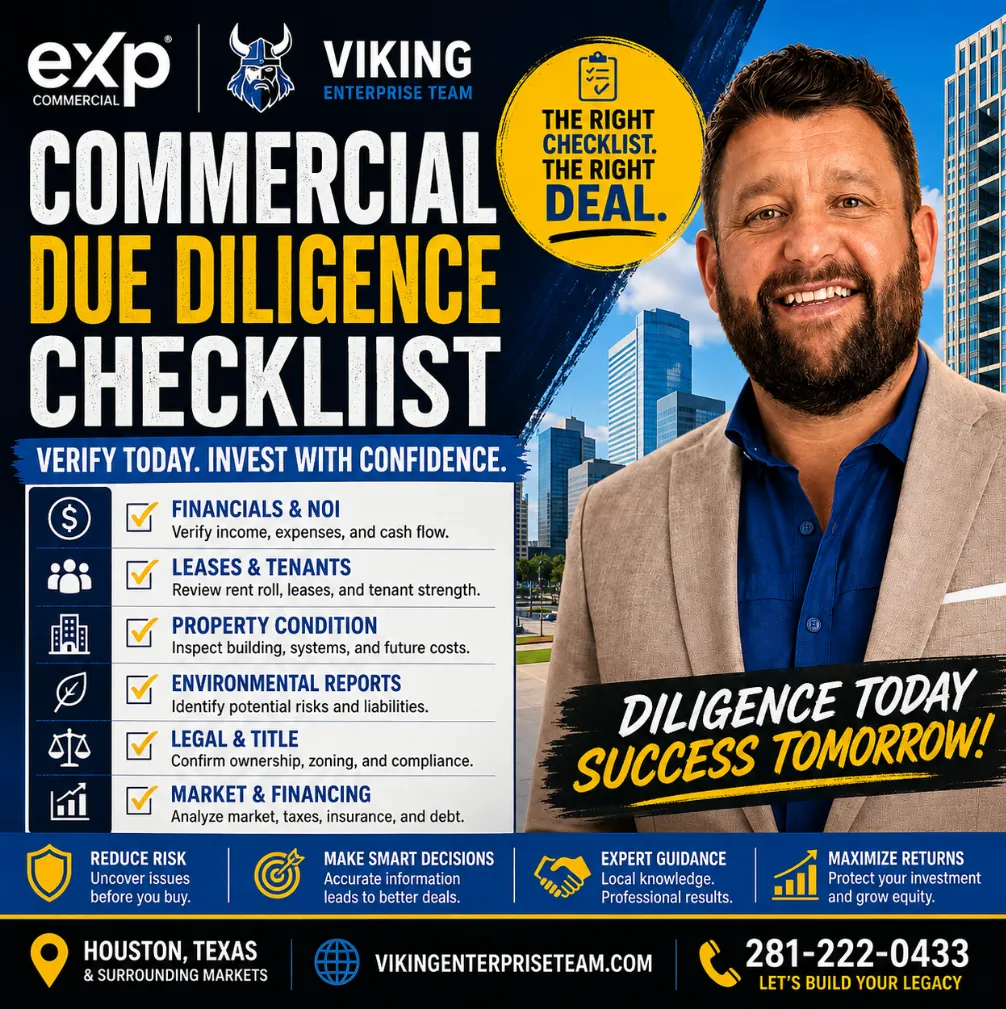
🔍 Commercial Due Diligence Checklist: 12 Things to Verify Before Buying Commercial Real Estate 🏢
🔍 Commercial Due Diligence Checklist: 12 Things to Verify Before Buying Commercial Real Estate 🏢
⚠️ Before You Buy Commercial Real Estate: The Due Diligence Checklist Every Investor Needs 📋
Commercial Due Diligence Checklist: What to Review Before Buying Commercial Real Estate
Buying commercial real estate is about more than finding a good property at an attractive price.
The real work begins when the property goes under contract.
Commercial real estate due diligence is the process of verifying the financial, physical, legal, environmental, operational, and market assumptions behind an acquisition. Done correctly, due diligence can uncover problems before they become expensive surprises—and help an investor determine whether the deal still makes sense.
For investors and business owners, the objective isn't simply to complete a checklist. It is to answer a more important question:
Does the property perform the way you thought it would when you made the offer?
Here is a practical commercial due diligence checklist to help you evaluate your next acquisition.
1. Review the Property Financials
Start by validating the property's income and expenses.
For an income-producing property, request documents such as:
·Trailing 12-month operating statement
·Prior two or three years of operating statements
·Current rent roll
·Property tax statements
·Insurance expenses
·Utility expenses
·Repair and maintenance history
·Property management expenses
·Capital expenditure history
·Accounts receivable and delinquency reports, when applicable
Don't automatically accept the seller's stated NOI.
Reconstruct the Net Operating Income (NOI) using the documentation available and determine whether current operations support the property's valuation.
2. Verify the Rent Roll
A rent roll may look impressive on a spreadsheet, but investors need to determine whether the income is actually collectible and sustainable.
Review:
·Tenant names
·Suite sizes
·Base rents
·Additional rent and reimbursements
·Lease commencement dates
·Lease expiration dates
·Security deposits
·Options
·Delinquencies
·Concessions
·Vacant suites
Compare the rent roll against the actual leases.
Discrepancies deserve further investigation.
3. Read the Leases
For leased commercial real estate, the leases are among the most important assets you are purchasing.
Prepare lease abstracts identifying critical provisions, including:
·Rental rates
·Escalations
·Renewal options
·Expense reimbursements
·Tenant improvement obligations
·Landlord obligations
·Exclusivity provisions
·Termination rights
·Assignment provisions
·Purchase options
·Rights of first refusal
·Co-tenancy clauses
·Maintenance responsibilities
A property's value can change substantially depending on what those leases actually require.
4. Inspect the Physical Property
Hire qualified professionals to evaluate the physical condition of the asset.
Depending on the property, inspections may include:
·Roof
·HVAC
·Electrical systems
·Plumbing
·Foundation
·Structural components
·Parking lot
·Drainage
·Elevators
·Fire protection systems
·Building envelope
·ADA-related considerations
The objective is not merely to identify what's broken today.
You also want to estimate future capital expenditures.
A property producing attractive cash flow can quickly become less attractive if major roof, HVAC, parking, or structural expenses are approaching.
5. Complete Environmental Due Diligence
Environmental risk can create significant financial and financing problems.
A Phase I Environmental Site Assessment is commonly used to identify potential environmental concerns associated with a commercial property.
If the Phase I identifies recognized environmental conditions or other concerns, additional investigation—potentially including a Phase II Environmental Site Assessment—may be recommended.
Environmental diligence can be particularly important for properties with historical uses involving fuel, automotive operations, manufacturing, dry cleaning, chemicals, or other potentially hazardous materials.
6. Review Title and Survey
Title and survey review can uncover issues that aren't obvious during a property tour.
Evaluate matters such as:
·Ownership
·Easements
·Encroachments
·Access
·Utility easements
·Restrictions
·Recorded agreements
·Liens
·Boundary issues
Confirm that the property has the legal access and rights necessary for its current and intended use.
7. Confirm Zoning and Land Use
Never assume that because a property is being used a certain way today, your intended future use will automatically be permitted.
Confirm:
·Current zoning
·Permitted uses
·Conditional uses
·Parking requirements
·Setbacks
·Signage restrictions
·Building height restrictions
·Development limitations
·Future land-use plans
This becomes especially important for owner-users, developers, redevelopment projects, and properties involving a change of use.
8. Investigate Property Taxes
Property taxes can materially affect commercial property cash flow.
Review the current tax assessment and understand how the property's tax burden could change following an acquisition.
Your analysis should focus on the property's anticipated future expenses, not simply what the previous owner paid historically.
9. Review Insurance Early
Insurance should not be an afterthought.
Obtain preliminary insurance information during due diligence, particularly when evaluating properties exposed to flood, windstorm, hail, fire, or other significant risks.
Unexpected insurance costs can materially change projected cash flow and debt coverage.
10. Analyze the Market and Competition
A property doesn't operate in isolation.
Study the surrounding submarket and competing properties.
Consider:
·Vacancy
·Asking rents
·Effective rents
·New construction
·Development pipeline
·Tenant demand
·Population growth
·Employment trends
·Traffic patterns
·Comparable sales
For Greater Houston investors, submarket analysis can be particularly important because performance can vary significantly between Houston, Katy, Fulshear, the Energy Corridor, and surrounding communities.
11. Evaluate Financing During Due Diligence
Financing should be analyzed alongside the property—not after due diligence is nearly finished.
Lenders may evaluate factors such as:
NOI → DSCR → Loan Proceeds → Equity Requirement → Investor Returns
A property can be attractive operationally yet fail to support the financing originally anticipated.
Running the capital structure early gives the buyer more time to identify alternatives.
12. Re-Underwrite the Deal Before the Due Diligence Period Expires
This may be the most important step.
Take everything discovered during due diligence and rebuild the investment model.
Update:
·NOI
·Capital expenditures
·Financing assumptions
·Property taxes
·Insurance
·Vacancy
·Tenant rollover
·Repair costs
·Leasing costs
·Exit assumptions
Then recalculate the metrics that matter:
Cap Rate | Cash-on-Cash Return | DSCR | IRR | Equity Multiple | Break-Even Occupancy
The deal you analyze at the end of due diligence may look different from the deal you originally placed under contract.
That's precisely why due diligence exists.
The Goal Isn't to Kill the Deal—It's to Understand the Deal
Experienced commercial real estate investors aren't necessarily looking for perfect properties.
They're looking for understood risks.
A roof that needs replacement isn't automatically a deal killer if the cost is properly identified and reflected in the economics.
A tenant rollover isn't necessarily a problem if the investor understands the leasing risk and has sufficient reserves.
The danger is paying a price based on assumptions that aren't supported by reality.
Commercial Brokerage + Capital Advisory
One advantage of evaluating brokerage and financing together is the ability to examine both sides of the transaction simultaneously.
Before moving forward with an acquisition, investors should understand:
What am I buying?
What is the property actually worth?
What risks am I assuming?
How much debt can the property support?
What does the investment look like after financing?
Combining commercial real estate analysis with capital advisory can create a more complete picture before capital is committed.
If you're evaluating a commercial property in Houston, Katy, Fulshear, West Houston, or the surrounding market, the eXp Commercial – Viking Enterprise Team can help you analyze the acquisition, evaluate financing, and navigate the transaction.
The objective is simple: make the decision based on the numbers—not assumptions.
Connect With Viking Enterprise Team
📍 eXp Commercial & eXp Realty
📍 Houston | Katy | Fulshear | West Houston
📅 Calendly.com/VikingEnterprise
📞 281-222-0433
📞 Bill Rapp, CCIM
eXp Commercial | Viking Enterprise Team
Commercial Real Estate & Capital Advisory
🌐 https://houstonrealestatebrokerage.com
https://www.houstonrealestatebrokerage.com/
https://www.houstonrealestatebrokerage.com/houston-cre-navigator
https://www.commercialexchange.com/agent/653bf5593e3a3e1dcec275a6
http://expressoffers.com/[email protected]
https://app.bullpenre.com/profile/1742476177701x437444415125976000
https://author.billrapponline.com/
https://www.amazon.com/dp/B0F32Z5BH2
https://veed.cello.so/FOmzTty6oi9
https://buymeacoffee.com/vikingente3
https://creplaybookseries.billrapponline.com
https://creplaybook.billrapponline.com/
© Bill Rapp, Broker Associate, eXp Commercial Viking Enterprise Team


