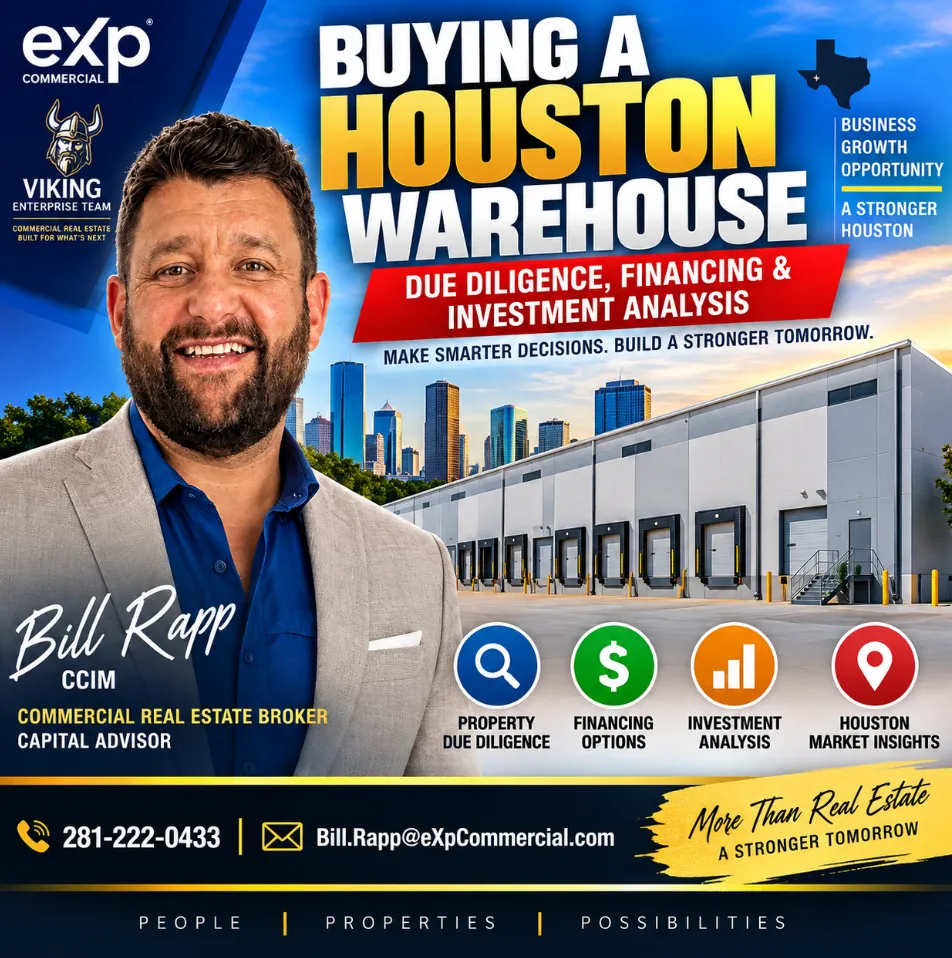
🏭 Buying a Houston Warehouse: The Complete Due Diligence, Financing & Investment Guide 🔍
🏭 Buying a Houston Warehouse: The Complete Due Diligence, Financing & Investment Guide 🔍
💰 Houston Warehouse Investing: What to Check Before You Buy an Industrial Property 🏢
Buying a Houston Warehouse: Due Diligence, Financing & Investment Analysis
Buying a warehouse in Houston can be an attractive strategy for both commercial real estate investors and business owners. But industrial real estate requires a different level of analysis than simply looking at the purchase price, square footage and projected rent.
A warehouse that looks attractive on paper can quickly become a problem if you discover inadequate electrical capacity, insufficient truck access, deferred roof repairs, environmental concerns, zoning limitations or financing constraints after you are under contract.
That is why successful industrial acquisitions begin with three separate questions:
Is this the right property? Is it a good investment? And can it be financed on acceptable terms?
Houston's industrial market makes those questions particularly relevant. Colliers reported approximately 7.6 million square feet of industrial net absorption during Q2 2026, bringing first-half absorption to approximately 11.9 million square feet. Overall vacancy declined to 7.2%, while approximately 26.1 million square feet remained under construction.
Those numbers demonstrate significant activity, but strong metropolitan-level demand does not automatically make an individual warehouse a good investment.
Here's what buyers should investigate.
1. Start With Location and Industrial Fundamentals
Industrial real estate is extremely location-sensitive.
For a retail property, buyers often concentrate on visibility, traffic counts and demographics. Warehouse users may care much more about highway access, truck routes, labor availability, delivery times and proximity to customers and suppliers.
Evaluate questions such as:
·How quickly can trucks reach major highways?
·Are there restrictions on truck traffic?
·Is the property accessible to employees?
·How close are customers, suppliers and distribution routes?
·Is surrounding development compatible with industrial operations?
·Could future residential development create operational conflicts?
Houston is not one homogeneous industrial market. Performance can vary considerably between submarkets.
For example, Colliers reported that the Northwest and Southwest Houston industrial submarkets accounted for 23.1% and 17.5%, respectively, of Q2 2026 leasing activity.
That is why I prefer to analyze the specific trade area and industrial corridor, not simply rely on Houston-wide statistics.
2. Inspect the Building—Not Just the Square Footage
Two 20,000-square-foot warehouses can have dramatically different utility to an occupant.
Before purchasing an industrial building, investigate the physical specifications carefully.
Clear Height
Clear height determines how efficiently warehouse space can be used vertically.
Higher clear heights may allow sophisticated racking systems and greater cubic storage capacity. But a local service company may not need the same clear height as a regional distribution operation.
The question isn't simply:
"How tall is the building?"
It's:
"Does the building's clear height support the intended operation and future tenant demand?"
Dock-High and Grade-Level Doors
Understand exactly how products and equipment will enter and leave the building.
Evaluate:
Dock-high doors
Grade-level doors
Dock equipment
Truck courts
Trailer storage
Turning radius
Drive-in access
A warehouse can have excellent interior space and still be operationally inefficient because trucks cannot maneuver properly.
3. Verify Electrical Capacity
Electrical capacity is becoming increasingly important for many industrial users.
Manufacturers, machine shops, fabrication companies, cold-storage operators and technology-related businesses can have significantly different power requirements from conventional warehouse users.
Determine:
Available amperage
Voltage
Phase
Transformer capacity
Existing electrical distribution
Potential upgrade costs
Never assume that because a building previously housed an industrial user, its electrical infrastructure will accommodate the next one.
4. Inspect the Roof and Structural Systems
A warehouse roof can represent one of the largest potential capital expenditures associated with an industrial acquisition.
Determine:
·Roof age
·Roofing system
·Remaining useful life
·Maintenance history
·Existing warranties
·Evidence of leaks or repairs
The same principle applies to structural components, foundations, HVAC equipment, fire-protection systems and paved areas.
Deferred maintenance should ultimately become part of your investment analysis and negotiation strategy.
A lower purchase price doesn't necessarily mean a better deal if substantial capital expenditures are waiting immediately after closing.
5. Review Environmental Risk
Environmental due diligence is particularly important with industrial property.
Historical uses can matter just as much as the property's current use.
Depending upon the transaction and lender requirements, buyers commonly obtain a Phase I Environmental Site Assessment to identify potential environmental concerns associated with current or historical operations.
If concerns are identified, additional investigation may be necessary.
Environmental issues can affect:
Property value
Financing
Insurance
Future redevelopment
Resale potential
Potential liability
This is one area where trying to save a relatively small amount during due diligence can create substantial downstream risk.
6. Confirm Zoning and Permitted Use
Owning an industrial building does not automatically mean every industrial activity is permitted.
Before closing, verify that the intended business use complies with applicable regulations and restrictions.
Depending on the location and proposed operation, this can include questions involving:
Land use
Outside storage
Signage
Parking
Truck circulation
Hazardous materials
Fire codes
Occupancy requirements
Building modifications
For owner-users, this step is particularly important.
The property doesn't simply need to be a good building. It needs to work legally and operationally for your specific business.
7. Analyze the Investment Like an Investor
If you're purchasing a leased warehouse, the building inspection is only half the due diligence.
The other half is understanding the income stream.
Start by verifying:
Contract rent
Lease expiration dates
Renewal options
Tenant reimbursements
Operating expenses
Property taxes
Insurance
Management expenses
Capital expenditures
Then calculate the property's stabilized Net Operating Income (NOI).
A simplified calculation is:
Gross Rental Income
– Vacancy/Credit Loss
– Operating Expenses
= Net Operating Income
NOI becomes the foundation for several other investment metrics.
Capitalization Rate
Cap Rate = NOI ÷ Purchase Price
For example, if a warehouse produces $300,000 in stabilized NOI and sells for $4 million:
$300,000 ÷ $4,000,000 = 7.5% cap rate
But cap rate alone does not determine whether the investment makes sense.
You also need to understand tenant credit, lease duration, future rollover risk, capital expenditures, replacement rent and financing.
8. Compare Contract Rent to Market Rent
This is one of the most overlooked components of industrial investment analysis.
Suppose you're buying a warehouse leased at $8.00 per square foot while comparable properties are leasing closer to $10.00.
That could create future upside.
But if the property is leased substantially above market, your current NOI may overstate the building's long-term earning power.
Houston's industrial asking rents vary substantially by property type and submarket. Partners Real Estate reported an overall Q2 2026 average asking NNN rate of $9.73 per square foot, but warehouse space averaged $8.85 while R&D space averaged $20.48.
That spread illustrates why buyers shouldn't underwrite a property based on a generic "Houston industrial rent."
Use comparable properties that actually compete with the subject.
9. Don't Ignore Lease Rollover Risk
Imagine buying a warehouse with excellent current cash flow—but the tenant's lease expires in 18 months.
Your investment analysis should consider what happens next.
Ask:
Will the tenant renew?
What is current market rent?
How long could releasing take?
Will you need to provide tenant improvements?
Will a new tenant demand free rent?
What brokerage commissions might be required?
An attractive going-in cap rate can quickly become less attractive once realistic rollover costs are incorporated.
10. Analyze the Financing Before Making the Offer
One of the biggest mistakes buyers make is treating financing as something to figure out after negotiating the property.
Financing should be analyzed alongside the acquisition.
For investment properties, lenders commonly evaluate metrics including:
Loan-to-Value (LTV)
Debt Service Coverage Ratio (DSCR)
Debt Yield
Borrower liquidity
Net worth
Property condition
Tenant quality
Lease structure
The maximum LTV quoted by a lender does not necessarily equal the loan amount you'll actually receive.
If the property's NOI cannot support the requested debt at the lender's required DSCR, proceeds may need to be reduced.
11. Owner-User Warehouse Financing Is Different
Business owners buying warehouses for their own operations may have financing alternatives that differ significantly from investor financing.
Depending on eligibility and transaction structure, options can include:
Conventional bank financing
SBA 504 financing
SBA 7(a) financing
Credit union financing
Bridge financing
Private or alternative commercial financing
The lender may evaluate both the property and operating business, including historical cash flow and the borrower's ability to service the proposed debt.
That creates an important strategic opportunity.
Instead of asking:
"How much building can I buy?"
Consider asking:
"What property and financing structure gives my business the strongest long-term occupancy economics?"
12. Model Your Cash-on-Cash Return
Leveraged investors should also evaluate the return generated on the cash they actually invest.
A simplified calculation is:
Cash-on-Cash Return = Annual Pre-Tax Cash Flow ÷ Total Cash Invested
Suppose you invest $1 million between your down payment and closing costs and expect $90,000 of annual pre-tax cash flow.
Your projected cash-on-cash return would be:
$90,000 ÷ $1,000,000 = 9%
But don't stop there.
Run scenarios for:
Higher interest rates
Unexpected vacancy
Lower renewal rents
Roof replacement
Insurance increases
Property tax changes
Capital improvements
Good underwriting doesn't ask what happens when everything goes right.
It asks whether the investment still works when something goes wrong.
13. Understand Houston's Current Industrial Market
Houston's industrial sector continues to demonstrate significant tenant activity.
Colliers reported 11.9 million square feet of net absorption during the first half of 2026, with Q2 absorption reaching a four-year quarterly high. However, the market also had approximately 26.1 million square feet under construction, while sublease availability increased to 7.3 million square feet.
Another Houston market report measured Q2 vacancy at 7.4%, with 26.9 million square feet under construction and an average asking NNN rental rate of $9.73 per square foot. Differences between research firms can reflect methodology and property-set differences, which is another reason to treat market reports as context rather than substitutes for property-specific underwriting.
For investors, that means analyzing both sides of the equation:
Demand AND new supply.
A growing market can still have individual submarkets or property types where new construction creates competition.
14. Build a Warehouse Acquisition Team
Industrial acquisitions can involve multiple specialties.
Depending on the property and transaction, your due diligence team may include:
Commercial real estate broker
Commercial lender or capital advisor
Real estate attorney
CPA
Property inspector
Environmental consultant
Engineer
Insurance professional
Title company
Each professional looks at the property through a different risk lens.
Your broker might analyze market rent.
Your lender evaluates debt service.
Your inspector evaluates physical condition.
Your attorney evaluates contractual and title issues.
Your CPA evaluates tax implications.
Together, those perspectives can provide a much clearer picture of the transaction.
The Bottom Line: Buy the Numbers, the Building and the Location
A Houston warehouse acquisition should pass three tests.
Physical test: Does the property work for its intended industrial use?
Financial test: Do the income, expenses, capital requirements and projected returns justify the purchase price?
Financing test: Can the acquisition support an appropriate debt structure without destroying the economics of the transaction?
When all three align, you may have a compelling acquisition opportunity.
When they don't, discovering the problem before closing can be just as valuable as finding a great deal.
At eXp Commercial – Viking Enterprise Team, we help Houston-area investors and business owners evaluate commercial properties from both the real estate and capital perspective—from property sourcing and investment analysis to acquisition strategy and financing coordination.
Considering buying a warehouse, flex property or industrial building in Houston? Let's analyze the property, numbers and financing before you commit.
Connect With Viking Enterprise Team
📍 eXp Commercial & eXp Realty
📍 Houston | Katy | Fulshear | West Houston
📅 Calendly.com/VikingEnterprise
📞 281-222-0433
📞 Bill Rapp, CCIM
eXp Commercial | Viking Enterprise Team
Commercial Real Estate & Capital Advisory
🌐 https://houstonrealestatebrokerage.com
https://www.houstonrealestatebrokerage.com/
https://www.houstonrealestatebrokerage.com/houston-cre-navigator
https://www.commercialexchange.com/agent/653bf5593e3a3e1dcec275a6
http://expressoffers.com/[email protected]
https://app.bullpenre.com/profile/1742476177701x437444415125976000
https://author.billrapponline.com/
https://www.amazon.com/dp/B0F32Z5BH2
https://veed.cello.so/FOmzTty6oi9
https://buymeacoffee.com/vikingente3
https://creplaybookseries.billrapponline.com
https://creplaybook.billrapponline.com/
© Bill Rapp, Broker Associate, eXp Commercial Viking Enterprise Team


