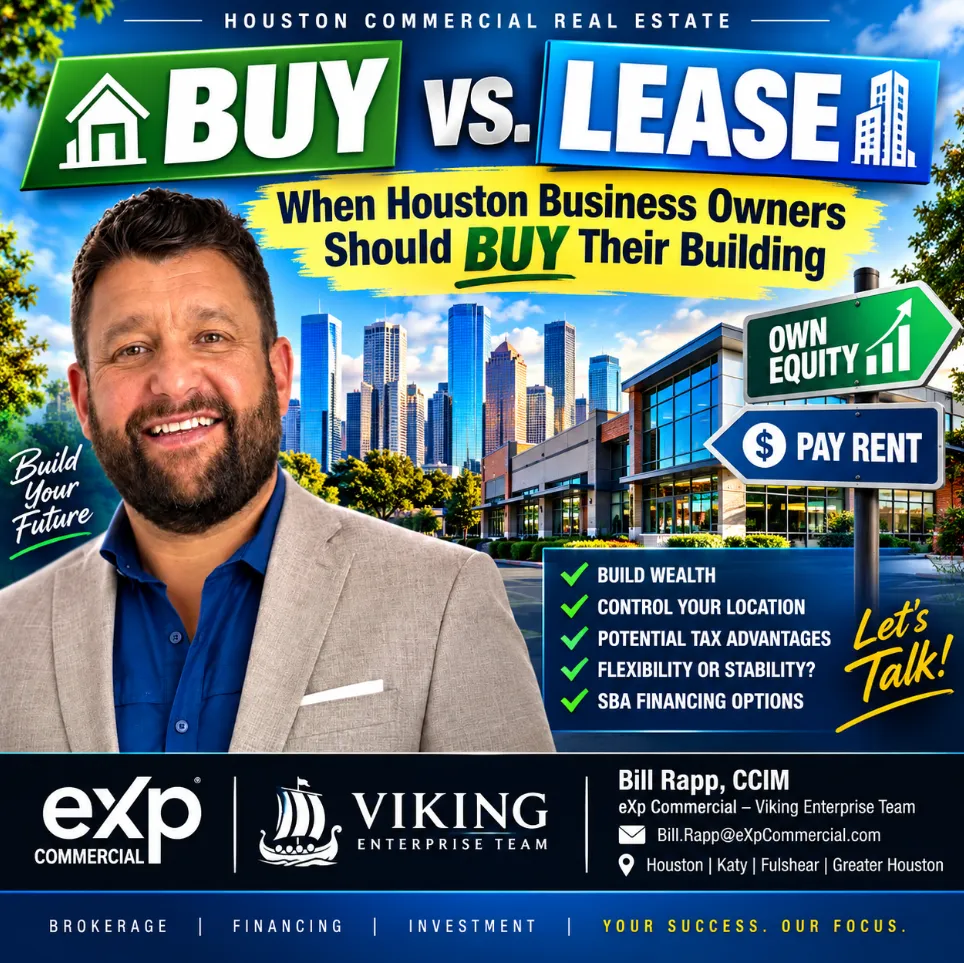
🏢 Buy vs. Lease Commercial Real Estate: When Houston Business Owners Should Buy Their Building 🔑
🏢 Buy vs. Lease Commercial Real Estate: When Houston Business Owners Should Buy Their Building 🔑
💰 Stop Paying Rent? How Houston Business Owners Can Decide When It’s Time to Own Commercial Real Estate 🏢
________________________________________________________________________________
Buy vs. Lease Commercial Real Estate: When Houston Business Owners Should Buy Their Building
For many Houston business owners, one of the biggest real estate decisions is surprisingly simple to state:
Should I keep leasing my commercial space—or buy a building?
The answer is rarely as simple as comparing your current rent payment with a projected mortgage payment.
Buying commercial real estate can give a business owner greater control over occupancy costs, the ability to build equity, potential tax advantages, and an additional asset that may appreciate over time. Leasing, however, can preserve working capital and provide flexibility when a company is growing, changing locations, or uncertain about its long-term space requirements.
The right decision comes down to your business plan, cash flow, financing options, expected occupancy period, property requirements, and the economics of the specific Houston submarket.
Here is how I recommend Houston-area business owners evaluate the decision.
Why Business Owners Consider Buying Commercial Real Estate
When you lease a building, your rent is primarily an operating cost. You receive the use of the property, but you generally do not participate directly in its appreciation or build ownership equity.
Buying changes that equation.
Part of the capital you put into the property—and, over time, part of your loan amortization—can build equity in an asset owned by you or an affiliated real estate entity.
For an established business planning to remain in the same general location for many years, that can create a compelling long-term strategy.
The question isn't simply:
"Can I afford to buy?"
A better question is:
"Does owning this property improve the long-term economics and strategic position of my business?"
1. Buy When Your Business Has Stable Long-Term Space Needs
Commercial real estate ownership tends to make more sense when you have reasonable confidence about where your business is going.
Consider questions such as:
·Will we probably occupy this location for at least five to ten years?
·Is our required square footage relatively predictable?
·Do we expect significant expansion or contraction?
·Is this location important to our employees, customers or referral sources?
·Would moving several years from now materially disrupt the business?
A physician practice, dental office, contractor, professional services firm, distribution company or established local retailer may have relatively predictable long-term real estate requirements.
A rapidly growing startup may not.
If you purchase 6,000 square feet today but need 15,000 square feet three years from now, the building can become a constraint instead of an asset.
That is one reason flexibility remains one of leasing's biggest advantages.
2. Compare Total Occupancy Cost—not Just Rent vs. Mortgage
One of the biggest mistakes business owners make is comparing their monthly rent directly with a proposed mortgage payment.
That isn't a true buy-versus-lease analysis.
Ownership can include:
·Principal and interest
·Property taxes
·Property insurance
·Repairs and maintenance
·Capital expenditures
·Association fees
·Property management
·Roof, HVAC and structural expenses
·Renovation costs
·Closing costs
Leasing can include:
·Base rent
·NNN or operating expenses
·Common-area maintenance
·Annual rent escalations
·Insurance obligations
·Maintenance responsibilities
·Tenant improvements
·Renewal risk
The analysis should model the total occupancy cost under both scenarios over several years.
Then consider the equity accumulated through ownership and the potential future value of the real estate.
3. Consider What Your Down Payment Could Earn Inside Your Business
Real estate isn't the only place where your capital can produce a return.
Suppose purchasing a property requires several hundred thousand dollars of cash.
Could that capital produce a higher return if invested in:
·Additional employees?
·New equipment?
·Marketing?
·Inventory?
·Another business location?
·Technology?
·An acquisition?
This is the opportunity cost of capital.
For some companies, owning commercial real estate creates tremendous long-term wealth.
For others, keeping capital invested in the operating business produces a substantially better return.
That calculation should be part of the decision.
4. Buying Can Create a Second Wealth-Building Engine
A successful business owner who purchases their building effectively creates two assets:
1. The operating business
2. The commercial real estate
The business generates operating income.
The property may generate equity through loan amortization and potentially appreciate over time.
Some owners establish a separate real estate entity that owns the building and leases it to the operating company, subject to appropriate legal, tax and lender structuring.
Over decades, this can become an important component of a business owner's wealth and eventual retirement or succession strategy.
Even if the operating business is eventually sold, the owner may potentially retain the property and lease it to the buyer or another tenant.
5. SBA Financing Can Change the Buy-vs.-Lease Calculation
Business owners sometimes assume purchasing commercial property requires the same equity levels associated with conventional investment real estate.
Owner-occupied commercial real estate can have very different financing options.
The SBA 504 program, for example, can be used for qualifying purchases, construction or renovation of owner-occupied commercial buildings and land, subject to program requirements. SBA 504 financing offers 10-, 20- and 25-year maturity options. SBA financing is intended for qualifying operating businesses rather than speculative investment in rental real estate.
Depending upon the business, transaction and property, SBA 7(a), conventional bank, credit union and other owner-user financing structures may also deserve consideration.
This is why I prefer analyzing the real estate and financing simultaneously.
A building that looks expensive under one financing structure can look very different under another.
6. Houston's Market Makes Property Type Important
There isn't one Houston commercial real estate market.
An industrial owner-user in Northwest Houston faces a completely different supply-and-demand environment than an office user in the Energy Corridor or a retailer looking for space in Katy.
Recent Q2 2026 Houston data illustrates the difference.
Houston industrial vacancy was approximately 7.4%, while average industrial asking rents were approximately $9.73 per square foot NNN.
Houston retail remained substantially tighter, with approximately 5.7% vacancy and average asking rents around $21.47 per square foot.
Houston office presented a very different picture, with approximately 26.6% vacancy and average asking rents around $31.38 per square foot full service.
These differences matter.
Higher vacancy may give tenants greater negotiating leverage and sometimes create owner-user acquisition opportunities.
Tighter submarkets can produce stronger landlord pricing power and make controlling your own location more attractive.
The correct decision needs to be made at the property and submarket level, not from Houston-wide averages alone.
7. Control Can Be as Valuable as Equity
Ownership provides something that doesn't always appear in a spreadsheet:
control.
A business owner may want to:
·Install specialized equipment
·Modify the building
·Add warehouse improvements
·Expand parking
·Improve signage
·Build medical or dental infrastructure
·Add loading capabilities
·Control future occupancy costs
·Avoid lease renewal uncertainty
A landlord may restrict some of those changes.
Ownership can give the business significantly greater control over its physical environment, subject to zoning, deed restrictions, lender requirements and other applicable regulations.
For businesses with specialized facilities, this can be extremely important.
When Leasing May Be the Better Strategy
Buying isn't automatically superior.
Leasing can make more sense when:
·Your business is growing rapidly.
·Your future space requirements are uncertain.
·You expect to relocate within several years.
·Cash is more valuable inside your operating business.
·You need a prime location where properties rarely become available for purchase.
·The purchase market is materially overpriced relative to rents.
·You don't want responsibility for major capital expenditures.
·Your credit or financial performance doesn't currently support attractive acquisition financing.
A well-negotiated lease can be an excellent business decision.
The objective isn't to own real estate simply for the sake of owning it.
The objective is to choose the occupancy strategy that best supports the company.
A Simple Buy-vs.-Lease Framework
Before purchasing your building, evaluate five major categories.
Business Stability
How predictable are your revenues, profitability, staffing and future space requirements?
Occupancy Horizon
How long do you realistically expect to remain at the property?
Capital
How much cash will the acquisition require, and what other opportunities compete for that capital?
Financing
What conventional, SBA or alternative financing options are available?
Property Economics
What are comparable lease rates, sale prices, operating expenses, taxes and potential future values?
When those five variables align, ownership can become extremely compelling.
Houston Business Owners Should Analyze Brokerage and Financing Together
One advantage business owners have is the ability to evaluate the transaction from both sides.
The property needs to make sense operationally.
The purchase price needs to make sense from a commercial real estate perspective.
And the financing needs to make sense from a cash-flow and capital-structure perspective.
Those decisions shouldn't be made independently.
Before renewing a commercial lease, I recommend comparing three scenarios:
Scenario A — Renew the existing lease
Scenario B — Lease another property
Scenario C — Purchase an owner-occupied building
Then compare the economics over five, seven and ten years.
You may discover that continuing to lease is the smartest option.
Or you may discover that the rent you've been paying could instead support ownership of a long-term commercial real estate asset.
The Bottom Line
The decision to buy vs. lease commercial real estate in Houston shouldn't be driven by the assumption that owning is always better.
It should be driven by the numbers.
If your business is financially stable, your space requirements are predictable, you expect to occupy the property long term, and appropriate financing is available, buying your building can potentially transform an occupancy expense into a long-term asset.
But when flexibility and liquidity matter more, leasing can remain the better strategy.
Before signing your next lease renewal, run the buy-vs.-lease numbers.
The answer may surprise you.
Connect With Viking Enterprise Team
📍 eXp Commercial & eXp Realty
📍 Houston | Katy | Fulshear | West Houston
📅 Calendly.com/VikingEnterprise
📞 281-222-0433
📞 Bill Rapp, CCIM
eXp Commercial | Viking Enterprise Team
Commercial Real Estate & Capital Advisory
🌐 https://houstonrealestatebrokerage.com
https://www.houstonrealestatebrokerage.com/
https://www.houstonrealestatebrokerage.com/houston-cre-navigator
https://www.commercialexchange.com/agent/653bf5593e3a3e1dcec275a6
http://expressoffers.com/[email protected]
https://app.bullpenre.com/profile/1742476177701x437444415125976000
https://author.billrapponline.com/
https://www.amazon.com/dp/B0F32Z5BH2
https://veed.cello.so/FOmzTty6oi9
https://buymeacoffee.com/vikingente3
https://creplaybookseries.billrapponline.com
https://creplaybook.billrapponline.com/
© Bill Rapp, Broker Associate, eXp Commercial Viking Enterprise Team


