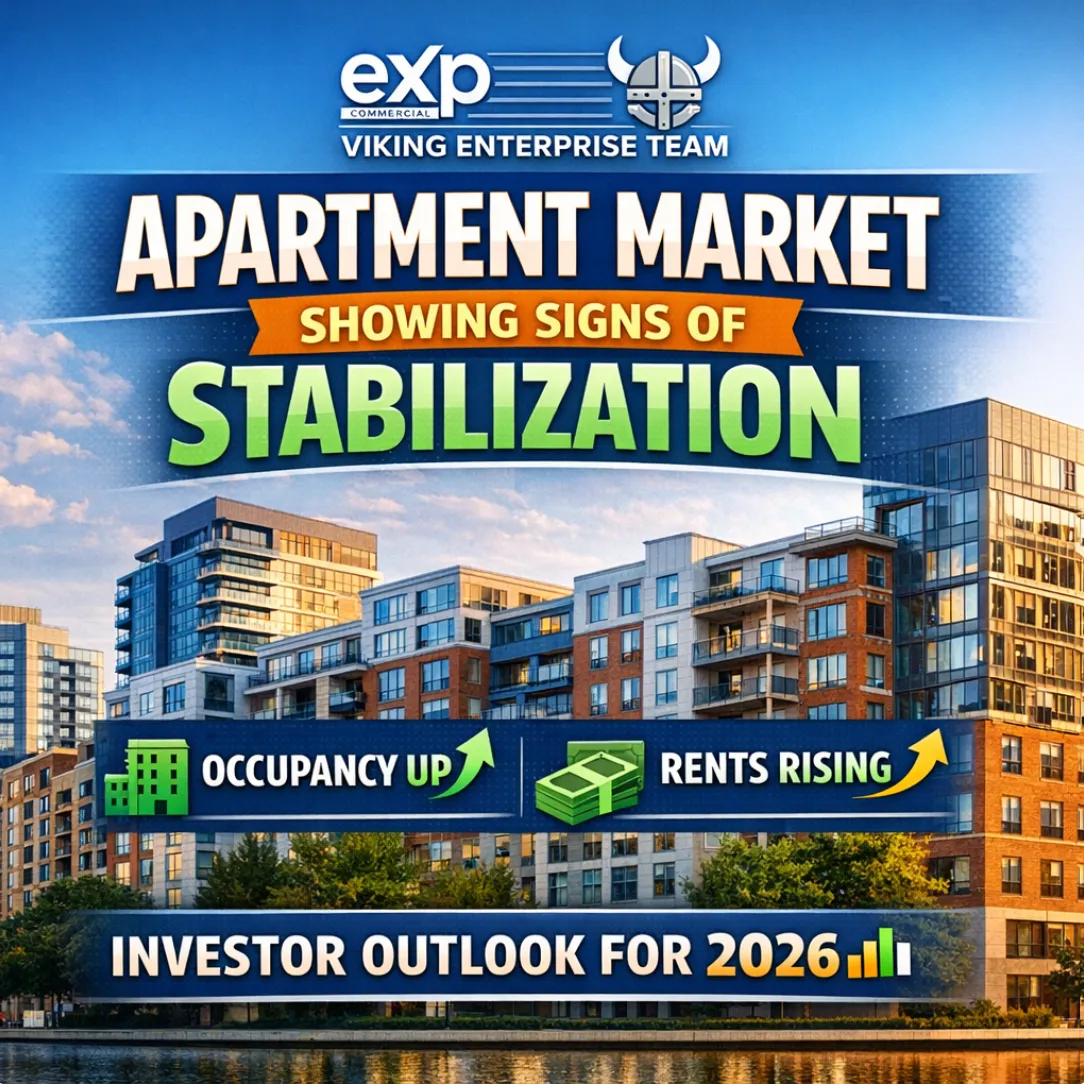
🏢📊 Apartment Market Stabilizing? What CRE Investors Need to Know in 2026 📊🏢
🏢📊 Apartment Market Stabilizing? What CRE Investors Need to Know in 2026 📊🏢
📉➡️📈 U.S. Multifamily Market Shows Early Signs of Stabilization After Supply Surge 📈➡️📉
Apartment Market Shows Early Signs of Stabilization
After more than a year of softening fundamentals driven by record construction and moderating demand, the U.S. apartment market is beginning to show early signs of stabilization.
Recent data from RealPage indicates that occupancy and rents have increased for two consecutive months, suggesting the multifamily sector may be transitioning away from the correction phase that dominated late 2025.
For commercial real estate investors, this shift could mark the beginning of a new cycle for multifamily assets heading into 2026 and beyond.
Occupancy Levels Are Gradually Improving
Apartment occupancy reached 94.8% in February, according to RealPage data.
This represents two consecutive monthly increases of 10 basis points, a positive signal after several months of declining occupancy during the second half of 2025.
However, perspective is important:
·Occupancy remains 10 basis points below year-ago levels
·Roughly 90 basis points below the April 2025 peak
In other words, the market is not booming again yet, but it appears to be moving toward equilibrium.
For investors, stabilization often creates better buying opportunities than boom periods, when pricing and competition tend to surge.
Rent Growth Turns Slightly Positive
Another encouraging indicator is rent growth returning to positive territory.
Effective asking rents rose 0.3% month-over-month in February, marking the second consecutive monthly increase after seven months of stagnation.
However, on an annual basis:
·Rents remain 0.4% lower than a year ago
·The market is still absorbing a large wave of new apartment deliveries
The takeaway is clear: rent growth is stabilizing, but not yet accelerating.
For investors, this environment often favors long-term buyers rather than short-term speculators.
Sun Belt Markets Still Feeling Supply Pressure
Regional performance across the U.S. remains uneven.
Many Sun Belt markets, which saw the most aggressive apartment development over the past three years, are still experiencing pricing pressure.
Markets facing the steepest rent declines include:
·Austin
·Denver
·Phoenix
·Charlotte
These cities are dealing with elevated supply pipelines, forcing operators to offer concessions and rent discounts to maintain occupancy.
In fact, the Southern U.S. has now gone nearly three years without consistent annual rent growth.
Coastal Tech Hubs and Midwest Markets Outperforming
While Sun Belt markets work through supply challenges, several other regions are performing much better.
Coastal technology hubs have seen strong rent growth:
·San Francisco
·San Jose
·New York
These cities have recorded annual rent increases between 4.5% and 9%, driven by:
·Tech hiring recovery
·Limited new supply
·High barriers to development
Meanwhile, several Midwest markets are quietly outperforming as well, including:
·Chicago
·Cleveland
·Cincinnati
·St. Louis
·Minneapolis
·Kansas City
These metros benefit from stable employment, lower construction activity, and strong renter demand.
The Supply Wave Is Beginning to Slow
Perhaps the most important factor supporting stabilization is the expected slowdown in new apartment construction.
Over the past several years, developers delivered record numbers of multifamily units, which temporarily pushed supply ahead of demand.
But that pipeline is now starting to moderate.
As construction activity slows, two things typically occur:
1️⃣ Occupancy improves
2️⃣ Rent growth returns
If the supply slowdown continues through the spring and summer leasing seasons, many analysts expect fundamentals to strengthen further in late 2026 and 2027.
What This Means for Investors
For commercial real estate investors, the current environment may represent a strategic entry point into multifamily assets.
Markets moving from correction to stabilization often present attractive opportunities because:
·Sellers may still be adjusting pricing expectations
·Interest rates may begin stabilizing
·Rent growth may resume gradually
Disciplined investors often focus on:
✔ Strong job growth markets
✔ Submarkets with limited new supply
✔ Properties with operational upside
These fundamentals typically drive long-term value creation in multifamily real estate.
Houston’s Multifamily Market Remains a Key Market to Watch
For investors focused on Texas commercial real estate, Houston continues to stand out as a structurally resilient multifamily market.
Key drivers include:
·Population growth
·Corporate relocation
·Energy and manufacturing expansion
·Infrastructure investment
While Houston has also experienced new apartment deliveries, the region’s diverse economy and continued population inflow have helped maintain strong absorption over time.
This dynamic is one reason why many institutional lenders and investors continue to view Houston as a core multifamily market heading into the next cycle.
Bottom Line
The U.S. apartment market is not experiencing a dramatic rebound, but the latest data suggests it may be transitioning from correction toward stabilization.
As new supply moderates and leasing patterns normalize, the multifamily sector could see gradual improvements in occupancy and rent growth throughout 2026.
For investors who understand market cycles, this phase often represents one of the most strategic moments to enter the market.
https://www.houstonrealestatebrokerage.com/
https://www.houstonrealestatebrokerage.com/houston-cre-navigator
https://www.commercialexchange.com/agent/653bf5593e3a3e1dcec275a6
http://expressoffers.com/[email protected]
https://app.bullpenre.com/profile/1742476177701x437444415125976000
https://author.billrapponline.com/
https://www.amazon.com/dp/B0F32Z5BH2
https://veed.cello.so/FOmzTty6oi9
https://buymeacoffee.com/vikingente3
https://creplaybookseries.billrapponline.com
https://creplaybook.billrapponline.com/
© 2023-2024 Bill Rapp, Broker Associate, eXp Commercial Viking Enterprise Team


