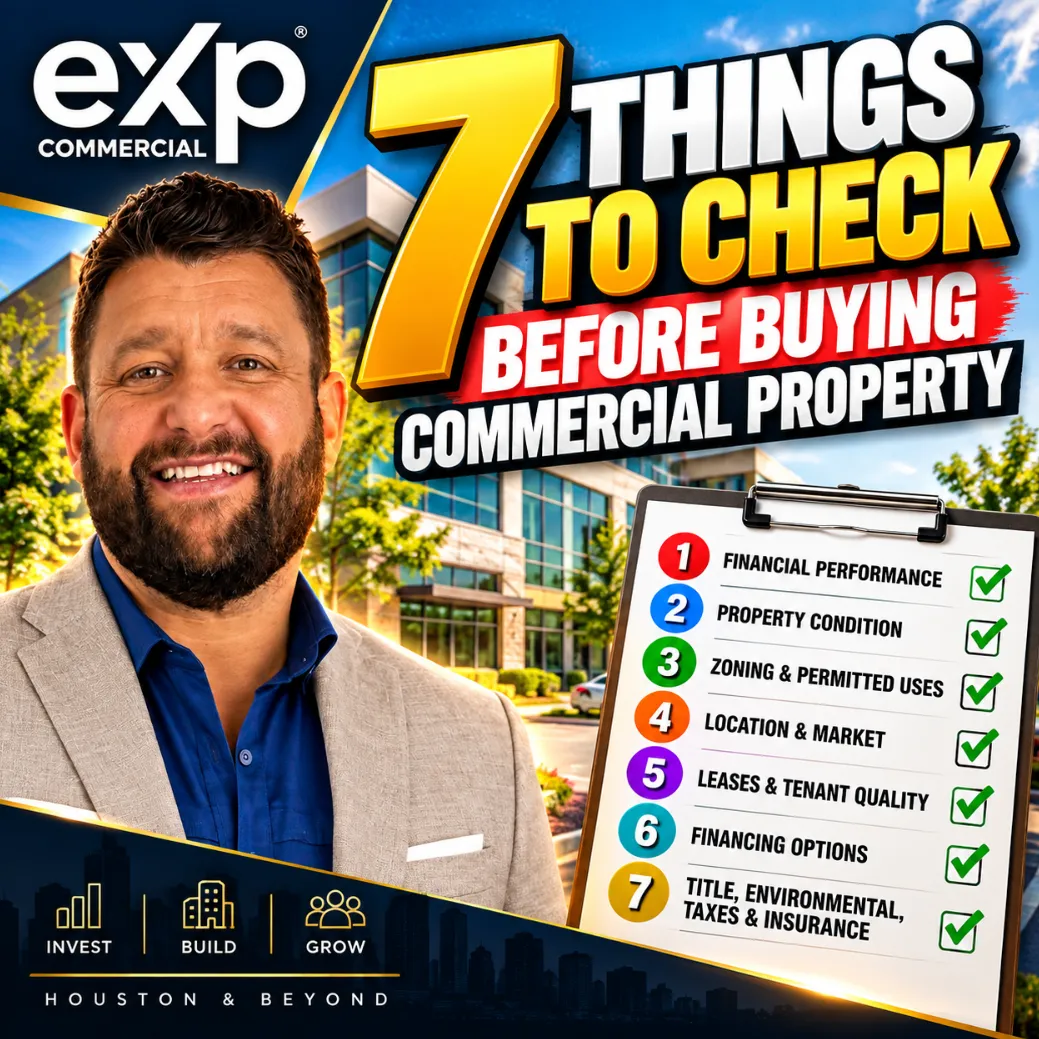
🏢 7 Things to Check Before Buying Commercial Property: Avoid Costly Investment Mistakes! 🔍
🏢 7 Things to Check Before Buying Commercial Property: Avoid Costly Investment Mistakes! 🔍
🚨 Buying Commercial Real Estate? 7 Due Diligence Checks Every Investor Must Know! 🏢
_______________________________________________________________________________
7 Things to Check Before Buying Commercial Property: Avoid Costly Investment Mistakes!
Buying commercial real estate can be one of the most significant financial decisions an investor or business owner makes. Whether you're purchasing a retail shopping center, industrial warehouse, medical office building, multifamily property, or office space for your own business, understanding what you're buying is essential.
The right property can generate income, build equity, support business expansion, and create long-term wealth.
The wrong property can expose you to unexpected expenses, financing challenges, legal complications, and costly repairs.
That's why commercial property due diligence is one of the most important steps in any acquisition.
As a commercial real estate broker and Certified Commercial Investment Member (CCIM) serving Katy, Fulshear, West Houston, and the Greater Houston market, I help investors and business owners evaluate opportunities beyond the asking price.
Before signing off on your next acquisition, here are seven critical things you should investigate.
1. Verify the Property's Financial Performance
The first rule of commercial real estate investing is simple: verify the numbers.
A property's advertised cap rate, rental income, or projected return doesn't necessarily reflect its actual financial performance.
Before purchasing an income-producing property, request and review:
·Trailing 12-month operating statement (T-12)
·Current rent roll and executed leases
·Historical income and expense statements
·Property tax assessments
·Insurance premiums
·Maintenance and repair expenses
·Capital expenditure history
·Tenant payment histories, when available
One of the most important metrics is Net Operating Income (NOI).
NOI = Effective Gross Income − Operating Expenses
NOI excludes debt service, income taxes, depreciation, and capital expenditures.
For example, suppose a commercial property generates $250,000 in annual effective income and has $90,000 in annual operating expenses.
Its NOI would be $160,000.
If the property is priced at $2 million:
Cap Rate = $160,000 ÷ $2,000,000 = 8%
An 8% cap rate might look attractive. But what happens if a major tenant leaves, property taxes increase, or the roof needs replacement?
Always evaluate normalized expenses, sustainable income, tenant risk, and future capital requirements—not just the advertised cap rate.
2. Investigate the Property's Physical Condition
A commercial building may look impressive during a property tour while concealing significant maintenance issues.
Before buying commercial property, consider engaging qualified professionals to evaluate:
·Roof condition and remaining useful life
·HVAC systems
·Electrical capacity and wiring
·Plumbing and sewer systems
·Structural integrity and foundation
·Parking lots, drainage, and pavement
·Fire protection and life-safety systems
·Accessibility and applicable building-code requirements
For industrial properties, also evaluate loading docks, clear heights, electrical service, truck access, and equipment requirements.
In Greater Houston, flood exposure and drainage deserve particular attention.
Review FEMA flood maps, local floodplain information, historical flooding, and available engineering reports. Flood maps alone do not establish that a property has never flooded.
A $100,000 roof replacement or major HVAC failure can dramatically change the economics of a commercial real estate investment.
Investor Tip: Obtain professional inspection reports and contractor estimates before your contractual inspection period expires.
3. Confirm Zoning, Land Use, and Permitted Uses
One of the biggest mistakes commercial property buyers make is assuming that a building can legally accommodate their intended business.
A property might be advertised as retail, office, industrial, or mixed-use, but that does not automatically mean your planned operation is permitted.
Review:
·Applicable zoning or land-use restrictions
·Deed restrictions and recorded covenants
·Permitted and conditional uses
·Parking requirements
·Building occupancy and fire-code requirements
·Signage restrictions
·Easements and access rights
·Development approvals and permit history
Houston-area buyers should pay special attention to jurisdiction.
The City of Houston generally does not have conventional zoning, but development regulations, deed restrictions, parking requirements, permitting rules, and other limitations still apply.
Surrounding municipalities, including Katy and Fulshear, may have their own zoning and land-use requirements.
For example, purchasing a warehouse to operate a commercial truck-driving school could raise questions about outdoor vehicle storage, traffic circulation, parking, and permitted land use.
Never assume that the property's current or advertised use guarantees approval for your intended operation.
Investor Tip: Confirm the intended use with the appropriate local authority and qualified legal or land-use professionals before removing contractual contingencies.
4. Analyze the Location and Surrounding Market
Location matters in commercial real estate, but the definition of a good location depends on the property type.
A retail business may prioritize visibility, traffic counts, customer demographics, and convenient access.
An industrial tenant may care more about highway connectivity, loading access, workforce availability, and transportation costs.
A medical practice may prioritize nearby residential growth, patient demographics, accessibility, and proximity to complementary healthcare providers.
Important market factors include:
·Population and employment trends
·Traffic patterns and road access
·Competing properties
·Market vacancy and absorption
·Comparable rental rates
·New construction and development pipelines
·Tenant demand
·Long-term economic drivers
In the Katy, Fulshear, and West Houston markets, expanding residential communities and infrastructure improvements can influence demand for retail, medical office, flex industrial, and neighborhood services.
However, growth does not automatically make every commercial property a strong investment.
Evaluate the property's specific trade area, competition, tenant profile, and acquisition basis.
Investor Tip: Analyze comparable sales and leases, not simply the seller's expectations.
5. Review Existing Leases and Tenant Quality
When purchasing an occupied commercial property, you are acquiring more than the building.
You're also acquiring the economic benefits and obligations associated with its leases.
Review every executed lease and amendment, including:
·Remaining lease term
·Base rental rates
·Scheduled rent increases
·Renewal and termination options
·Tenant improvement obligations
·Expense reimbursement provisions
·Security deposits
·Maintenance responsibilities
·Assignment and subletting provisions
·Personal or corporate guarantees
For triple-net (NNN) leases, determine which expenses tenants are actually responsible for paying.
Not all leases labeled NNN allocate expenses the same way.
A lease may contain caps, exclusions, landlord repair obligations, or limitations on capital expense recovery.
Also consider tenant creditworthiness, historical payment performance, business viability, and concentration risk.
For example, a shopping center with one tenant representing 60% of rental income could face significant exposure if that tenant vacates.
Investor Tip: Obtain tenant estoppel certificates when appropriate and verify lease terms against the rent roll and seller's representations.
6. Evaluate Financing Before Making an Offer
Commercial real estate financing is different from residential mortgage financing.
Lenders evaluate several factors, including:
·Property type and condition
·Loan-to-value ratio (LTV)
·Debt service coverage ratio (DSCR)
·Borrower liquidity and credit
·Tenant quality and occupancy
·Business cash flow
·Property valuation
·Loan term, amortization, and balloon risk
Financing options may include conventional bank loans, SBA 7(a) loans, SBA 504 financing, credit union loans, bridge loans, and other commercial lending programs.
For qualifying owner-occupied properties, SBA financing may provide a useful alternative to conventional financing, subject to program rules and eligibility requirements.
Investors purchasing income-producing commercial properties generally need to demonstrate sufficient cash flow, equity, and reserves.
Example:
Suppose a commercial building has annual NOI of $180,000 and annual debt service of $135,000.
DSCR = $180,000 ÷ $135,000 = 1.33x
This means the property's NOI is approximately 1.33 times its annual debt service.
Whether that satisfies a lender depends on the property, financing program, and underwriting requirements.
Also evaluate prepayment penalties, yield maintenance, recourse provisions, interest-rate adjustments, lender reserves, and closing costs.
Investor Tip: Obtain financing guidance early, ideally before committing to a purchase contract, and make sure your financing contingency and closing timeline are realistic.
7. Investigate Title, Environmental Risks, Taxes, and Insurance
The final category can uncover some of the most expensive surprises.
Before closing, coordinate a thorough review of legal, environmental, and ownership-related issues.
Title and survey: Confirm legal ownership, recorded liens, easements, encroachments, access rights, and relevant title exceptions. Review an appropriate commercial survey, such as an ALTA/NSPS survey when warranted.
Environmental due diligence: A Phase I Environmental Site Assessment may be appropriate, especially for industrial properties, automotive facilities, former gas stations, and sites with potentially contaminating historical uses. Environmental professionals can advise whether additional investigation is necessary.
Property taxes: Verify current assessments, applicable exemptions, potential reassessment exposure, and how a change in ownership may affect future expenses.
Insurance: Obtain insurance quotes before closing. Consider flood, windstorm, property, liability, and other coverage relevant to the building and its location.
Legal and contractual review: Have qualified counsel evaluate the purchase agreement, contingencies, closing documents, and any unusual title or property restrictions.
Investor Tip: Do not assume that a clear-looking building inspection means the property's legal and environmental risks have been resolved.
Real-World Example: The $2 Million Commercial Property
Consider a hypothetical investor evaluating a $2 million retail building.
The seller advertises an 8% capitalization rate based on $160,000 in annual NOI.
Initially, the property appears attractive.
But due diligence reveals:
·$75,000 in near-term roof repairs
·$20,000 in additional annual insurance expenses
·A major tenant whose lease expires within 18 months
·Potential increases in property taxes after acquisition
If annual insurance expenses increase by $20,000 without corresponding recoveries, NOI declines from $160,000 to $140,000.
At the same $2 million purchase price, the cap rate falls from 8% to 7%.
That calculation doesn't even account for the roof replacement or potential vacancy.
The investor may still decide to purchase the property, but now has better information to negotiate pricing, request repairs, establish reserves, or reconsider the acquisition.
That's the purpose of commercial real estate due diligence.
It's not simply about finding reasons to reject a deal.
It's about understanding the risks before committing your capital.
Final Thoughts: Buy With Confidence, Not Assumptions
Buying commercial real estate can be an effective strategy for generating income, controlling business occupancy costs, building equity, and diversifying an investment portfolio.
But successful acquisitions require disciplined underwriting and comprehensive due diligence.
Before purchasing your next commercial property, remember these seven priorities:
1.Verify financial performance.
2.Inspect the physical condition.
3.Confirm legal and permitted uses.
4.Analyze the market and location.
5.Review leases and tenant quality.
6.Evaluate financing terms.
7.Investigate title, environmental, tax, and insurance exposure.
A disciplined acquisition process can help reduce avoidable surprises and support better long-term investment decisions.
Work With a Commercial Real Estate Professional
I'm Bill Rapp, CCIM, with the Viking Enterprise Team at eXp Commercial.
I work with commercial property investors, business owners, developers, and owner-users throughout Katy, Fulshear, West Houston, and the Greater Houston area.
Whether you're purchasing your first commercial building, expanding your investment portfolio, or looking to own the property where your business operates, my goal is to help you evaluate the opportunity with a clear understanding of its financial and operational implications.
Let's discuss your commercial real estate goals.
Bill Rapp, CCIM
eXp Commercial — Viking Enterprise Team
📍 Serving Katy | Fulshear | Richmond | Brookshire | West Houston | Greater Houston
📧 [email protected]
☎️ 281-222-0433
🌐 HoustonRealEstateBrokerage.com
📍 eXp Commercial & eXp Realty
📅 Calendly.com/VikingEnterprise
https://www.houstonrealestatebrokerage.com/
https://www.houstonrealestatebrokerage.com/houston-cre-navigator
https://www.commercialexchange.com/agent/653bf5593e3a3e1dcec275a6
http://expressoffers.com/[email protected]
https://app.bullpenre.com/profile/1742476177701x437444415125976000
https://author.billrapponline.com/
https://www.amazon.com/dp/B0F32Z5BH2
https://veed.cello.so/FOmzTty6oi9
https://buymeacoffee.com/vikingente3
https://creplaybookseries.billrapponline.com
https://creplaybook.billrapponline.com/
© Bill Rapp, Broker Associate, eXp Commercial Viking Enterprise Team


