🏢📈 2026 Senior Housing Boom: Why Investors Are Racing Into Senior Living CRE 👵💰
🏢📈 2026 Senior Housing Boom: Why Investors Are Racing Into Senior Living CRE 👵💰
👴🏢 “Runway to Record Demand” – The Senior Housing Investment Wave of 2026 🚀📊
The commercial real estate market continues evolving in 2026, but one asset class is separating itself from the pack: senior housing.
Driven by powerful demographic trends, historically low new supply, rising occupancy, improving operations, and aggressive institutional investment activity, senior housing is rapidly becoming one of the most attractive sectors in commercial real estate.
According to the 2026 ASHA Senior Housing Report, the industry may be entering a multi-year growth cycle that resembles the early expansion phases of multifamily housing—but with even more predictable long-term demand fundamentals.
For investors, operators, developers, lenders, and commercial real estate professionals, this sector deserves serious attention.
📊 Why Senior Housing Demand Is Accelerating
One of the biggest forces driving the market is demographics.
In 2026, the oldest baby boomers are now entering their 80s—an age range that historically drives significant demand for:
·Independent living
·Assisted living
·Memory care
·Skilled nursing facilities
·Active adult communities
Occupancy numbers continue improving nationwide:
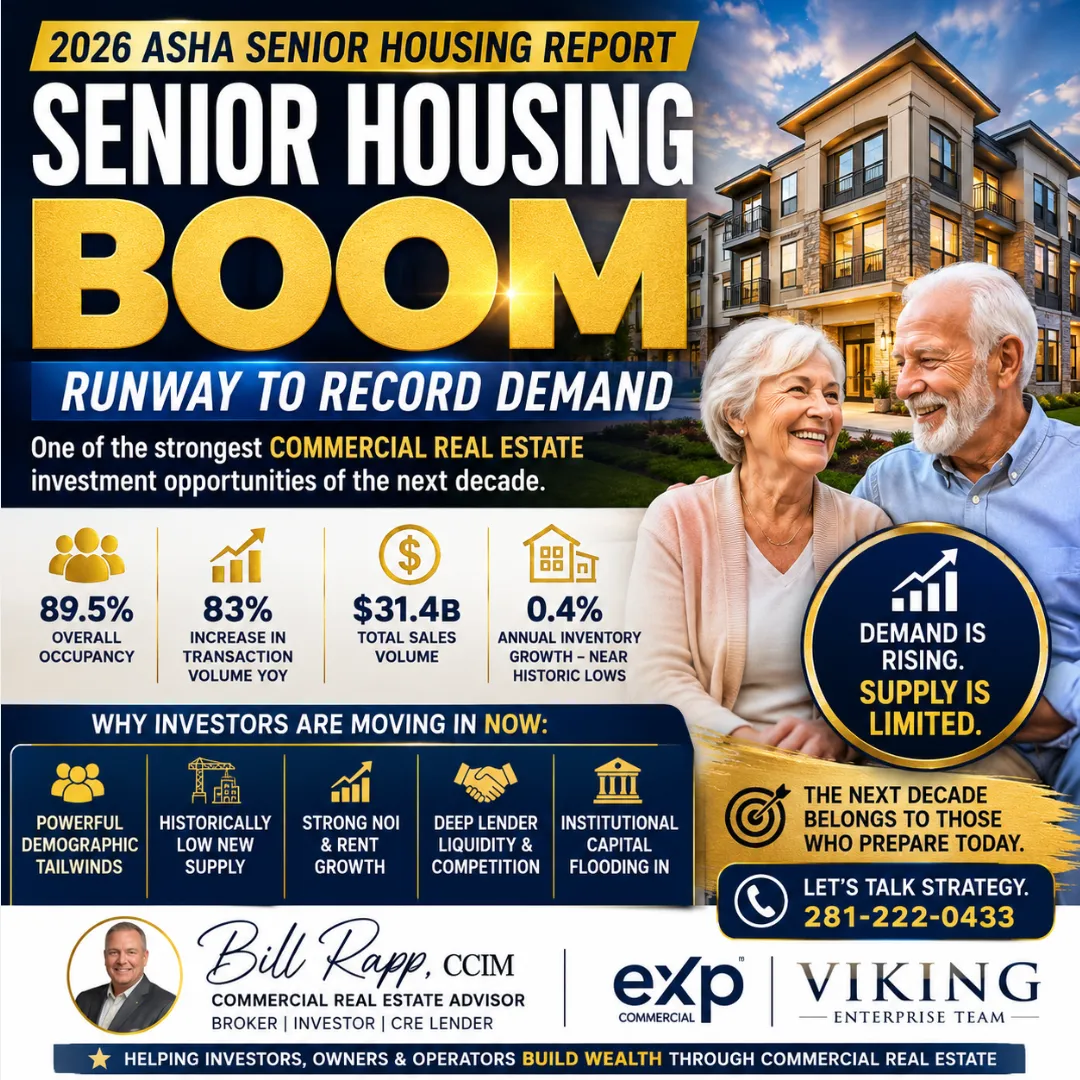
✅ Overall senior housing occupancy: 89.5%
✅ Independent living occupancy: 91.1%
✅ Assisted living occupancy: 87.9%
✅ Active adult occupancy: 91.2%
✅ 19 consecutive quarters of occupancy growth
Industry analysts now expect occupancy to exceed the previous historical peak of 91.3%.
That matters because rising occupancy directly impacts rental revenue, NOI growth, property values, and lender confidence.
🏗️ New Supply Is Extremely Limited
Demand is surging.
New development is not.
That imbalance is creating one of the most favorable supply-demand dynamics in commercial real estate today.
Current challenges limiting new construction include:
·Elevated construction costs
·High interest rates
·Expensive labor
·Longer development timelines
·Yield uncertainty
The result?
📉 Annual inventory growth has fallen to just 0.4%
📉 Construction pipelines are at their lowest level since 2012
📉 Some markets are now seeing negative inventory growth
This creates a major advantage for existing owners of stabilized senior housing assets.
In many cases, investors can acquire properties below replacement cost while benefiting from future occupancy and rent growth.
💰 Institutional Investors Are Aggressively Buying
Institutional capital has fully entered the sector.
Senior housing transaction volume surged approximately 83% year-over-year, with total investment sales volume reaching roughly $31.4 billion.
Major buyers now include:
·REITs
·Private equity firms
·Institutional investors
·Healthcare-focused funds
·Family offices
Notable deals include:
🏢 Sonida Senior Living acquiring assets from CNL Healthcare Properties for $1.8 billion
🏢 National Health Investors acquiring nine communities for $105.5 million
High-quality assets are reportedly receiving 10–15 competitive offers in many markets.
That type of bidding pressure is compressing cap rates quickly.
📉 Cap Rates Continue Compressing
As investor demand rises, pricing is becoming more aggressive across the sector.
Typical cap rate ranges include:
·Class A senior housing: 5%–6%
·15–20-year-old assets: 6.5%–7%
·30-year-old assets: 7%–7.5%
Why are investors accepting lower yields?
Because many believe NOI growth is only beginning.
This is one of the most important concepts in commercial real estate:
Small increases in NOI can create massive increases in property value.
At a 5% cap rate:
That means:
A $200,000 NOI increase could create roughly $4 million in additional asset value at a 5% cap rate.
This is why operational efficiency matters so much in senior housing.
🏦 Debt Markets Are Opening Back Up
Lenders are becoming increasingly aggressive in the sector again due to improving fundamentals.
Active capital providers now include:
·Regional banks
·Institutional lenders
·Life insurance companies
·Fannie Mae
·Freddie Mac
Freddie Mac alone reportedly closed approximately $3 billion in senior housing loans in 2025 and expects to increase volume to roughly $4 billion in 2026.
Borrowers are also seeing more favorable terms:
✅ Lower loan spreads
✅ Longer interest-only periods
✅ Improved covenant flexibility
✅ Increased lender competition
For investors, that means stronger leverage options and improved acquisition economics.
📈 NOI Growth Opportunities Remain Strong
Operators are benefiting from multiple positive trends simultaneously:
·Higher occupancy
·Rent growth
·Better pricing strategies
·Improved operational efficiency
National Health Investors recently reported approximately 7.6% same-store NOI growth.
Some recently acquired portfolios are projected to generate high single-digit or even low double-digit NOI growth moving forward.
That is attracting major institutional attention.
⚠️ Risks Still Exist
Despite strong fundamentals, senior housing is not risk-free.
Key operational challenges remain:
👷 Labor Shortages
Staffing shortages and wage inflation continue pressuring margins.
⏳ Shorter Resident Stays
Residents are entering facilities later in life with higher acuity needs.
💻 Technology Requirements
Future facilities will likely require investments into:
·Smart building systems
·AI-driven leasing/sales platforms
·Healthcare integration technology
·Resident connectivity infrastructure
The operators who adapt best operationally will likely outperform over the next decade.
🧠 Investment Takeaway
Senior housing is transitioning from a niche investment category into a mainstream institutional asset class.
The long-term thesis is becoming increasingly difficult to ignore:
✅ Aging demographics
✅ Strong occupancy growth
✅ Historically low supply
✅ Rising rents
✅ Expanding NOI margins
✅ Deep lender liquidity
✅ Growing institutional demand
For commercial real estate investors, this may become one of the defining real estate themes of the next decade.
The biggest winners will likely be investors who can identify:
·Strong operators
·Undermanaged assets
·Below replacement-cost acquisitions
·Markets with growing senior populations
·Areas with limited future development pipelines
Bottom line:
Senior housing may be entering one of the strongest long-term growth cycles in commercial real estate today.
https://www.houstonrealestatebrokerage.com/
https://www.houstonrealestatebrokerage.com/houston-cre-navigator
https://www.commercialexchange.com/agent/653bf5593e3a3e1dcec275a6
http://expressoffers.com/[email protected]
https://app.bullpenre.com/profile/1742476177701x437444415125976000
https://author.billrapponline.com/
https://www.amazon.com/dp/B0F32Z5BH2
https://veed.cello.so/FOmzTty6oi9
https://buymeacoffee.com/vikingente3
https://creplaybookseries.billrapponline.com
https://creplaybook.billrapponline.com/
© 2023-2024 Bill Rapp, Broker Associate, eXp Commercial Viking Enterprise Team


