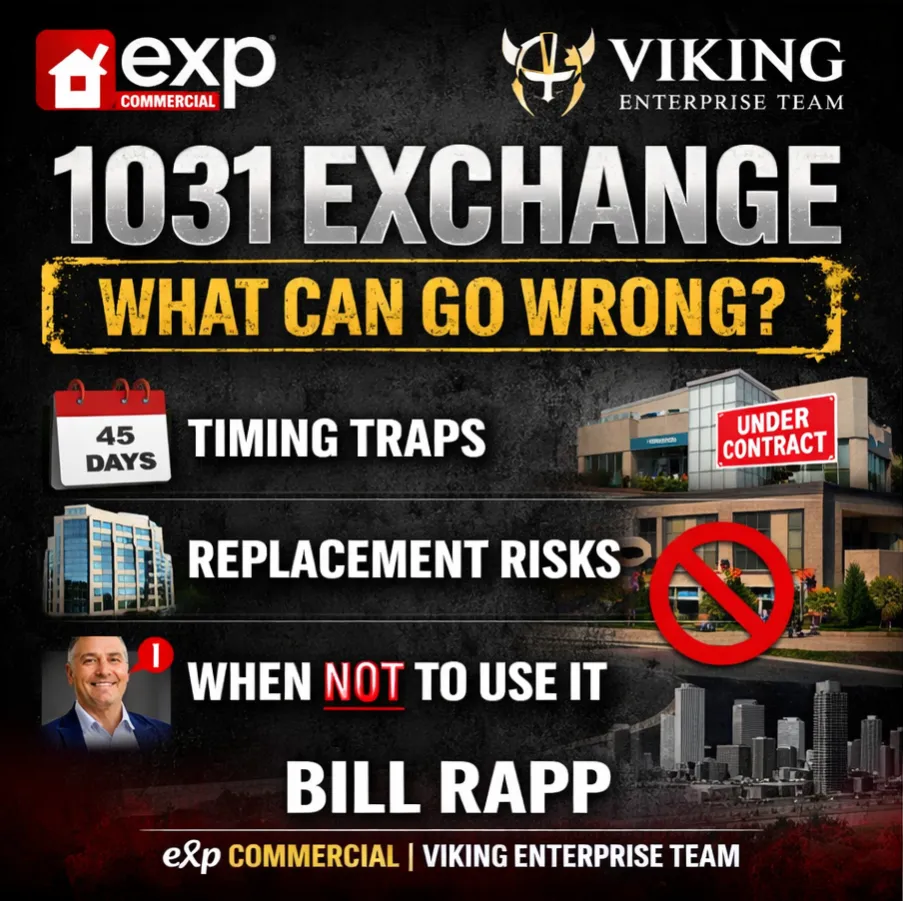
💰 1031 Exchange Explained: Timing Traps, Replacement Risk & Costly Mistakes to Avoid ⚠️
💰 1031 Exchange Explained: Timing Traps, Replacement Risk & Costly Mistakes to Avoid ⚠️
🔁 1031 Exchange Mistakes That Kill Wealth: What Every CRE Owner Must Know 🏢
1031 Exchange Explained (What Can Go Wrong)
If you own investment real estate in Houston, Katy, Fulshear, or anywhere in Texas, a 1031 exchange can be one of the most powerful wealth-preservation tools available.
But here’s the truth most owners don’t hear:
A 1031 exchange can increase your portfolio — or permanently damage it — depending on execution.
Let’s go beyond the basics and talk about what actually goes wrong in 1031 exchanges.
What Is a 1031 Exchange?
A 1031 exchange (named after Section 1031 of the Internal Revenue Code) allows investors to defer capital gains taxes by reinvesting proceeds from the sale of investment property into another like-kind investment property.
Instead of writing a six-figure check to the IRS, you redeploy that equity into a new asset.
Used correctly, it’s portfolio leverage.
Used poorly, it’s forced reinvestment under pressure.
The 3 Biggest 1031 Exchange Risks
1️⃣ Timing Traps (The 45-Day & 180-Day Clock)
4
The moment you close on your relinquished property, two clocks start:
·45 days to identify replacement property
·180 days to close on it
There are no extensions (except rare federal disaster declarations).
What Goes Wrong:
• Sellers close without a replacement strategy
• Buyers overpay due to deadline pressure
• Poor-quality assets get identified “just to meet the rule”
• Financing delays blow up the 180-day window
I’ve seen investors sell strong-performing assets in Katy or West Houston — only to rush into weaker properties because the clock forced their hand.
Discipline must start before the sale.
2️⃣ Replacement Property Risk
4
Many investors focus only on tax deferral — not on asset quality.
This is dangerous.
Common Replacement Errors:
• Overpaying to “make the math work”
• Ignoring tenant rollover risk
• Underestimating deferred maintenance
• Weak lease structures (modified NNN vs true NNN confusion)
• Buying outside your operational expertise
Remember:
The IRS doesn’t care if you bought a bad deal.
Tax deferral does not equal investment performance.
A 1031 should improve:
·Cash flow
·Asset quality
·Location strength
·Tenant durability
·Portfolio structure
If it doesn’t improve at least one of those, you’re trading stability for tax deferral.
3️⃣ When NOT to Use a 1031 Exchange
This is where high-level strategy matters.
A 1031 exchange is not mandatory.
Sometimes paying taxes is the smarter move.
Situations Where a 1031 May Not Make Sense:
✔ You want liquidity
✔ You plan to reduce real estate exposure
✔ You’re transitioning to passive investments
✔ Estate planning via step-up basis is a better strategy
✔ Market pricing is irrational and replacements are weak
In today’s Houston-area submarkets, we’re seeing compressed cap rates in certain retail and medical assets. If you sell high but can’t buy smart, the exchange can trap you into mediocrity.
Tax deferral should serve strategy — not dictate it.
Other Critical Failure Points
❌ Choosing the Wrong Qualified Intermediary
Funds must go through a legitimate QI. Mishandling funds can invalidate the exchange.
❌ Improper Identification Rules
You must follow either:
·3-property rule
·200% rule
·95% rule
Mistakes here void the deferral.
❌ Debt Replacement Errors
You must replace:
·Equal or greater value
·Equal or greater debt (or add cash)
Otherwise, taxable “boot” is triggered.
Strategic 1031 Planning Framework
Before listing your property, ask:
1.What is my long-term portfolio goal?
2.Do I want more management or less?
3.What is my capital stack tolerance?
4.Am I upgrading asset quality?
5.What happens if I don’t find a deal?
This is why 1031 exchanges must be coordinated between:
·Broker
·CPA
·Qualified Intermediary
·Lender
A well-executed exchange is structured — not reactive.
Houston & West Texas Market Considerations
In growth corridors like Katy, Fulshear, Brookshire, and Richmond:
• Retail fundamentals remain strong
• Industrial demand is stable
• Medical office continues expanding
• Older office product carries leasing risk
That means your replacement selection matters more than ever.
Final Takeaway
A 1031 exchange is not just a tax strategy.
It’s a portfolio restructuring event.
Done right, it compounds wealth.
Done wrong, it locks you into weaker real estate for years.
If you’re nearing disposition and considering a 1031 exchange, structure it before you sell — not after.
Call to Action
Thinking about selling an investment property in Houston or surrounding markets?
Let’s map your exit and replacement strategy before you trigger the clock.
🔗 https://houstonrealestatebrokerage.com
📞 Bill Rapp – eXp Commercial | Viking Enterprise Team
https://www.houstonrealestatebrokerage.com/
https://www.houstonrealestatebrokerage.com/houston-cre-navigator
https://www.commercialexchange.com/agent/653bf5593e3a3e1dcec275a6
http://expressoffers.com/[email protected]
https://app.bullpenre.com/profile/1742476177701x437444415125976000
https://author.billrapponline.com/
https://www.amazon.com/dp/B0F32Z5BH2
https://veed.cello.so/FOmzTty6oi9
https://buymeacoffee.com/vikingente3
https://creplaybookseries.billrapponline.com
https://creplaybook.billrapponline.com/
© 2023-2024 Bill Rapp, Broker Associate, eXp Commercial Viking Enterprise Team


